
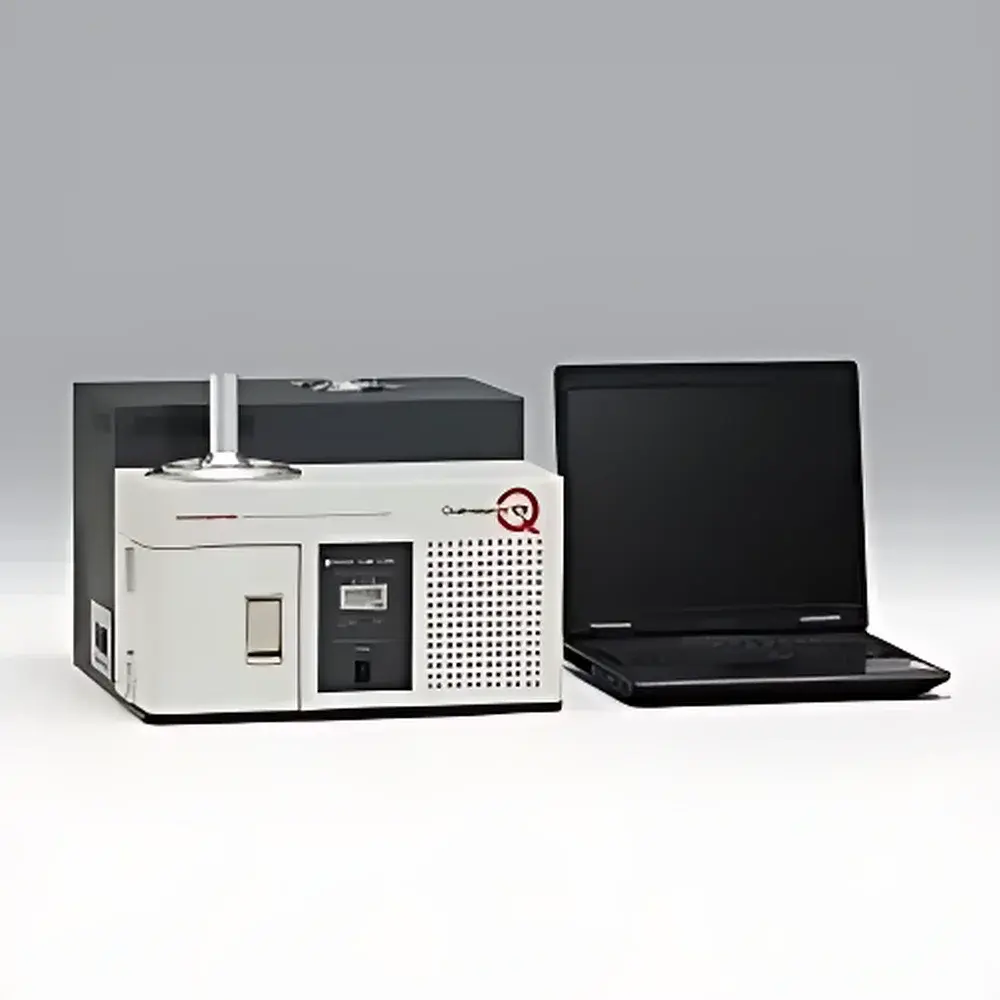
Hamamatsu C11347-11 Quantaurus-QY Absolute Photoluminescence Quantum Yield Measurement System
| Brand | Hamamatsu |
|---|---|
| Origin | Japan |
| Manufacturer Type | Original Equipment Manufacturer (OEM) |
| Product Origin | Imported |
| Model | Quantaurus-QY |
| Measurement Mode | DC |
| Excitation Wavelength Range | 250–800 nm |
| Emission Wavelength Range | 300–950 nm |
| Excitation Bandwidth (FWHM) | <10 nm |
| Spectrometer Type | Czerny-Turner |
| Detector | Cooled Back-Illuminated CCD |
| Detector Channels | 1024 |
| Detector Cooling Temperature | −15 °C |
| A/D Resolution | 16 bit |
| Spectral Resolution | <2 nm |
| Integrating Sphere Material | Spectralon® |
| Sphere Diameter | 3.3 inch |
| Fiber Optic Bundle Length | 1.5 m |
| Input Aperture Diameter | 1 mm |
Overview
The Hamamatsu C11347-11 Quantaurus-QY is a fully integrated, turnkey absolute photoluminescence quantum yield (PLQY) measurement system engineered for precision characterization of luminescent materials across research and industrial R&D environments. It operates on the fundamental principle of comparative photon counting within a calibrated integrating sphere geometry, enabling direct determination of the ratio of emitted photons to absorbed photons—i.e., the absolute PLQY (ΦPL). Unlike relative methods requiring reference standards, this system delivers traceable, wavelength-resolved quantum efficiency values without reliance on empirical calibration factors. Its optical architecture combines a 150 W xenon arc lamp with a motorized monochromator for tunable excitation, a high-reflectance Spectralon® integrating sphere (3.3″ diameter), and a thermoelectrically cooled back-illuminated CCD spectrometer (200–950 nm range, <2 nm resolution). The system supports both steady-state (DC) excitation and synchronous spectral acquisition, making it suitable for quantitative evaluation of organic emitters, inorganic phosphors, quantum dots, metal–organic complexes, and biofluorophores under controlled thermal and environmental conditions.
Key Features
- Integrated hardware platform combining excitation source, monochromator, integrating sphere, and multi-channel spectrometer in a single compact enclosure
- Automated excitation wavelength selection via motorized monochromator (250–800 nm), enabling full excitation-emission matrix (EEM) mapping
- Cooled back-illuminated CCD detector (−15 °C) with 1024-channel linear array and 16-bit A/D conversion for high dynamic range and low-noise spectral acquisition
- High-fidelity spectral resolution (<2 nm) and narrow excitation bandwidth (<10 nm FWHM) for accurate separation of excitation scatter and sample emission
- Standardized Spectralon® integrating sphere (3.3″) ensuring uniform collection efficiency across the 300–950 nm emission band
- Support for cryogenic measurements down to 77 K using liquid nitrogen-compatible sample holders (e.g., A11238-01)
- Modular sample handling: interchangeable fixtures for thin films (A10095-01/-03), powders (A10095-01/-03), and solutions at ambient or cryogenic temperatures (A10104-01, A10095-04)
- Compliance-ready software architecture supporting audit trails, user access control, and electronic signatures per FDA 21 CFR Part 11 requirements
Sample Compatibility & Compliance
The Quantaurus-QY accommodates diverse physical forms—including solid-state thin films, dispersed powders, and homogeneous solutions—without requiring reconfiguration of optical alignment. Film samples are mounted on substrate-free holders to eliminate baseline interference; powder measurements employ dedicated Spectralon-lined cups to minimize multiple scattering artifacts; solution cells support both room-temperature and cryogenic operation (down to 77 K), critical for resolving thermally activated non-radiative decay pathways. All sample interfaces are designed to maintain geometric consistency with NIST-traceable sphere calibration protocols. The system meets ISO/IEC 17025 requirements for testing laboratories when operated under documented SOPs, and its data integrity framework aligns with GLP and GMP principles for regulated material qualification (e.g., OLED host/emitter validation, LED phosphor batch release, or fluorescent probe certification per USP <1046>).
Software & Data Management
Hamamatsu’s proprietary Quantaurus Analysis Software provides a validated, dialog-driven interface for instrument control, spectral acquisition, and quantitative analysis. Core modules include: (1) absolute PLQY calculation using dual-spectrum methodology (excitation-scattered + emission vs. total emission); (2) excitation wavelength scanning to generate ΦPL(λex) profiles; (3) photoluminescence excitation (PLE) spectroscopy; (4) full emission spectrum deconvolution with automatic excitation peak subtraction; (5) CIE 1931 chromaticity coordinate mapping, correlated color temperature (CCT), and color rendering index (CRI) computation. Raw spectral data are stored in HDF5 format with embedded metadata (wavelength calibration, integration time, temperature, sample ID), ensuring FAIR (Findable, Accessible, Interoperable, Reusable) data management. Export options include CSV, ASCII, and PDF reports compliant with internal quality documentation workflows.
Applications
This system serves as a primary metrology tool in advanced optoelectronic materials development. It is routinely deployed for: quantifying efficiency gains in next-generation blue-emitting Ir(III) phosphors for OLED displays (per J. Am. Chem. Soc. 2009, 131, 9813); benchmarking quantum dot photostability under variable excitation fluence; evaluating triplet harvesting in TADF emitters; assessing dye-sensitized solar cell (DSSC) chromophore absorption/emission overlap ratios; and validating fluorophore quantum yields in biological imaging probes (e.g., ratiometric Zn2+ sensors, PLoS ONE 2012, 7, e37551). Its capacity to correlate ΦPL with temperature (RT to +180 °C) and excitation energy enables mechanistic studies of non-radiative relaxation channels—essential for structure–property optimization in emissive metal–organic frameworks (MOFs) and lanthanide-doped nanomaterials.
FAQ
What distinguishes absolute from relative quantum yield measurement?
Absolute PLQY is determined directly from photon flux ratios within an integrating sphere, eliminating dependence on reference standards. Relative methods require certified reference dyes and introduce cumulative uncertainty from spectral mismatch errors.
Can the system measure time-resolved quantum yield?
No—the Quantaurus-QY is optimized for steady-state (DC) photoluminescence. For lifetime-resolved quantum yield, Hamamatsu recommends coupling with the Quantaurus-Tau fluorescence lifetime spectrometer.
Is nitrogen purging supported for oxygen-sensitive samples?
Yes—an optional nitrogen purge port is available on the integrating sphere housing to maintain inert atmospheres during measurement of triplet-state emitters or photooxidation-prone organometallics.
How is spectral calibration maintained over time?
The system includes automated wavelength calibration routines using built-in Hg/Ar spectral lines, with optional NIST-traceable external calibration kits for periodic verification.
Does the software support custom script-based automation?
Yes—Python and LabVIEW APIs are provided for integration into automated material screening platforms and high-throughput synthesis workflows.





