
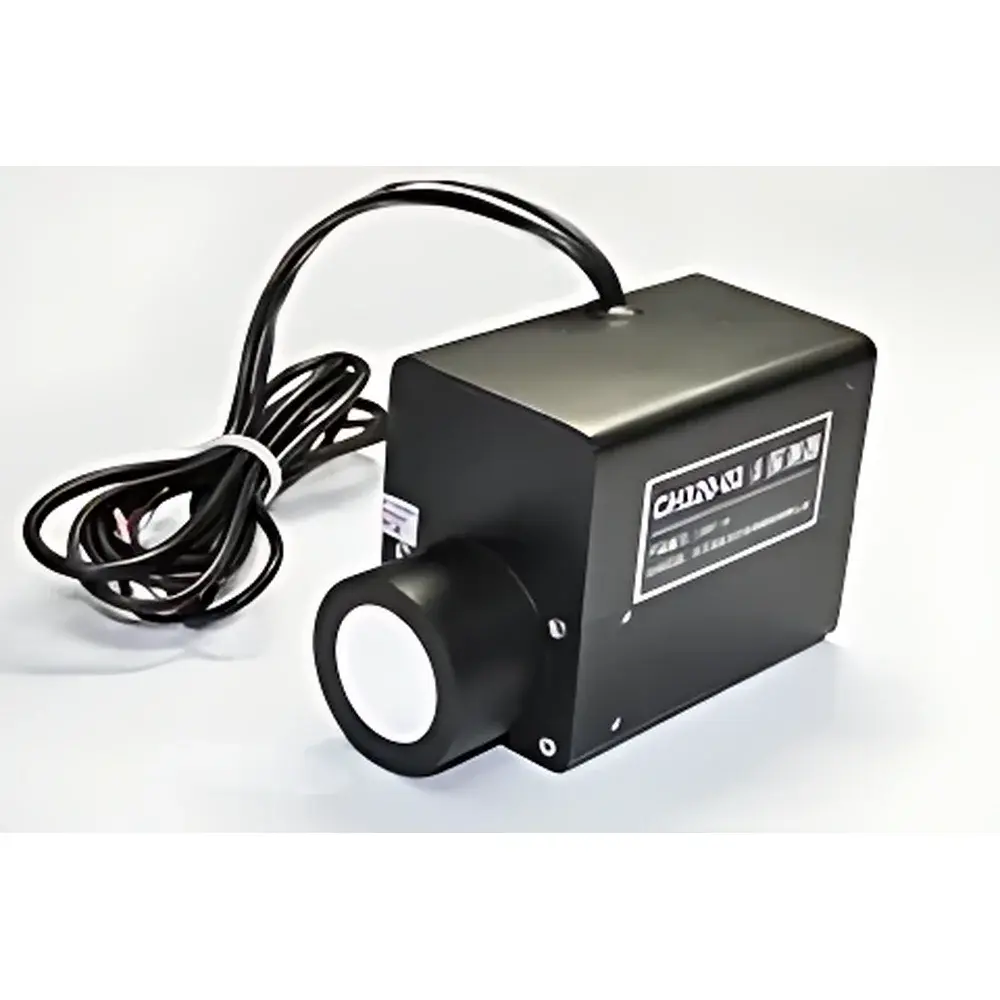
Hamamatsu CH320-02 Scintillation Detector for Low-Energy Beta Radiation
| Brand | Hamamatsu Photonics (BHP) |
|---|---|
| Origin | Beijing, China |
| Manufacturer Type | Authorized Distributor |
| Regional Classification | Domestic (PRC) |
| Model | CH320-02 |
| Price Range | USD 280 – 700 |
Overview
The Hamamatsu CH320-02 Scintillation Detector is a solid-state, low-energy beta radiation counting instrument engineered for precise detection and quantification of β⁻ particles in the energy range of approximately 10 keV to 500 keV. It employs a thin, optically coupled plastic scintillator coupled to a high-gain photomultiplier tube (PMT), enabling efficient conversion of incident beta radiation into measurable light pulses. Each detected event generates a standardized TTL-compatible digital pulse with fixed amplitude and fast rise time (<10 ns), eliminating analog signal conditioning requirements and ensuring compatibility with standard counter/timer modules, data acquisition systems (DAQ), and programmable logic controllers (PLCs). Designed for integration into continuous environmental monitoring platforms—particularly ambient particulate matter (PM₂.₅) mass concentration analyzers—the CH320-02 operates on the beta attenuation principle: air samples are drawn across a filter tape, and the rate of beta particle transmission through the deposited aerosol layer is measured before and after collection. The differential attenuation correlates directly with aerosol mass loading, supporting gravimetric-equivalent PM₂.₅ reporting per ISO 14644-1, EN 12341, and EPA Method PS-11.
Key Features
- Low-noise pulse output: TTL-level digital pulses (3.3 V / 5 V compatible) with consistent amplitude and sub-15 ns pulse width for reliable edge-triggered counting
- Wide dynamic range: Capable of handling count rates from 0.1 cps to >10⁵ cps without significant dead-time distortion or pulse pile-up
- High beta detection efficiency: ≥45% for ¹⁴C (Emax = 156 keV) and ≥78% for ⁹⁰Sr/⁹⁰Y (Emax = 546 keV) under standard geometry and source-to-detector distance of 5 mm
- Robust mechanical architecture: Hermetically sealed PMT housing with integrated voltage divider, shock-resistant scintillator mount, and EMI-shielded coaxial output connector (SMA)
- Stable temperature response: Gain drift < ±0.02%/°C over 15–35°C operating range; no active temperature compensation required for typical indoor or sheltered outdoor deployment
- Long-term reliability: Rated for >20,000 hours of continuous operation; scintillator material exhibits negligible yellowing or light-output degradation under ambient UV exposure
Sample Compatibility & Compliance
The CH320-02 is optimized for use with filter-based sampling media including quartz fiber, Teflon-coated glass fiber, and polyvinyl chloride (PVC) membranes—common substrates in regulatory-grade PM₂.₅ monitors. Its thin entrance window (1.5 µm aluminized Mylar) ensures minimal self-absorption of low-energy electrons while maintaining vacuum integrity in pressurized sample chambers. The detector complies with electromagnetic compatibility requirements per IEC 61326-1 (industrial environment), meets RoHS 2011/65/EU material restrictions, and supports traceable calibration protocols aligned with ISO/IEC 17025:2017. When deployed in certified ambient air quality monitoring stations, it contributes to measurement uncertainty budgets defined in ISO 20988:2020 (air quality—uncertainty estimation for automated monitoring systems).
Software & Data Management
The CH320-02 interfaces seamlessly with third-party DAQ software (e.g., LabVIEW, MATLAB Data Acquisition Toolbox, Python-based PyDAQmx) via its TTL pulse train output. Hamamatsu provides optional SDK libraries (C/C++, .NET) for custom firmware integration, enabling synchronized timestamping, pulse rate logging, and real-time dead-time correction algorithms. All acquired count data can be exported in CSV or HDF5 format, supporting audit-ready storage compliant with GLP and ISO 17025 documentation requirements. For regulated applications, the detector’s deterministic pulse output facilitates full 21 CFR Part 11 compliance when paired with validated software platforms that enforce electronic signatures, audit trails, and user access controls.
Applications
- Ambient PM₂.₅ continuous emission monitoring systems (CEMS) deployed by national environmental protection agencies
- Indoor air quality (IAQ) assessment in cleanrooms, hospitals, and semiconductor fabrication facilities
- Radioisotope-labeled tracer studies in atmospheric dispersion modeling and aerosol deposition research
- Calibration reference instruments for beta-emitting nuclide standards (e.g., ¹⁴C, ³H, ⁹⁰Sr) in metrology laboratories
- Portable radiation survey tools for nuclear decommissioning and waste characterization where low-energy beta sensitivity is critical
FAQ
Is the CH320-02 suitable for detecting alpha particles?
No. Its thin entrance window and plastic scintillator composition are optimized for beta electrons; alpha particles are fully absorbed by the window and do not reach the active volume.
Does this detector require high-voltage power supply?
Yes. It operates at a nominal PMT supply voltage of −1000 V DC, supplied via an external, stabilized HV module (e.g., Hamamatsu C11204 series) with current limiting and overvoltage protection.
Can it be used in high-humidity environments?
It is rated for operation up to 85% RH non-condensing; extended exposure above 90% RH requires enclosure with desiccant or purge gas (dry N₂) to prevent PMT gain instability.
What is the recommended calibration frequency?
Annual calibration against a traceable ¹⁴C point source is recommended for regulatory applications; biannual verification is sufficient for research-grade deployments.
Is OEM integration support available?
Yes. Hamamatsu offers mechanical drawings, electrical interface schematics, thermal derating curves, and EMC test reports under NDA for system integrators developing certified air quality analyzers.
Related Products







