
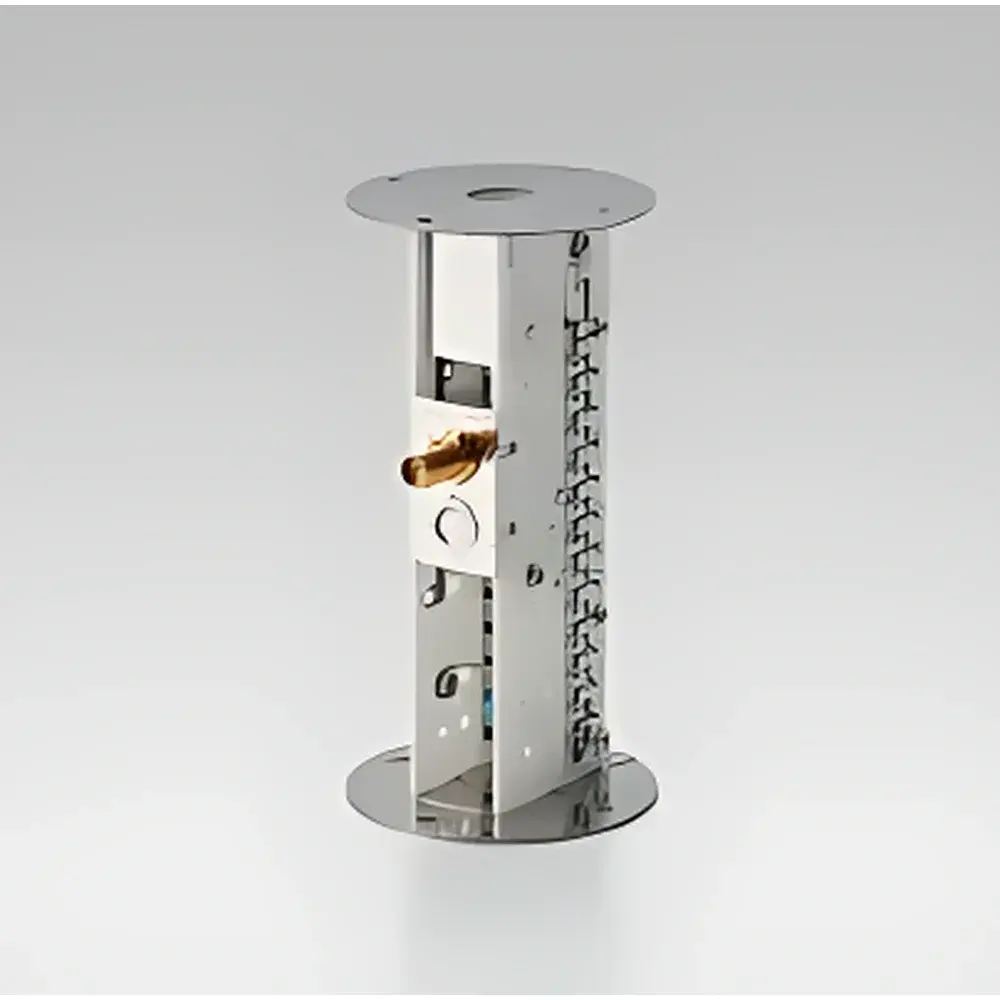
Hamamatsu Electron Multiplier R13733
| Brand | Hamamatsu |
|---|---|
| Origin | Japan |
| Manufacturer Type | Original Equipment Manufacturer (OEM) |
| Product Origin | Imported |
| Model | R13733 |
| Pricing | Available Upon Request |
| Dynode Stages | 18 |
| Dynode Structure | Linear Focused |
| Dynode Material | Al₂O₃ |
| Input Aperture Diameter | 11 mm |
| Operating Voltage | 2500 V |
| Typical Gain | 3.0 × 10⁷ |
| Typical Rise Time | 7.0 ns |
| Anode-to-Other-Dynodes Capacitance | 3.0 pF |
| Anode-to-First-Dynode Voltage | 0 V |
| Anode-to-Last-Dynode Voltage | 0 V |
| Maximum Average Anode Current | 10 µA |
| Required Operating Vacuum | ≤ 1 × 10⁻² Pa |
| Dimensions (L × W × H) | See mechanical drawing in datasheet |
Overview
The Hamamatsu Electron Multiplier R13733 is a high-performance, off-axis dual-mode discrete-dynode electron multiplier engineered for demanding mass spectrometry applications—particularly inductively coupled plasma mass spectrometry (ICP-MS). It operates on the principle of secondary electron emission, where incident ions strike the first dynode surface (fabricated from aluminum oxide, Al₂O₃), initiating a cascade of electrons amplified across 18 linear-focused dynode stages. This architecture delivers stable, low-noise signal amplification under ultra-high vacuum conditions (≤ 1 × 10⁻² Pa), enabling detection of single-ion events with high temporal fidelity and long-term gain stability. Its off-axis geometry minimizes direct line-of-sight between ion source and anode, reducing background noise and improving signal-to-noise ratio—critical for trace-element analysis at sub-femtogram-per-liter detection limits.
Key Features
- 18-stage linear-focused dynode chain ensures uniform electron trajectory and minimized transit-time spread.
- Al₂O₃ dynode material provides high secondary emission yield, low outgassing, and excellent resistance to contamination from matrix-rich ICP-MS samples.
- Off-axis configuration suppresses stray ion and photon feedback, enhancing dynamic range and reducing false counts during high-sensitivity acquisition.
- Optimized anode design with 3.0 pF inter-dynode capacitance supports fast pulse response (7.0 ns typical rise time), suitable for time-resolved and multi-collector ICP-MS operation.
- Rated for continuous average anode current up to 10 µA—compatible with both analog and pulse-counting detection modes without gain saturation or thermal drift.
- Robust ceramic-metal hermetic seal construction ensures long service life and consistent performance across repeated bake-out cycles in UHV environments.
Sample Compatibility & Compliance
The R13733 is designed for integration into commercial and custom ICP-MS platforms requiring high-gain, low-background ion detection. It accommodates singly and multiply charged atomic and polyatomic ions across the full mass range (m/z 5–280), including challenging analytes such as 40Ar+, 208Pb+, and 238U+. Its mechanical interface (11 mm input aperture) conforms to standard flange-mount configurations used by major OEMs (e.g., Thermo Fisher, Agilent, Nu Instruments). The device complies with ISO 9001 manufacturing protocols and meets residual gas compatibility requirements for Class 100 cleanroom assembly. While not certified to specific regulatory standards itself, its design supports systems compliant with ISO/IEC 17025, ASTM D5673 (for environmental water analysis), and USP <621> chromatographic system suitability criteria when deployed in validated laboratory workflows.
Software & Data Management
As a hardware detector component, the R13733 does not include embedded firmware or onboard software. It interfaces directly with external high-voltage power supplies (e.g., Hamamatsu C11204 series) and data acquisition systems via standard BNC or SHV connectors. When integrated into ICP-MS platforms, it operates transparently within vendor-supplied acquisition software (e.g., Thermo Fisher Qtegra, Agilent MassHunter), supporting both analog current measurement and digital pulse counting. Full audit trail capability—including HV setpoint logging, gain calibration history, and anode current trending—is maintained at the instrument control layer in accordance with FDA 21 CFR Part 11 requirements when deployed in GLP/GMP-regulated environments. Calibration certificates traceable to NIST standards are available upon request.
Applications
- Ultra-trace elemental quantification in environmental water, soil digests, and biological fluids (e.g., serum, urine).
- Isotope ratio measurements for geochronology (U–Pb, Lu–Hf) and nuclear forensics.
- Single-cell ICP-MS for metallomics and nanoparticle characterization.
- High-mass-resolution analysis of refractory oxides and hydrides in semiconductor-grade reagents.
- Multi-collector ICP-MS (MC-ICP-MS) systems requiring synchronized, low-jitter detection across multiple Faraday and electron multiplier channels.
FAQ
What vacuum level is required for stable operation of the R13733?
The R13733 requires a base pressure of ≤ 1 × 10⁻² Pa (≤ 7.5 × 10⁻⁵ Torr) for optimal gain stability and minimal dark current. Operation above this threshold increases noise and accelerates dynode fatigue.
Can the R13733 be used in both analog and pulse-counting modes?
Yes—the device supports both detection paradigms without hardware modification. Pulse counting is recommended for low-abundance isotopes (< 10⁴ cps); analog mode is preferred for high-flux signals (> 10⁶ cps) to avoid dead-time losses.
Is the R13733 compatible with high-energy ion beams?
It is optimized for keV-range ions typical of ICP-MS extraction optics. Direct exposure to >5 keV ions or energetic neutral particles may cause irreversible dynode surface damage and is not recommended.
How often should gain calibration be performed?
Initial calibration is mandatory after installation or HV reset. Routine verification is advised every 24–48 hours during continuous operation; frequency increases in high-matrix or high-salt applications due to potential Al₂O₃ surface passivation.
Does Hamamatsu provide replacement dynode assemblies or refurbishment services?
No—R13733 is supplied as a sealed, non-serviceable OEM component. Replacement is required upon performance degradation exceeding ±15% gain deviation or sustained anode current >12 µA.
Related Products




