
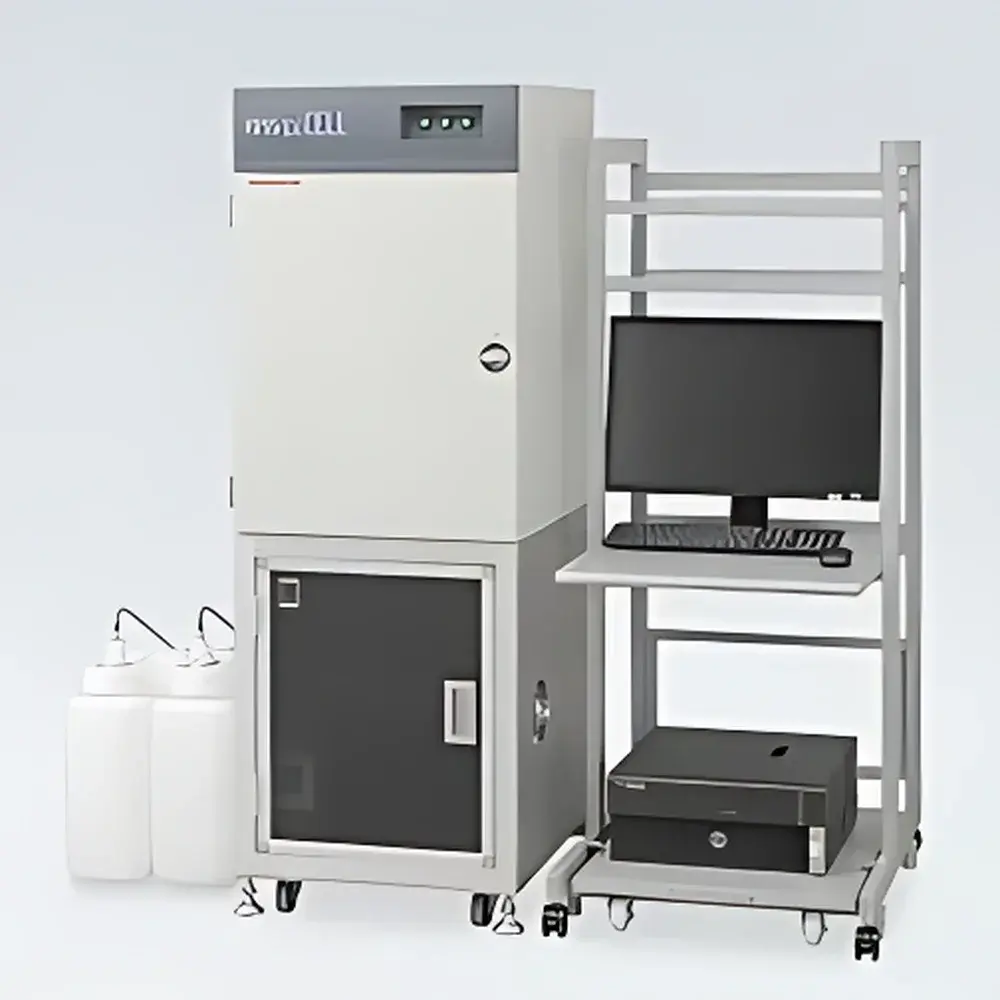
Hamamatsu FDSS®/μCELL Functional Drug Screening System C13299
| Brand | Hamamatsu |
|---|---|
| Origin | Japan |
| Manufacturer Type | Original Equipment Manufacturer (OEM) |
| Product Category | Imported Instrument |
| Model | C13299 |
| Pricing | Upon Request |
Overview
The Hamamatsu FDSS®/μCELL Functional Drug Screening System (Model C13299) is a dedicated, benchtop-integrated platform engineered for kinetic, high-content functional assays in early-stage drug discovery. It employs time-resolved fluorescence and bioluminescence detection based on Hamamatsu’s proprietary qCMOS® sensor technology — a back-illuminated, scientific-grade CMOS imaging sensor optimized for ultra-low-noise, high-dynamic-range photon counting across microplate formats. Unlike conventional plate readers with sequential well-scanning architectures, the FDSS/μCELL performs true parallel measurement: simultaneous compound addition (via integrated 96- or 384-channel dispensers) and real-time optical readout across all wells — eliminating inter-well temporal lag and enabling millisecond-scale kinetic resolution of cellular responses. Its core measurement principle relies on ligand-induced changes in intracellular second messengers (e.g., Ca²⁺, cAMP), membrane potential, ion flux, or protein-protein interactions, captured via fluorescent dyes, genetically encoded biosensors (e.g., Cameleon, GloSensor), or luminescent reporters (e.g., NanoLuc-based BRET systems). Designed for reproducible assay execution under physiologically relevant conditions, the system supports optional temperature control (+35 °C to +37 °C), CO₂ incubation, and electrical field stimulation (EFS) for electrophysiological profiling of iPSC-derived cardiomyocytes, neurons, and skeletal myocytes.
Key Features
- True parallel kinetics: Simultaneous reagent dispensing and full-plate optical acquisition — no well-to-well delay
- qCMOS® sensor architecture: High quantum efficiency (>80% at 500–600 nm), low read noise (<1.5 e⁻ RMS), and wide dynamic range (up to 6 decades)
- Dual-format dispensing: 96-channel head (10–200 µL) and 384-channel head (1–30 µL), both compatible with standard SBS-compliant plates
- Multi-wavelength excitation: LED-based sources at 470 nm / 530 nm; emission filtering via motorized filter changer for FRET/BRET compatibility
- High-speed acquisition: Base sampling rate of 10 Hz; upgradable to 120 Hz (8.3 ms interval) with U8524-11 high-speed option
- Integrated environmental control: Optional heater unit (±0.3 °C stability) and CO₂ incubation module for long-term live-cell assays
- Electrophysiological extension: Optional EFS head for synchronized pacing and concurrent optical readout in 96-well format
- Modular automation readiness: External TTL/RS-232 interfaces for integration into robotic workcells or LIMS-controlled screening pipelines
Sample Compatibility & Compliance
The FDSS/μCELL accommodates standard transparent-bottom black microplates (96- and 384-well, SBS format, 8–15 mm height) and supports a broad spectrum of assay chemistries validated in peer-reviewed literature and industry-standard protocols. It is routinely deployed in GLP-compliant safety pharmacology studies, including hERG liability assessment using iPSC-cardiomyocyte models and neurotoxicity screening with iPSC-neurons. The system meets mechanical and electrical safety requirements per IEC 61010-1 and EMC compliance per IEC 61326-1. While not pre-certified for FDA 21 CFR Part 11, its software architecture supports audit trail logging, user access control, and electronic signature implementation — enabling validation per internal SOPs aligned with GxP frameworks. All optical components are calibrated traceable to NIST standards, and photometric linearity is verified per ASTM E1303.
Software & Data Management
FDSS/μCELL operates via Hamamatsu’s proprietary FDSS Control Software v5.x, a Windows-based application supporting assay protocol scripting, real-time waveform visualization, and batch analysis of kinetic traces. Raw data is saved in HDF5 format — a self-describing, hierarchical binary structure ensuring long-term archival integrity and interoperability with Python (h5py), MATLAB, and third-party analysis platforms (e.g., GraphPad Prism, Assay Explorer). The software includes built-in algorithms for peak detection, area-under-curve (AUC) quantification, tau decay fitting, and ratiometric normalization (e.g., FRET ratio, BRET ratio). For regulated environments, optional IQ/OQ documentation packages are available, and the system supports CSV export with timestamped metadata for LIMS ingestion. All data acquisition events — including dispenser trigger timing, filter position, temperature logs, and user actions — are recorded in an immutable audit trail compliant with ALCOA+ principles.
Applications
- GPCR screening: Real-time Ca²⁺ flux (Fluo-4, Cal-520) and cAMP dynamics (GloSensor 22F) across full 96/384-well plates
- Ion channel profiling: Na⁺ (Corona-Green), K⁺ (FluxOR), Cl⁻ (MEQ), and membrane potential (Di-8-ANEPPS) assays in native or recombinant cell lines
- Luminescent assays: High-sensitivity luciferase-based reporter gene assays (e.g., NFAT, CREB), ATP viability, and aequorin-based Ca²⁺ detection
- FRET/BRET biosensing: Quantitative monitoring of protein conformational change, dimerization, and post-translational modification using CFP/YFP, BRET1/2, or NanoBRET® constructs
- iPSC-derived functional toxicology: Cardiac arrhythmia risk assessment (field potential duration, beat rate variability), neuronal network activity (Ca²⁺ oscillation synchrony), and hepatocyte metabolic stress endpoints
FAQ
What microplate formats does the FDSS/μCELL support?
It accepts standard SBS-compliant 96-well and 384-well plates with transparent black bottoms and heights between 8 mm and 15 mm.
Can the system perform simultaneous dispensing and reading?
Yes — compound addition and optical acquisition occur in true parallel mode across all wells, with sub-millisecond synchronization accuracy.
Is temperature control integrated or optional?
Temperature regulation is optional via the heater unit (U8524-01), maintaining ±0.3 °C stability between +35 °C and +37 °C.
Does the system support CO₂ incubation?
Yes — the optional CO₂ incubation module enables long-term kinetic assays under physiological pH conditions.
What is the maximum sampling frequency with the high-speed option?
With the U8524-11 upgrade, the system achieves 120 Hz sampling (8.3 ms interval), suitable for rapid Ca²⁺ transients and action potential kinetics.
Is external automation integration possible?
Yes — the system provides TTL trigger inputs/outputs and RS-232 serial communication for seamless integration with liquid handlers, stackers, and LIMS.
Are calibration certificates provided with the instrument?
NIST-traceable photometric and volumetric calibration reports are available upon request as part of installation qualification (IQ).



