
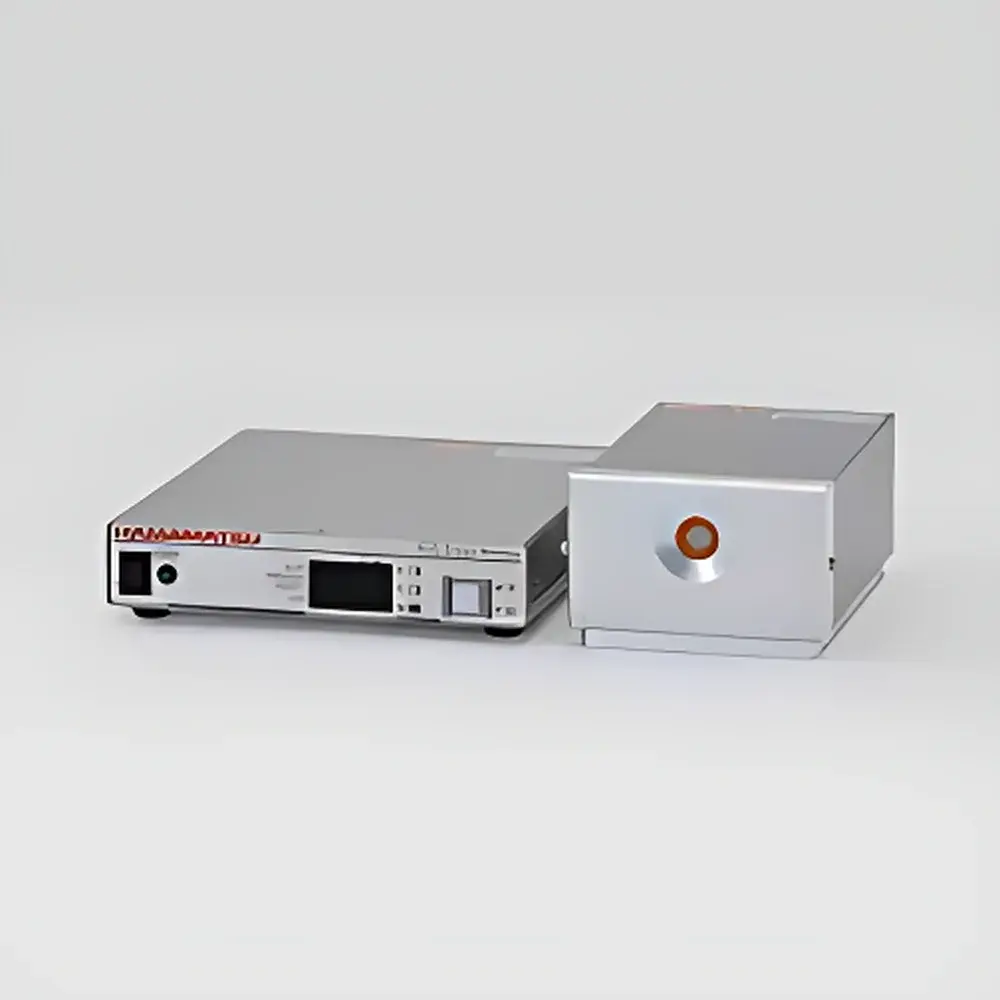
Hamamatsu L11754-01 Soft X-Ray Source
| Brand | Hamamatsu |
|---|---|
| Origin | Japan |
| Manufacturer Type | Original Equipment Manufacturer (OEM) |
| Product Category | Imported |
| Model | L11754-01 |
| Pricing | Upon Request |
Overview
The Hamamatsu L11754-01 is a compact, air-cooled soft X-ray source engineered for high-sensitivity elemental analysis of low-atomic-number (low-Z) materials in industrial inspection and quality assurance applications. Operating at a nominal acceleration voltage of 15 kV, it emits characteristic soft X-rays primarily in the 0.1–1.0 keV energy range—optimized for excitation and detection of light elements such as carbon (C), nitrogen (N), oxygen (O), fluorine (F), sodium (Na), and magnesium (Mg). Unlike conventional hard X-ray tubes, this source leverages a transmission-type tungsten-target cathode design with a thin beryllium exit window (typically ≤25 µm), enabling efficient emission of low-energy photons while maintaining vacuum integrity. Its physical architecture supports integration into space-constrained inline inspection systems, including food packaging line monitors, pharmaceutical blister-pack analyzers, and semiconductor wafer foreign-object detection platforms.
Key Features
- Soft X-ray emission spectrum centered at ~0.8–1.0 keV (15 kV operation), ideal for detecting organic contaminants, polymer residues, and light-element inclusions.
- Compact lamp head design (dimensions: 42 mm × 42 mm × 63 mm, mass: 220 g including standard accessories), facilitating modular integration into OEM inspection equipment.
- Wide beam divergence angle (±30° full width at half maximum, per *1 specification), enabling uniform illumination over extended sample areas without mechanical scanning.
- Plastic-based radiation shielding compatibility (e.g., polyethylene or borosilicate-loaded polymers), eliminating the need for lead enclosures and reducing system weight, cost, and regulatory handling complexity.
- Integrated controller interface supporting TTL-triggered pulse mode and analog voltage-controlled intensity modulation (0–5 V input), enabling synchronization with high-speed imaging sensors and conveyor-based timing systems.
- OEM-optimized electrical interface: 24 V DC input, low EMI design, and CE-compliant EMC performance for embedded instrumentation deployment.
Sample Compatibility & Compliance
The L11754-01 is compatible with non-vacuum, ambient-pressure sample environments—making it suitable for real-time inspection of packaged goods, flexible films, and bulk powders. It complies with IEC 61000-6-3 (EMC emission limits) and IEC 61000-6-2 (immunity requirements) for industrial equipment. Radiation safety adheres to ISO 15708-2:2017 (X-ray equipment for non-destructive testing) and national regulations governing low-dose X-ray sources (e.g., Japan’s Ordinance on Prevention of Ionizing Radiation Hazards; U.S. FDA 21 CFR Part 1020.40 for cabinet X-ray systems). While not a complete analytical instrument, its output characteristics support method development aligned with ASTM E2921 (Standard Guide for X-ray Fluorescence Analysis of Light Elements) and ISO 21043-2 (XRF instrumentation specifications).
Software & Data Management
As a component-level source, the L11754-01 does not include embedded firmware or proprietary software. It interfaces via analog/digital control lines to host OEM systems, which typically implement data acquisition, exposure sequencing, and dose logging in accordance with GLP/GMP traceability requirements. When integrated into validated inspection platforms, its operational parameters—including trigger timing, pulse duration, and intensity setpoints—are logged with time-stamped audit trails compliant with FDA 21 CFR Part 11 (electronic records and signatures) where applicable. Hamamatsu provides detailed technical documentation (including spectral response curves, thermal derating charts, and lifetime degradation profiles) to support IQ/OQ/PQ validation protocols.
Applications
- Food packaging integrity verification: Detection of silicone lubricant residues, cellulose microfibrils, or starch-based foreign particles in sealed pouches and trays.
- Pharmaceutical primary packaging inspection: Identification of polymer fragments, desiccant dust, or aluminum foil delamination in blister packs and sachets.
- Electronics manufacturing QA: Visualization of solder flux residues, conformal coating voids, and epoxy filler inconsistencies beneath thin plastic housings.
- Material science R&D: Excitation source for benchtop soft X-ray absorption spectroscopy (XAS) setups targeting K-edges of light elements in catalysts and battery electrode materials.
- Recycled polymer sorting: Discrimination of PET vs. PVC based on differential soft X-ray attenuation signatures in automated sorting lines.
FAQ
What is the difference between the L11754-01 and L11754-01W models?
The L11754-01 is designated for domestic distribution in Japan and conforms to Japanese regulatory labeling and documentation standards; the L11754-01W variant meets international export requirements, including English-language manuals, CE marking, and RoHS/REACH compliance documentation.
Can this source be operated continuously?
Yes, but duty cycle must be managed per Hamamatsu’s thermal derating curve—continuous operation at rated 15 kV requires forced-air cooling and ambient temperature ≤25°C; intermittent pulsed mode (≤10 ms pulses, 10 Hz max) is recommended for high-throughput inspection systems.
Is radiation shielding certification provided with the unit?
No—shielding design is the responsibility of the OEM integrator. Hamamatsu supplies attenuation data (e.g., 90% dose reduction achievable with 5 mm polyethylene at 0.9 keV) and recommends third-party shielding validation per local regulatory authority guidelines.
Does Hamamatsu offer application support for integration?
Yes—technical application engineers provide system-level integration guidance, including beam collimation recommendations, detector coupling optimization, and signal-to-noise ratio modeling for specific sample matrices.
Related Products





