
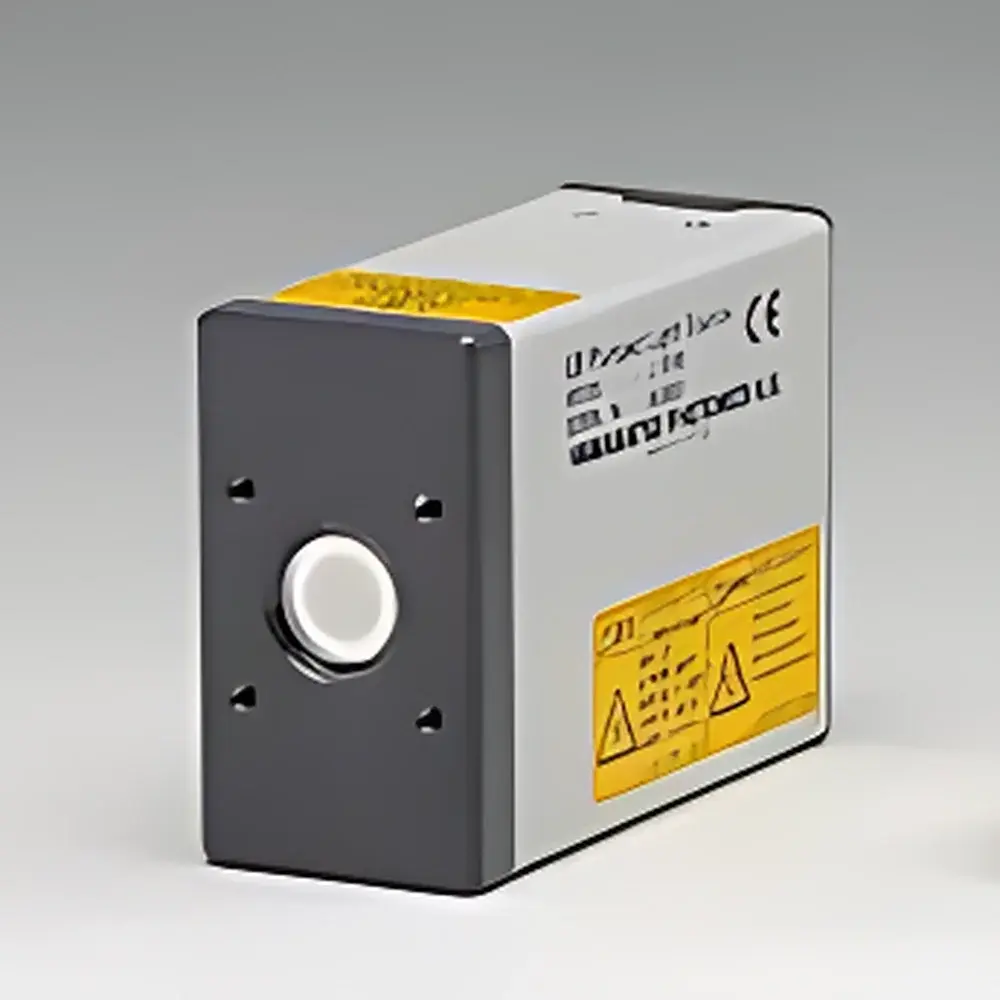
Hamamatsu L12848-305 UV Cathodoluminescent Light Source
| Brand | Hamamatsu |
|---|---|
| Origin | Japan |
| Manufacturer Type | Original Equipment Manufacturer (OEM) |
| Import Status | Imported |
| Model | L12848-305 |
| Light Source Type | Cathodoluminescent UV Source |
| Illumination Mode | External Irradiation |
| Peak Emission Wavelength | 310 nm |
| Radiant Intensity (at 310 nm) | ~8× higher than standard UV LEDs |
| Operating Lifetime | ≥5,000 hours |
| Integrated Power Supply | Yes |
| Dimensions (L × W × H) | 30.5 × 25.0 × 15.0 mm |
| Mercury-Free | Yes |
| Compliance | RoHS-compliant, CE-marked for laboratory equipment use |
Overview
The Hamamatsu L12848-305 is a compact, mercury-free ultraviolet cathodoluminescent light source engineered for stable, high-intensity deep-UV emission at 310 nm. Unlike conventional mercury-vapor or deuterium lamps, this device generates UV radiation through electron-beam excitation of a phosphor-coated cathode — a solid-state cathodoluminescence process that eliminates reliance on hazardous elemental mercury while delivering superior spectral stability and spatial coherence. Its integrated DC power supply and miniature form factor (30.5 × 25.0 × 15.0 mm) enable direct OEM integration into analytical platforms where space constraints, regulatory compliance (e.g., RoHS, REACH), and long-term operational reliability are critical. The source exhibits minimal thermal drift and no warm-up delay, making it suitable for time-resolved fluorescence detection, UV-curable resin monitoring, and continuous-duty environmental sensing applications requiring consistent irradiance over extended periods.
Key Features
- Mercury-free UV generation via cathodoluminescence — compliant with global environmental directives including RoHS and EU Directive 2011/65/EU
- Peak radiant output centered at 310 nm, with spectral full-width at half-maximum (FWHM) < 15 nm — optimized for excitation of common UV-sensitive fluorophores and photoinitiators
- Radiant intensity approximately eight times greater than commercially available 310-nm UV LEDs under equivalent drive conditions
- Integrated constant-current power module supporting 5–24 V DC input; no external driver or ballast required
- Rated operational lifetime ≥5,000 hours at nominal current, with gradual lumen depreciation rather than catastrophic failure
- Hermetically sealed ceramic-metal package ensuring resistance to humidity, vibration, and thermal cycling in laboratory and industrial environments
Sample Compatibility & Compliance
The L12848-305 is designed for external irradiation geometry and interfaces seamlessly with standard optical mounts (e.g., SM1-threaded housings, kinematic stages). It emits collimated UV flux suitable for excitation of quartz cuvettes, microfluidic chips, polymer films, and biological specimens without inducing significant sample heating. As a Class 1 LED-equivalent UV source per IEC 62471:2006, it poses no photobiological hazard under normal operating conditions. The device conforms to CE marking requirements for laboratory instrumentation and meets electromagnetic compatibility standards EN 61326-1:2013 and safety standard EN 61010-1:2010. While not certified for GMP or FDA 21 CFR Part 11 environments out-of-the-box, its deterministic output and absence of calibration drift support traceable integration into GLP-compliant analytical workflows when paired with NIST-traceable radiometric sensors.
Software & Data Management
As a hardware-level illumination component, the L12848-305 operates independently of proprietary software stacks. Its analog control interface (0–5 V input for intensity modulation) enables synchronization with third-party data acquisition systems such as National Instruments DAQmx, Thorlabs Kinesis, or LabVIEW-based instrument controllers. Users may log irradiance history using calibrated photodiode monitors (e.g., Hamamatsu S120VC series) interfaced via USB or analog output. Firmware-independent operation ensures compatibility with legacy and custom-built spectroscopic platforms, including those deployed under ISO/IEC 17025-accredited quality management systems.
Applications
- Fluorescence excitation in compact portable spectrometers and handheld analyzers
- UV curing process validation for dental composites, inkjet inks, and conformal coatings
- Accelerated weathering studies assessing polymer UV degradation kinetics per ASTM G154 and ISO 4892-3
- Real-time detection of airborne aromatic hydrocarbons via UV-induced fluorescence
- Calibration reference for UV-VIS spectrophotometers requiring stable 310-nm line sources
- Photochemical reactor illumination in flow chemistry and photocatalytic oxidation systems
FAQ
Is the L12848-305 compatible with fiber-optic coupling?
Yes — the source’s exit aperture is optimized for coupling into 200–600 µm core multimode UV-grade silica fibers using standard SMA905 or FC/PC adapters.
Does it require forced air cooling?
No — passive conduction cooling suffices under continuous operation at rated current; ambient temperature must remain below 40°C for specified lifetime.
Can output intensity be modulated dynamically?
Yes — analog 0–5 V input allows linear intensity control from 10% to 100% of maximum radiant flux with <10 µs rise time.
What is the angular emission profile?
The source delivers a Lambertian emission pattern with ±30° half-angle divergence, enabling uniform illumination across 10–25 mm diameter fields at 20 mm working distance.
Is spectral recalibration required during service life?
No — cathodoluminescent phosphor aging results in monotonic intensity reduction only; peak wavelength shift is <0.2 nm over 5,000 hours.






