
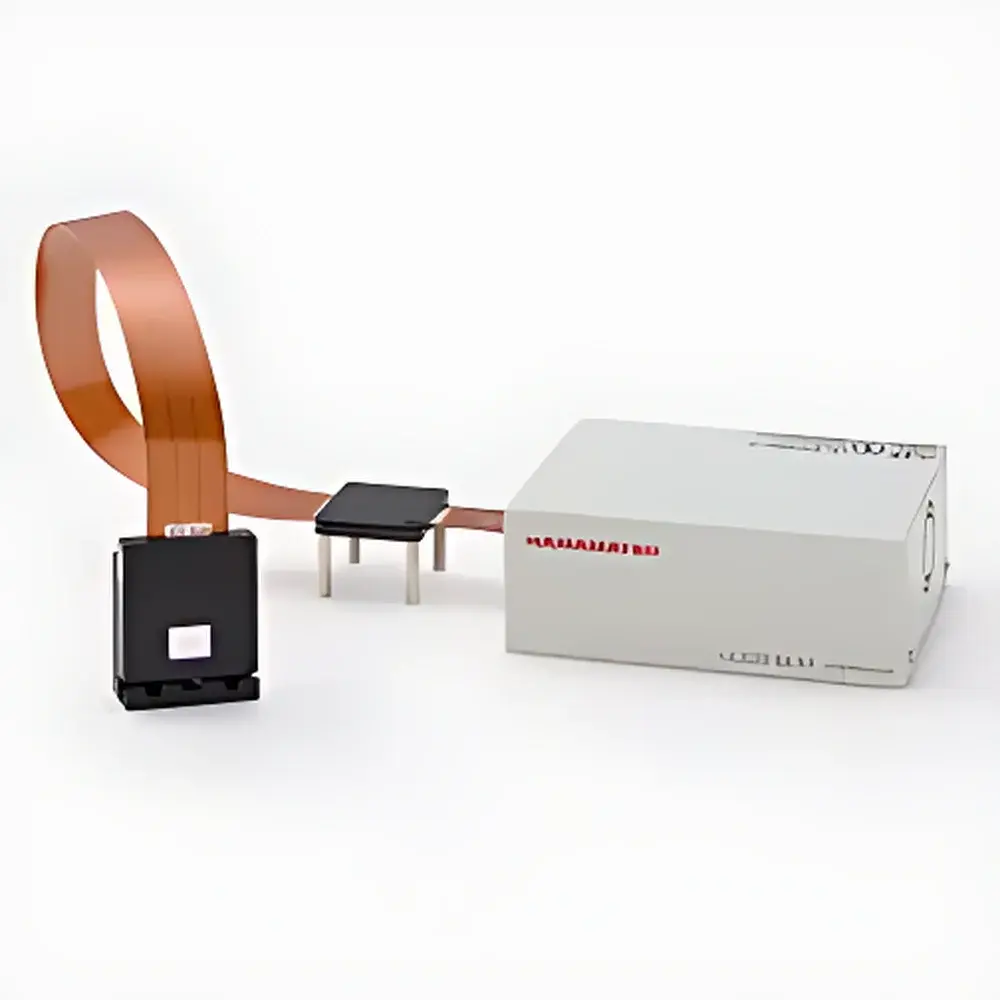
Hamamatsu LCOS-SLM X15213-02L
| Brand | Hamamatsu |
|---|---|
| Origin | Japan |
| Manufacturer Type | Original Equipment Manufacturer (OEM) |
| Import Status | Imported |
| Model | X15213-02L |
| Pricing | Available upon Request |
Overview
The Hamamatsu LCOS-SLM X15213-02L is a high-performance reflective-type pure-phase spatial light modulator engineered for precision wavefront control in advanced optical systems. Built on silicon-based liquid crystal on silicon (LCOS) technology, it enables voltage-driven, sub-wavelength phase modulation of incident light with exceptional fidelity. Unlike transmissive SLMs or segmented mirror devices, the X15213-02L operates via continuous, analog-controlled liquid crystal layer deformation—delivering smooth, diffraction-limited phase profiles without pixelation artifacts. Its design targets demanding applications including adaptive optics, holographic beam shaping, ultrafast pulse shaping, optical trapping, and quantum optics experiments where deterministic phase control at high optical throughput is critical. The device is optimized for operation within the near-infrared range (750–850 nm), with peak performance calibrated at λ = 785 nm under standard illumination conditions.
Key Features
- Pure-phase modulation architecture with linear, monotonic phase response across full 2π range
- High optical efficiency: 97% light utilization under specified measurement conditions (λ = 785 nm)
- High diffraction efficiency enabled by >96% fill factor and minimized inter-pixel scattering
- Robust high-power compatibility: rated for continuous-wave laser operation up to 800 ± 50 nm with thermal management compatible with multi-watt IR sources
- Native DVI-D interface support (SXGA resolution: 1280 × 1024 pixels) for plug-and-play integration with standard laboratory PCs
- Integrated USB-B 2.0 (high-speed) port for firmware updates, calibration data loading, and real-time parameter configuration
- Onboard correction engine compensates for inherent LC nonlinearity, static wavefront distortion, and pixel-to-pixel phase crosstalk
- Fast electro-optic response: 30 ms rise time, 80 ms fall time—suitable for quasi-static and low-frequency dynamic modulation schemes
Sample Compatibility & Compliance
The X15213-02L is designed for integration into ISO-standard optical breadboards and kinematic mounts via its standardized mechanical footprint and front-surface reflective geometry. It supports collimated input beams with diameters up to 12 mm (within effective aperture of 15.9 × 12.8 mm). The device complies with IEC 61000-6-3 (EMC emission standards) and IEC 61000-6-2 (immunity requirements) for laboratory instrumentation. While not certified for medical or industrial safety-critical use out-of-the-box, its optical design adheres to ISO 10110-7 surface quality specifications for coated reflective optics. Calibration data—including pixel-wise phase response maps and gamma correction tables—is provided in HDF5 format, supporting traceable metrology workflows aligned with ISO/IEC 17025 principles when used with NIST-traceable interferometric verification setups.
Software & Data Management
Hamamatsu provides the proprietary SLM Control Studio software suite (Windows 10/11, 64-bit), which delivers native DVI signal generation, real-time phase pattern synthesis, and hardware-accelerated correction matrix application. The software supports import of complex amplitude fields (e.g., Gerchberg-Saxton outputs), Zernike polynomial decomposition, and user-defined phase mask scripting via Python API (pySLM). All phase map uploads are logged with timestamp, system configuration hash, and operator ID—enabling audit-ready records compliant with GLP and FDA 21 CFR Part 11 requirements when deployed in regulated R&D environments. Raw phase calibration files are stored in vendor-neutral formats (HDF5, TIFF) to ensure long-term data integrity and interoperability with MATLAB, Python (NumPy/SciPy), and LabVIEW platforms.
Applications
- Adaptive optics correction in astronomical telescopes and ophthalmic imaging systems
- Holographic optical tweezers for multi-point particle manipulation in biophysics
- Programmable diffractive optical elements (DOEs) for laser material processing beam homogenization
- Ultrafast pulse compression and spectral phase shaping in Ti:sapphire and Yb-fiber amplifier chains
- Quantum state engineering via spatial mode sorting (e.g., OAM multiplexing in photonic quantum communication)
- Calibration reference for Shack-Hartmann wavefront sensors and interferometric metrology tools
FAQ
What is the maximum safe average power density this SLM can handle at 785 nm?
The X15213-02L is qualified for continuous-wave operation at ≤5 W/cm² over its active area under forced-air cooling conditions; derating is required above 40°C ambient.
Does the device support grayscale phase modulation with 8-bit resolution only, or is higher bit-depth achievable?
While native DVI input is 8-bit (256 levels), internal DAC resolution and phase linearity enable effective 10–11 bit phase quantization via dithering and frame-averaging techniques implemented in SLM Control Studio.
Can the SLM be synchronized with external triggers such as camera exposure or laser pulses?
Yes—USB-B interface supports TTL-compatible trigger input/output lines for hardware synchronization with femtosecond lasers, EMCCDs, or arbitrary waveform generators.
Is custom firmware development supported for OEM integration?
Hamamatsu offers NDA-protected SDKs and reference designs for embedded controller integration, including FPGA-based real-time pattern streaming and closed-loop wavefront correction architectures.



