
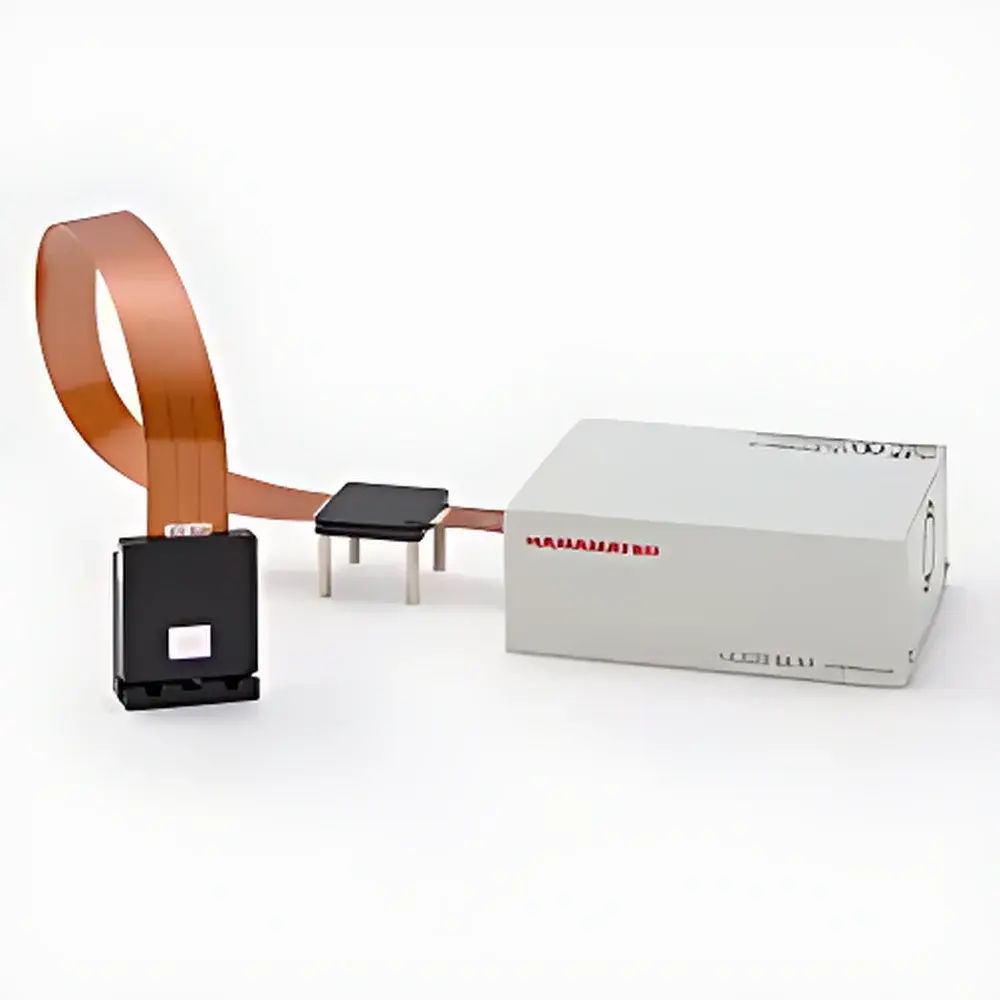
Hamamatsu LCOS-SLM X15213-03CR
| Brand | Hamamatsu |
|---|---|
| Origin | Japan |
| Manufacturer Type | Original Equipment Manufacturer (OEM) |
| Product Category | Imported Optical Component |
| Model | X15213-03CR |
| Pricing | Available Upon Request |
| Pixel Pitch | 12.5 µm |
| Input Interface | DVI-D / USB-B (USB 2.0 High-Speed) |
| DVI Resolution | SXGA (1280 × 1024) |
| Active Pixel Count | 1272 × 1024 |
| Effective Aperture | 15.9 mm × 12.8 mm |
| Maximum Spatial Resolution | 40 lp/mm |
| Fill Factor | 96 % |
| Rise Time | 27 ms |
| Fall Time | 83 ms |
| Operating Wavelength Range | 1050 ± 50 nm |
| Optical Efficiency | 97 % (measured at λ = 1064 nm) |
| Modulation Type | Pure Reflective Phase-Only |
Overview
The Hamamatsu LCOS-SLM X15213-03CR is a high-power-capable, pure reflective phase-only spatial light modulator engineered for demanding laser beam shaping and wavefront control applications in industrial photonics. Built upon silicon-on-silicon liquid crystal (LCOS) architecture, it integrates a CMOS backplane with nematic liquid crystal layer to enable pixel-level voltage addressing—allowing precise, dynamic modulation of optical phase profiles without amplitude disturbance. Unlike transmissive SLMs or segmented mirror devices, this device operates exclusively in reflection mode, delivering high optical throughput and minimal thermal lensing under intense irradiation. Its core innovation lies in proprietary thermal management design: optimized heat conduction paths, low-thermal-resistance substrate bonding, and thermally stable LC alignment layers collectively suppress temperature rise in the active LC layer during prolonged exposure to high-intensity near-infrared lasers. As a result, the X15213-03CR achieves a continuous-wave (CW) power handling capability of ≥700 W at 1050–1100 nm—3.5× higher than its predecessor (X15213-03BR)—making it uniquely suited for integration into high-power laser manufacturing systems where thermal drift must be minimized for process repeatability.
Key Features
- Pure reflective phase-only modulation architecture—no amplitude coupling, ideal for holographic beam shaping and adaptive optics.
- High-resolution SXGA-grade active area (1272 × 1024 pixels) with 12.5 µm pitch and 96% fill factor, enabling fine-grained wavefront control up to 40 line pairs per millimeter.
- Optimized for 1050 ± 50 nm operation—fully compatible with Yb-doped fiber lasers, thin-disk lasers, and other industrial NIR sources used in metal additive manufacturing and precision welding.
- Thermally robust construction achieving ≥700 W CW power tolerance—validated under ISO 11551-compliant laser-induced damage threshold (LIDT) testing protocols.
- Dual-input interface support: DVI-D for real-time pattern streaming at 60 Hz frame rate; USB-B (USB 2.0 HS) for firmware updates, calibration data loading, and low-bandwidth configuration.
- 97% optical efficiency at 1064 nm—minimizing thermal load on downstream optics and improving overall system energy economy.
Sample Compatibility & Compliance
The X15213-03CR is designed for integration into Class 4 laser systems compliant with IEC 60825-1:2014 and ANSI Z136.1-2022 safety standards. Its optical surface meets MIL-PRF-13830B scratch-dig specifications, and the sealed LC cell conforms to JIS C 0920 humidity resistance requirements (85% RH, 85°C, 1000 h). The device supports GLP/GMP-aligned operation when paired with traceable calibration routines and audit-ready firmware logs. While not certified as medical device hardware, its performance stability and repeatability meet baseline criteria referenced in ISO 13485 Annex A for critical optical subsystems in regulated laser processing equipment.
Software & Data Management
Hamamatsu provides the SLM Control Suite v3.x—a platform-independent application (Windows/macOS/Linux) supporting real-time phase map generation via GPU-accelerated algorithms including Gerchberg-Saxton, direct binary search, and Zernike decomposition. All phase patterns are stored in IEEE 754-compliant 16-bit signed integer format (.slm binary or .tiff), ensuring bit-perfect reproducibility across sessions. The USB interface enables firmware version tracking, EEPROM-based serial number logging, and timestamped thermal sensor readouts (integrated thermistor array). For automated production environments, the SDK supports Python/C++ APIs with deterministic latency ≤1.2 ms from host command to pixel voltage stabilization—critical for closed-loop adaptive machining workflows requiring sub-millisecond synchronization with motion controllers.
Applications
- Metal powder bed fusion (PBF) in additive manufacturing—dynamic focus shaping, multi-beam splitting, and intensity homogenization for uniform melt pool formation.
- High-speed laser welding and cutting—real-time compensation of thermal distortion through closed-loop wavefront correction using integrated interferometric feedback.
- Ultrafast laser pulse shaping—coherent control of femtosecond pulses via spectral phase modulation in conjunction with 4f pulse shapers.
- Adaptive optics in high-energy laser systems—compensation of static and dynamic aberrations induced by thermal blooming in amplifier chains.
- Quantum optics experiments—generation of structured light fields (e.g., vortex beams, Bessel beams) for optical trapping and atom manipulation.
FAQ
What is the maximum average power density this SLM can withstand at 1064 nm?
The X15213-03CR supports ≥700 W total incident CW power over its full aperture, corresponding to an average power density of ~570 W/cm² (calculated over 15.9 × 12.8 mm effective area).
Is the device compatible with third-party phase retrieval or wavefront sensing software?
Yes—Hamamatsu publishes full register-level documentation and provides MATLAB/Python wrappers for raw pixel addressing, enabling interoperability with Shack-Hartmann analyzers, iterative optimization toolchains, and custom metrology platforms.
Does the SLM require active cooling in standard operation?
No active cooling is required for operation below 700 W; passive heatsinking via the provided aluminum mounting base suffices. For pulsed operation above 10 kW peak power or ambient temperatures >40°C, optional forced-air or liquid-cooled mounts are available (part numbers listed in Technical Note TN-X15213-03CR-Rev.D).
Can the device be used outside its specified wavelength range?
Operation outside 1000–1100 nm is not recommended—LC birefringence dispersion and anti-reflection coating performance degrade significantly beyond this band, resulting in reduced phase fidelity and increased absorption-induced heating.
How is calibration traceability maintained across units?
Each unit ships with NIST-traceable phase response characterization data (per-pixel voltage-to-phase transfer function) measured at 1064 nm, archived in HDF5 format with SHA-256 checksums for integrity verification during GxP audits.





