
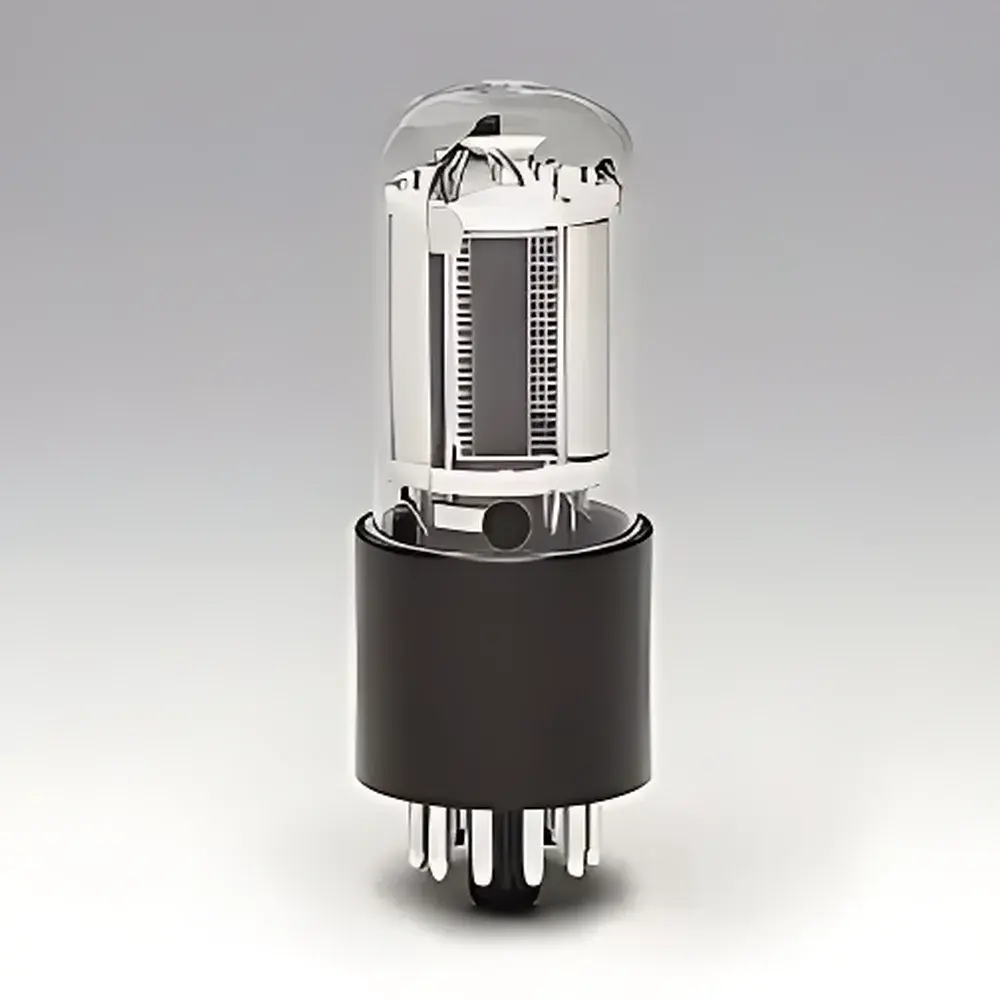
Hamamatsu Photomultiplier Tube R13456
| Brand | Hamamatsu |
|---|---|
| Origin | Japan |
| Manufacturer Type | Original Equipment Manufacturer (OEM) |
| Product Category | Imported |
| Model | R13456 |
| Price Range | USD 0–1,450 (FOB Yokohama) |
Overview
The Hamamatsu R13456 is a side-on, 28 mm diameter photomultiplier tube (PMT) engineered for high-sensitivity spectroscopic detection across an extended ultraviolet-to-near-infrared (UV-NIR) spectral range. Utilizing a multi-alkali (S-20) photocathode deposited on a borosilicate glass envelope, the R13456 delivers superior quantum efficiency in the 700–980 nm region compared to legacy PMTs such as the R928—making it particularly suited for low-light applications in fluorescence spectroscopy, time-resolved luminescence, and Raman signal amplification where NIR photon yield is critical. Its square-shaped photocathode (8 × 24 mm active area) provides optimized spatial uniformity and efficient coupling with slit-based monochromators or fiber-optic input interfaces. The device operates on standard negative high-voltage biasing (−1000 V typical), with electron multiplication achieved through a 10-stage linear-focused dynode chain ensuring stable gain and minimal pulse amplitude variation.
Key Features
- Extended spectral response: 185–980 nm with peak quantum efficiency near 420 nm and enhanced NIR responsivity beyond 750 nm
- High cathode radiant sensitivity: 74 mA/W (typical) at 400 nm, enabling efficient UV photon conversion
- Exceptional anode luminous sensitivity: 2800 A/lm (typical), supporting low-flux detection without external amplification
- Ultrafast temporal performance: 2.2 ns rise time and 22 ns transit time (±1.2 ns transit time spread), suitable for sub-nanosecond time-correlated single-photon counting (TCSPC)
- Low dark current: ≤5 nA after 30 min warm-up (typical), reducing background noise in long-integration measurements
- Robust mechanical design: 28 mm metal-ceramic package with side-window geometry for direct optical alignment and thermal stability
Sample Compatibility & Compliance
The R13456 is compatible with standard C-mount and SMA-coupled optical housings, and integrates seamlessly into OEM spectrometers, fluorometers, and particle detectors requiring analog current output or gated photon counting. Its spectral response aligns with ASTM E308-22 (Standard Practice for Computing the Colors of Objects) and ISO 11664-6 (Colorimetry — Part 6: CIE standards for absolute spectral radiometric measurements). The device complies with RoHS Directive 2011/65/EU and meets IEC 61000-4-2 (ESD immunity) and IEC 61000-4-3 (radiated RF immunity) requirements when installed per Hamamatsu’s recommended shielding and grounding protocols. It supports GLP/GMP traceability when paired with calibrated reference sources and documented HV supply calibration logs.
Software & Data Management
While the R13456 is an analog detector requiring external high-voltage supply and signal conditioning, it is fully supported by industry-standard data acquisition platforms including National Instruments DAQmx, Keysight PathWave, and MATLAB Instrument Control Toolbox. When used with TCSPC modules (e.g., PicoQuant HydraHarp 400 or Becker & Hickl SPC-150), the R13456 enables timestamped photon event logging with <10 ps timing resolution (system-limited). All gain, dark current, and linearity specifications are traceable to NIST-calibrated irradiance standards via Hamamatsu’s Certificate of Conformance (CoC), which includes individual unit test reports covering cathode uniformity mapping and pulse height distribution analysis.
Applications
- UV-Vis-NIR absorbance and fluorescence spectroscopy in pharmaceutical QC labs (USP & EP compliant workflows)
- Time-resolved fluorescence lifetime imaging (FLIM) in biophotonics research systems
- Low-light Raman scattering detection in process analytical technology (PAT) environments
- Cherenkov radiation monitoring in nuclear instrumentation and reactor diagnostics
- Plasma emission analysis in industrial combustion and semiconductor etch chamber monitoring
- Single-molecule detection in confocal microscopy setups with pulsed laser excitation
FAQ
What is the recommended operating voltage range for the R13456?
The nominal inter-dynode voltage gradient is 100 V per stage; total supply voltage should be maintained between −900 V and −1100 V for optimal gain stability and linearity.
Can the R13456 be used in vacuum environments?
Yes—the metal-ceramic hermetic seal supports operation under continuous vacuum down to 1 × 10⁻⁶ Pa, provided feedthroughs comply with MIL-STD-202G Method 212.
Is the R13456 compliant with FDA 21 CFR Part 11 for regulated bioanalytical instruments?
As a component-level detector, the R13456 itself does not carry Part 11 certification; however, its performance parameters and CoC documentation support audit-ready validation when integrated into 21 CFR Part 11–compliant instrument architectures.
How does the red/white ratio affect spectral calibration?
The R-68 ratio (0.4 typ.) quantifies relative response at 680 nm versus broadband tungsten illumination; it serves as a diagnostic metric during factory calibration and must be verified post-installation using NIST-traceable filters to ensure consistent NIR quantitation.
What cooling options improve dark current performance?
Thermoelectric (Peltier) cooling to −20 °C reduces dark current by ~50% and extends dynamic range in long-exposure applications; Hamamatsu recommends the C11020 series cold finger adapter for integration.




