
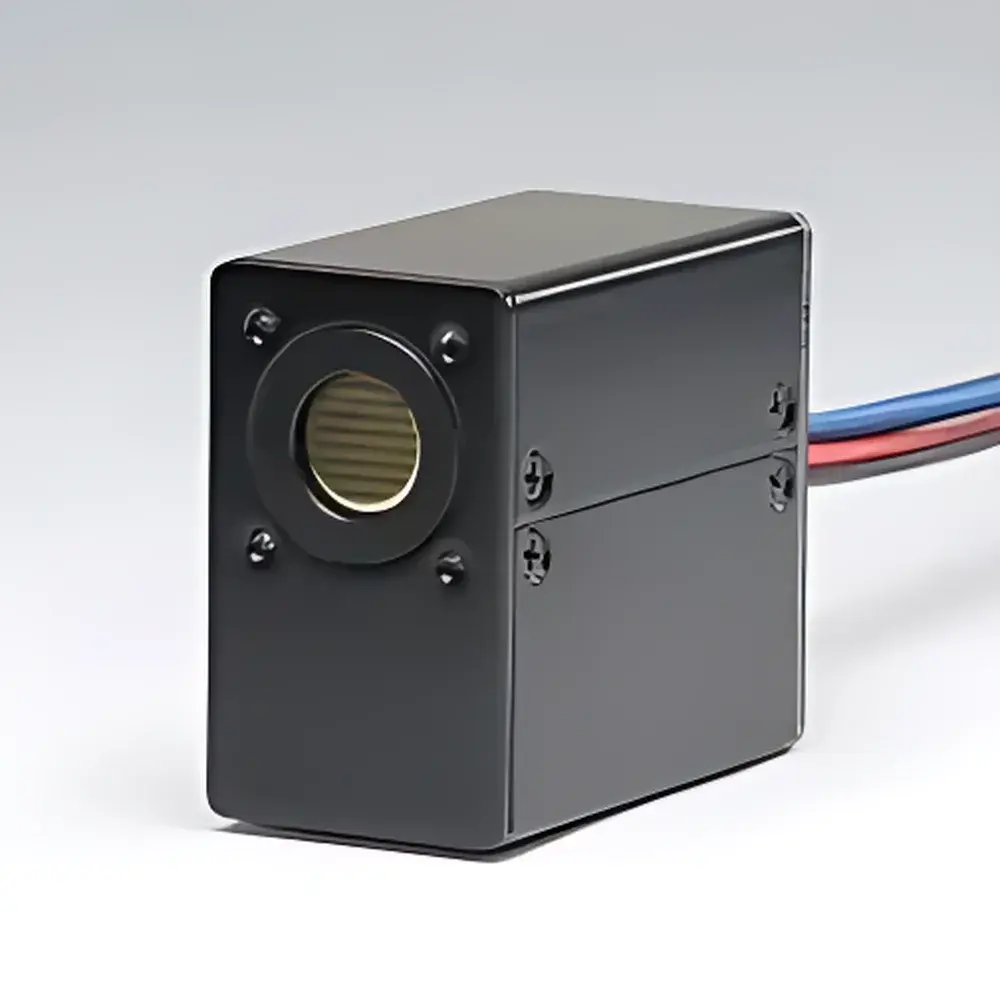
Hamamatsu Photon Counting Head H10682-210
| Brand | Hamamatsu |
|---|---|
| Origin | Japan |
| Manufacturer Type | Original Equipment Manufacturer (OEM) |
| Product Category | Optical Component |
| Model | H10682-210 |
| Photocathode Type | Ultra Bialkali (UBA) |
| Photocathode Shape | Round |
| Photocathode Diameter | 8 mm |
| Spectral Range | 230–700 nm |
| Peak Wavelength | 400 nm |
| Dimensions (W×H×D) | 22.0 × 36.0 × 40.0 mm |
| Operating Voltage | +4.75 to +5.25 V DC |
| Max Input Voltage | +6 V |
| Max Input Current | 40 mA |
| Count Sensitivity (300 nm) | 3.9 × 10⁵ s⁻¹·pW⁻¹ |
| Count Sensitivity (400 nm) | 6.1 × 10⁵ s⁻¹·pW⁻¹ |
| Count Sensitivity (500 nm) | 4.6 × 10⁵ s⁻¹·pW⁻¹ |
| Count Sensitivity (600 nm) | 1.3 × 10⁵ s⁻¹·pW⁻¹ |
| Count Sensitivity (700 nm) | 9.1 × 10³ s⁻¹·pW⁻¹ |
| Maximum Count Rate | 5.0 × 10⁶ s⁻¹ |
| Dark Count Rate (Typ.) | 50 s⁻¹ |
| Dark Count Rate (Max) | 100 s⁻¹ |
| Pulse Pair Resolution | 20 ns |
| Output Pulse Width | 10 ns |
| Min Output Pulse Height | +2 V |
| Typ. Output Pulse Height | +2.2 V |
| Recommended Load Resistance | 50 Ω |
| Output Logic | Positive |
| Operating Temperature | +5 to +40 °C |
| Storage Temperature | −20 to +50 °C |
| Weight | 47 g |
Overview
The Hamamatsu Photon Counting Head H10682-210 is a compact, OEM-integrated photomultiplier tube (PMT)-based photon detection module engineered for high-sensitivity, time-resolved single-photon counting applications in demanding optical laboratory environments. At its core lies an ultra-bialkali (UBA) photocathode sealed within a hermetically metal-ceramic package—delivering superior quantum efficiency across the near-UV to visible spectrum (230–700 nm), with peak responsivity at 400 nm. Unlike conventional analog PMT modules, the H10682-210 integrates a low-noise, high-speed photon counting circuit and a stabilized high-voltage power supply on-board. This architecture eliminates external HV biasing and threshold tuning, enabling plug-and-play operation with only a +5 V DC supply—ideal for integration into spectrometers, fluorescence lifetime systems, time-correlated single-photon counting (TCSPC) setups, and quantum optics instrumentation.
Key Features
- Ultra-bialkali (UBA) photocathode with 8 mm diameter round active area, optimized for maximum photon detection efficiency in the 300–500 nm range
- Integrated high-voltage generator and discriminator circuit—factory-calibrated for optimal pulse discrimination and minimal afterpulsing
- High temporal resolution: 20 ns pulse-pair resolution and 10 ns output pulse width support sub-nanosecond timing fidelity
- Low intrinsic noise: typical dark count rate of 50 s⁻¹ (max 100 s⁻¹) ensures robust signal-to-noise performance in low-light measurements
- Over-illumination detection circuitry provides real-time diagnostic feedback—outputs a dedicated flag signal when incident flux exceeds linear counting regime
- Positive-logic TTL-compatible output (≥ +2 V, 50 Ω matched) enables direct interfacing with time-to-digital converters (TDCs), FPGA-based acquisition boards, or standard counter/timer modules
- Compact footprint (22.0 × 36.0 × 40.0 mm) and lightweight design (47 g) facilitate space-constrained integration in portable or multi-channel detector arrays
Sample Compatibility & Compliance
The H10682-210 is designed for use with weak optical signals from pulsed or continuous-wave sources—including laser-induced fluorescence, Raman scattering, bioluminescence, and single-molecule emission. Its spectral response aligns with common excitation wavelengths used in life science and materials characterization (e.g., 355 nm, 405 nm, 488 nm lasers). The module complies with IEC 61000-6-3 (emission) and IEC 61000-6-2 (immunity) standards for industrial electromagnetic compatibility. While not certified for medical or safety-critical applications, its stable gain and traceable calibration support GLP-compliant data acquisition when deployed in validated instrument platforms. No internal batteries or hazardous substances are present; RoHS 3 and REACH compliance is maintained per Hamamatsu’s manufacturing specifications.
Software & Data Management
As a hardware-level photon detection component, the H10682-210 does not include embedded firmware or onboard storage. It delivers raw TTL pulses synchronized to photon arrival events—enabling full flexibility in downstream processing. Users typically interface the module with third-party data acquisition systems such as National Instruments DAQmx, Becker & Hickl SPC-150, or custom FPGA-based TCSPC engines. For traceability in regulated environments, timestamped pulse streams can be logged with audit-trail-capable software that supports 21 CFR Part 11 electronic signature requirements when deployed within a validated system architecture. Hamamatsu provides comprehensive datasheets, spectral response curves, and aging/linearity test reports—essential for IQ/OQ documentation during instrument qualification.
Applications
- Time-resolved fluorescence spectroscopy and lifetime imaging (FLIM)
- Single-molecule detection and nanoparticle tracking
- Laser-induced breakdown spectroscopy (LIBS) photon gating
- Quantum key distribution (QKD) receiver front-ends
- Low-light radiometry and absolute photon flux calibration
- Multi-channel coincidence counting in quantum optics experiments
- Integration into OEM analytical instruments requiring rugged, self-contained photon counting heads
FAQ
What is the recommended load impedance for the output signal?
A 50 Ω termination is required to preserve pulse integrity and minimize reflections—consistent with standard high-speed digital measurement practices.
Can the H10682-210 operate continuously at its maximum count rate?
Yes, the module maintains linearity up to 5.0 × 10⁶ s⁻¹ under stable thermal conditions (+5 to +40 °C); sustained operation above this limit triggers the over-illumination warning output.
Is cooling required to achieve specified dark count performance?
No active cooling is needed—the stated dark count rates (50 s⁻¹ typ.) are guaranteed at ambient temperatures between +5 and +40 °C.
How does the UBA photocathode differ from the SBA variant (H10682-110)?
The UBA cathode offers higher quantum efficiency below 400 nm and improved blue response uniformity, making it preferable for UV-excited fluorescence and short-pulse detection.
Does Hamamatsu provide calibration certificates with each unit?
Calibration data (spectral sensitivity, dark count, pulse height distribution) is included in the shipment documentation; NIST-traceable calibration is available upon request as a value-added service.



