
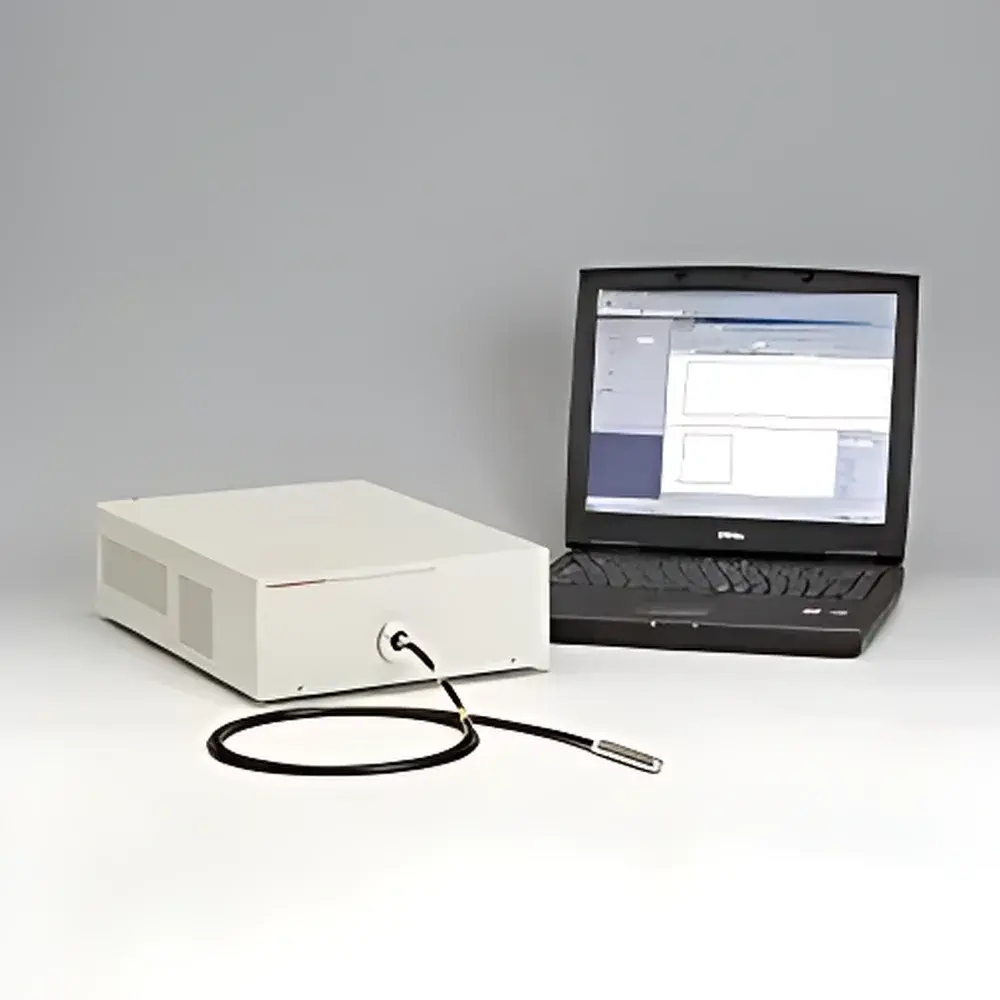
Hamamatsu PMA-12 Series Fiber Optic Spectrometer
| Brand | Hamamatsu |
|---|---|
| Origin | Japan |
| Manufacturer Type | Original Equipment Manufacturer (OEM) |
| Product Origin | Imported |
| Model | PMA-12 Series |
| Spectral Range | 200 nm to 950 nm |
| Detector Type | Back-Thinned CCD Linear Array |
| Optical Design | Czerny-Turner |
| F-number | f/4 |
| Spectral Resolution | < 2 nm (verified with Hg/Ar emission lines) |
| Pixel Count | 1024 channels |
| Pixel Size | 24 µm |
| Active Sensor Area | 2.928 mm |
| Cooling Temperature | −15 °C |
| Read Noise | 16 electrons (rms) |
| Dark Current | 75 electrons/scan (at −15 °C, 20 ms integration) |
| Integration Time | 19 ms to 64 s |
| A/D Resolution | 16-bit |
| Input Fiber | Bundled fiber, φ1 mm core, φ12 mm stainless-steel sheath, 1.5 m length |
| Fiber Coupling | SMA 905 connector |
| Trigger Interface | TTL-compatible, high-impedance input |
| Data Interface | USB 2.0 |
| Power Supply | AC 100–240 V, 50/60 Hz |
Overview
The Hamamatsu PMA-12 Series Fiber Optic Spectrometer is a self-contained, benchtop-grade spectroscopic measurement system engineered for high-stability, real-time spectral acquisition in laboratory and industrial environments. Built upon the Czerny-Turner optical architecture with an f/4 aperture, the PMA-12 integrates a thermoelectrically cooled back-thinned CCD linear array detector (1024 pixels, 24 µm pitch), precision diffraction grating, collimating/focusing optics, and regulated power supply within a single compact housing. Its 200–950 nm spectral coverage—spanning deep UV through visible to near-infrared—is optimized for applications requiring broad-band detection without mechanical scanning. The system’s fixed optical path eliminates alignment drift, while factory calibration of wavelength accuracy and relative spectral responsivity ensures traceable, repeatable measurements across extended operational periods. Designed for plug-and-play deployment, the PMA-12 operates without external controllers or cooling accessories, making it suitable for embedded OEM integration as well as standalone analytical use.
Key Features
- Monolithic optomechanical design: All optical components—including grating, mirrors, slit, and detector—are rigidly mounted to minimize thermal and mechanical drift.
- Thermoelectric cooling to −15 °C: Reduces dark current by >90% compared to uncooled operation, enabling low-light measurements with integration times up to 64 seconds.
- High quantum efficiency back-thinned CCD: Delivers superior UV sensitivity (particularly below 350 nm) and uniform pixel response across the full 1024-channel array.
- Pre-calibrated spectral response: Wavelength scale accuracy ±0.5 nm (RMS), radiometric responsivity calibrated against NIST-traceable standards; calibration data embedded in firmware.
- Real-time multi-wavelength acquisition: Full-spectrum readout at up to 50 Hz (depending on integration time), supporting kinetic studies and process monitoring.
- Robust fiber-optic interface: SMA 905–compatible input with bundled stainless-steel armored fiber (1.5 m, 1 mm core), rated for repeated bending and ambient light rejection.
Sample Compatibility & Compliance
The PMA-12 accepts light via standard optical fiber, enabling non-contact, remote, or in-situ sampling from diverse sources—including LEDs, lasers, plasma emissions, fluorescence probes, and diffuse reflectance targets. Its wide dynamic range (typical >5 × 10⁴:1, dependent on integration time and signal level) supports both weak luminescence and intense broadband illumination. The instrument complies with IEC 61000-6-3 (EMC emission) and IEC 61000-6-2 (immunity) standards. While not certified for medical or pharmaceutical GMP production environments out-of-the-box, its stable calibration, audit-ready firmware logging, and deterministic USB 2.0 communication protocol support validation under ISO/IEC 17025 and ASTM E275–23 (Standard Practices for Describing and Measuring Performance of UV-Visible Spectrophotometers). Optional software tools enable 21 CFR Part 11–compliant electronic signatures and audit trails when deployed with validated host applications.
Software & Data Management
Hamamatsu provides the proprietary SpectraSmart™ software suite (Windows-based), offering real-time spectrum display, peak identification, spectral subtraction, intensity normalization, and export to CSV, TXT, or HDF5 formats. The SDK includes C/C++, Python, and LabVIEW APIs with full register-level control over integration time, trigger mode (free-run, software, or external TTL), gain, and temperature setpoint. All raw frame data retain 16-bit depth prior to on-board processing; no lossy compression is applied. Firmware supports dual-mode operation: “Standard” mode for maximum SNR, and “High-Speed” mode with reduced readout noise trade-offs. Calibration files (wavelength, linearity, dark reference) are stored internally and auto-loaded at initialization, eliminating manual file management.
Applications
- UV-Vis-NIR absorbance and transmittance quantification in chemistry and materials science labs.
- Plasma diagnostics and arc lamp characterization in semiconductor fabrication tool monitoring.
- LED binning and spectral stability tracking during manufacturing QA/QC.
- Fluorescence lifetime precursor analysis (intensity-based decay profiling).
- In-line colorimetry and spectral reflectance mapping for coating and pigment R&D.
- Educational spectroscopy platforms where ruggedness, ease of setup, and reproducibility are prioritized over ultra-high resolution.
FAQ
Is the PMA-12 compatible with third-party spectrometers’ calibration standards?
Yes—the instrument’s wavelength and responsivity calibrations are traceable to NIST SRM 2035 (Holmium Oxide) and SRM 2036 (Didymium), and calibration coefficients conform to the ASTM E308–22 spectral data exchange format.
Can the PMA-12 operate in vacuum or controlled-atmosphere enclosures?
The unit is rated for ambient operation only (5–40 °C, <80% RH, non-condensing); it is not hermetically sealed and contains internal air gaps critical for thermal management—vacuum deployment requires custom engineering consultation.
What is the typical warm-up time to achieve thermal equilibrium?
Approximately 15 minutes after power-on at 25 °C ambient; full detector stabilization (−15 °C setpoint ±0.2 °C) is confirmed via onboard thermistor telemetry.
Does the USB 2.0 interface support isochronous data streaming?
No—data transfer uses bulk transfer mode; however, the firmware guarantees deterministic latency (<5 ms jitter) and full-frame delivery integrity via cyclic redundancy check (CRC) on every packet.
Are OEM integration kits available for embedded systems?
Yes—Hamamatsu offers mechanical mounting brackets, DC power conversion modules (for 12 V input), and headless firmware variants with simplified command sets for integration into automated test equipment (ATE) and industrial controllers.





