
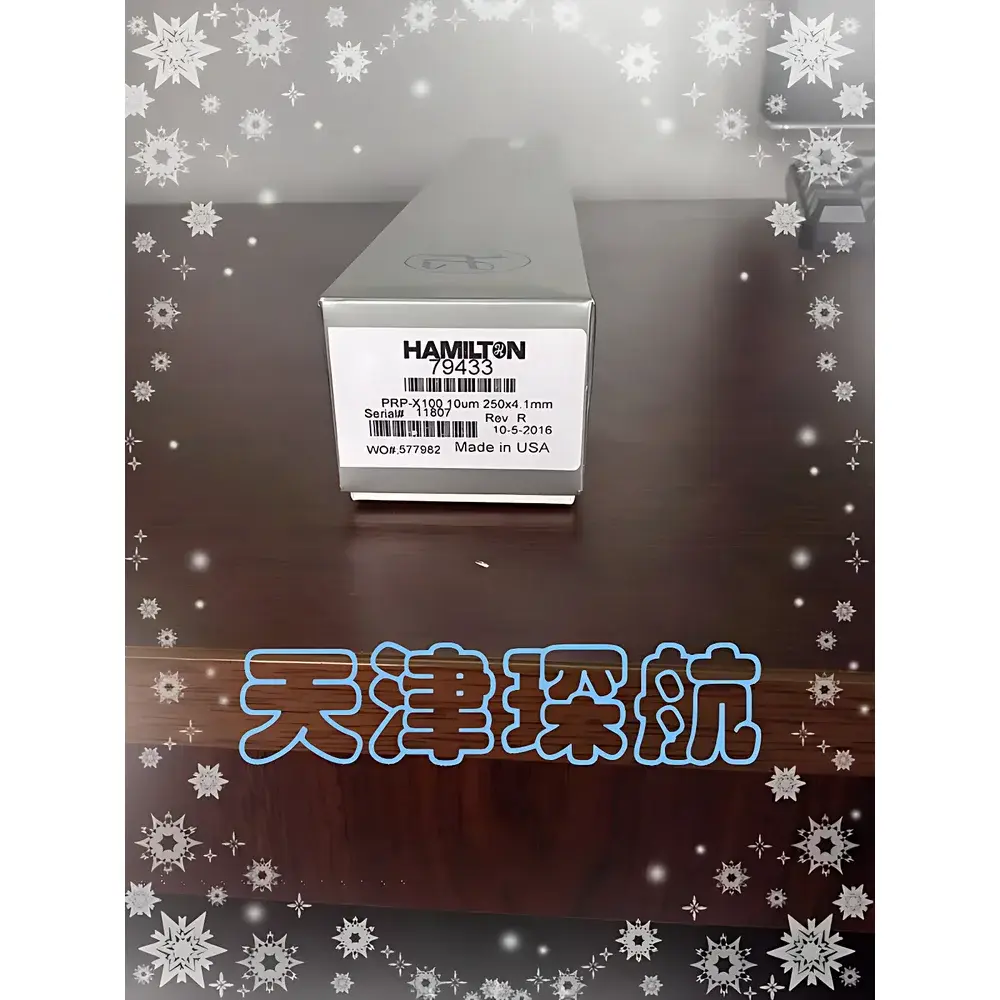
Hamilton PRP-X100 Anion Exchange HPLC Column, 4.1 mm × 250 mm, 10 µm Particle Size, Stainless Steel Housing (Cat. No. 79433)
| Brand | HAMILTON |
|---|---|
| Stationary Phase | PSDVB/Trimethylammonium |
| Mode | Anion Exchange |
| Particle Size | 10 µm |
| Pore Size | 100 Å |
| Inner Diameter | 4.1 mm |
| Length | 250 mm |
| Housing Material | Stainless Steel |
| Max. Pressure | 5,000 psi |
| Exchange Capacity | 0.304 meq/column |
| pH Stability Range | 1–13 |
| Mobile Phase Compatibility | 0–100% aqueous/organic (e.g., methanol, acetonitrile) |
| Temperature Limit | 60 °C (at pH 1–7), 50 °C (at pH 8–13) |
| Regeneration Protocol | 50 mL methanol + 1% v/v 6 N HNO₃ |
Overview
The Hamilton PRP-X100 Anion Exchange HPLC Column (Cat. No. 79433) is a high-capacity, polymeric strong anion exchange column engineered for robust and reproducible separation of inorganic and organic anions under demanding analytical conditions. Based on a cross-linked polystyrene-divinylbenzene (PSDVB) matrix functionalized with quaternary trimethylammonium groups, the PRP-X100 delivers exceptional chemical stability across the full pH range (1–13) and compatibility with high-organic mobile phases—including up to 100% methanol or acetonitrile—enabling efficient elution and cleaning of strongly retained hydrophobic anions. Its 10 µm particle size and 100 Å pore structure provide optimal mass transfer kinetics and surface accessibility for diverse analytes, including arsenate (AsO₄³⁻), arsenite (H₃AsO₃), bromate, chlorate, perchlorate, phosphate species, sulfate, sulfite, EDTA, low-molecular-weight organic acids (e.g., formic, acetic, phosphonic, chloroacetic acids), and halides (F⁻, Cl⁻, Br⁻, I⁻). Designed specifically for regulatory-compliant analysis of total and speciated inorganic arsenic in food, water, and environmental matrices, this column meets method requirements outlined in EPA Method 6300, ISO 17294-2, and AOAC Official Method 2013.05.
Key Features
- Polymeric PSDVB backbone with covalently bound trimethylammonium functional groups ensures long-term pH stability (pH 1–13) and resistance to hydrolysis—unlike silica-based anion exchangers.
- High anion exchange capacity (0.304 meq/column) enables quantitative retention and resolution of low-concentration anionic species, including sub-ppb arsenic species in complex food digests.
- Stainless steel hardware (316 SS) rated to 5,000 psi supports use with modern UHPLC and HPLC systems without mechanical degradation.
- Compatible with both conductivity detection (CD) and UV detection (190–220 nm), facilitating method flexibility in multi-analyte workflows.
- Validated for gradient elution using KOH, NaOH, or ammonium carbonate/bicarbonate buffers—fully compatible with suppressed and non-suppressed IC systems.
- Regenerable via simple protocol: 50 mL methanol containing 1% (v/v) 6 N nitric acid, followed by equilibration—extending column lifetime beyond 1,000 injections under routine QC conditions.
Sample Compatibility & Compliance
The PRP-X100 column demonstrates broad applicability across regulated and research-driven sample types, including drinking water, wastewater, soil extracts, rice flour digests, seafood homogenates, and pharmaceutical excipients. It complies with key international standards governing anion analysis: ASTM D4327 (IC for anions in water), ISO 10304-1 (determination of anions by IC), USP (conductivity testing of purified water), and FDA guidance for elemental impurities (ICH Q3D). The column’s pH resilience and organic solvent tolerance support GLP/GMP-compliant methods requiring rigorous system suitability testing, column qualification, and revalidation after regeneration. All hardware components meet ASME BPE and FDA 21 CFR Part 11 data integrity expectations when integrated into validated chromatography data systems (CDS).
Software & Data Management
When deployed on Agilent, Thermo Fisher, Waters, or Shimadzu HPLC/UHPLC platforms, the PRP-X100 integrates seamlessly with instrument control software (e.g., OpenLab CDS, Chromeleon, Empower) for automated method execution, peak integration, and report generation. Retention time stability (<0.2% RSD over 100 injections) and peak symmetry (asymmetry factor 0.9–1.3 for F⁻–SO₄²⁻) ensure reliable calibration curve linearity (r² ≥ 0.9995) across dynamic ranges from 0.1–100 µg/L for arsenic species. Audit trails, electronic signatures, and raw data archiving comply with 21 CFR Part 11 requirements when configured with appropriate CDS permissions and backup protocols.
Applications
- Speciation analysis of inorganic arsenic (As(III), As(V)) in rice, seaweed, and infant formula per EU Commission Regulation (EU) No 2023/915.
- Simultaneous quantification of bromate, chlorate, and perchlorate in bottled water per EPA Method 300.1 and ISO 10304-4.
- Separation of organic acids (e.g., citrate, malate, succinate) in beverage and fermentation monitoring applications.
- Analysis of phosphate esters and phosphonates in agrochemical formulations and industrial effluents.
- Quality control of anionic surfactants and chelating agents (e.g., EDTA, DTPA) in pharmaceutical intermediates.
- Environmental monitoring of anionic pollutants (e.g., selenate, molybdate, tungstate) in groundwater and leachate.
FAQ
What is the recommended mobile phase for arsenic speciation using PRP-X100?
A potassium hydroxide gradient (5–35 mM KOH, 0–100% water/methanol) is recommended for baseline resolution of As(III), DMA, MMA, and As(V) in food digests.
Can PRP-X100 be used with UV detection for halide analysis?
Yes—halides exhibit native UV absorbance at 195–205 nm; optimal sensitivity is achieved using low-UV-transparent solvents (e.g., high-purity water/acetonitrile) and flow cell pathlengths ≥ 10 mm.
Is guard column protection necessary for routine food analysis?
Yes—Hamilton recommends the stainless steel guard column starter kit (Cat. No. 79448) to extend main column life when analyzing protein-rich or particulate-containing digests.
What is the maximum operating temperature at pH 10?
50 °C, as specified in Hamilton’s technical documentation; prolonged exposure above this limit reduces exchange capacity and increases backpressure.
How does PRP-X100 compare to silica-based anion exchangers in terms of pH durability?
Unlike silica columns—which degrade irreversibly below pH 2 or above pH 8—PRP-X100 maintains consistent retention and efficiency across pH 1–13 due to its inert polymeric matrix.





