
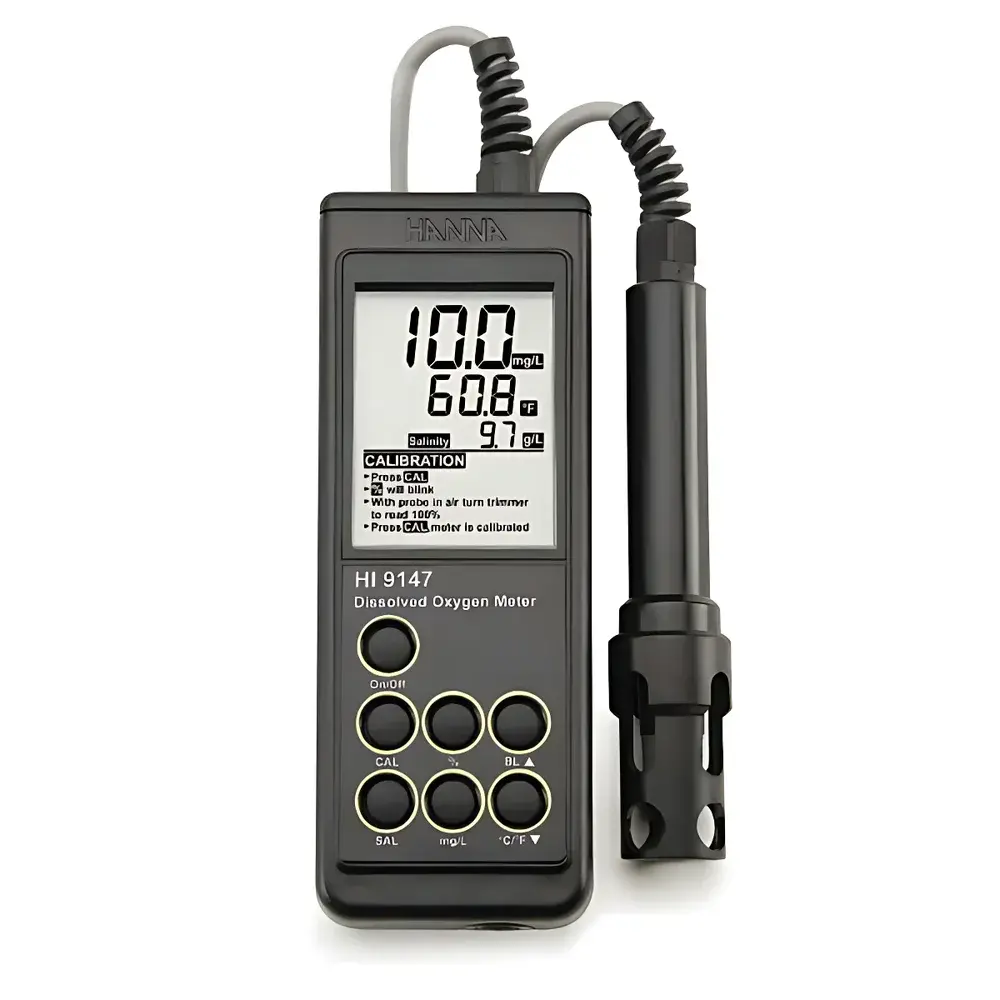
Hanna HI9147 Portable Dissolved Oxygen Meter for Aquaculture
| Brand | Hanna |
|---|---|
| Origin | Italy |
| Model | HI9147 |
| Instrument Type | Portable |
| Measurement Principle | Galvanic Cell Electrochemical Probe |
| DO Range | 0.0 to 50.0 mg/L (ppm) |
| Saturation | 0 to 600% |
| Accuracy | ±1% of reading |
| Resolution | 0.1 mg/L (DO), 1% (saturation) |
| Temperature Range | 0.0 to 50.0 °C |
| Temp. Accuracy | ±0.2 °C |
| Altitude Compensation | 0 to 4000 m |
| Salinity Compensation | 0 to 51 g/L |
| Electrode | HI76409 galvanic DO probe with integrated temperature sensor, 4/10/15 m cable options |
| Power | 3 × 1.5 V AAA batteries |
| IP Rating | IP67 |
| Dimensions | 185 × 72 × 36 mm |
| Weight | 450 g |
Overview
The Hanna HI9147 is a field-deployable dissolved oxygen (DO) meter engineered specifically for aquaculture operations, hatcheries, pond management, and environmental water quality monitoring. It employs a galvanic cell electrochemical sensing principle—distinct from polarographic systems—which eliminates the need for electrode polarization time prior to measurement. This design enables immediate, stable readings upon immersion, significantly improving workflow efficiency during high-frequency sampling across multiple ponds or raceways. The instrument measures DO concentration in both mass-based units (mg/L or ppm O₂) and relative saturation (%), with automatic compensation for temperature (0.0–50.0 °C), atmospheric pressure (via altitude input: 0–4000 m), and salinity (0–51 g/L). Its robust, IP67-rated housing ensures reliable operation in humid, splash-prone, or outdoor environments typical of fish farms and coastal monitoring sites.
Key Features
- Galvanic DO sensor (HI76409 probe) with built-in thermistor for simultaneous temperature measurement—no warm-up delay required.
- Intuitive LCD interface with contextual on-screen guidance, battery status indicator, and real-time unit selection (mg/L or % saturation).
- One-point, air-saturated calibration at ambient conditions—fully automated and traceable to standard atmospheric O₂ partial pressure (20.9% at sea level).
- Integrated environmental compensation algorithms compliant with ISO 5814:2012 (water quality — determination of dissolved oxygen — electrochemical probe method).
- Dedicated protective sleeve for the DO membrane minimizes mechanical damage during handling and transport in rugged field settings.
- Modular probe configuration with optional 4 m, 10 m, or 15 m cable lengths—optimized for shallow ponds, deep tanks, or offshore cage monitoring.
- Low-power electronics enabling >200 hours of continuous operation on three AAA alkaline cells.
Sample Compatibility & Compliance
The HI9147 is validated for use in freshwater, brackish water, and seawater matrices within aquaculture systems—including recirculating aquaculture systems (RAS), flow-through raceways, and static nursery ponds. It meets functional requirements outlined in ASTM D888-22 (Standard Test Methods for Dissolved Oxygen in Water) and supports GLP-aligned data integrity through manual calibration logging and environmental parameter tagging. While not a 21 CFR Part 11-compliant system (as it lacks electronic signature and audit trail functionality), its calibration and measurement protocols align with routine QC practices recommended by FAO Technical Paper No. 588 (Water Quality Guidelines for Freshwater Aquaculture). The HI76409 probe conforms to CE marking directives for electromagnetic compatibility (2014/30/EU) and low-voltage safety (2014/35/EU).
Software & Data Management
The HI9147 operates as a standalone field instrument without proprietary software dependency. All measurements are displayed in real time; no internal data storage or USB/Bluetooth connectivity is provided. Users record results manually or integrate readings into external LIMS or spreadsheet-based QA logs. Calibration events—including date, ambient pressure estimate (via altitude entry), and salinity setting—are retained only as operator-noted metadata. For laboratories requiring digital traceability, Hanna recommends pairing the HI9147 with the HI9828 multiparameter platform or exporting field data via third-party logging tools compatible with RS232 serial output (available on select configurations with optional interface module).
Applications
- Real-time DO profiling across aquaculture production units to prevent hypoxic stress in finfish (e.g., tilapia, salmonids) and crustaceans (e.g., shrimp).
- Verification of aeration system performance and oxygen transfer efficiency (OTE) in RAS biofilters and degassing columns.
- Pre-release water quality screening for juvenile stock transferred between hatchery tanks and grow-out ponds.
- Regulatory compliance monitoring under national aquaculture licensing frameworks requiring periodic DO reporting (e.g., EU Directive 2006/88/EC).
- Field validation of laboratory-based DO measurements obtained via Winkler titration or optical sensors.
- Baseline establishment for DO diurnal cycling studies in eutrophic or algal-bloom-prone water bodies.
FAQ
Does the HI9147 require electrode polarization before use?
No. The galvanic HI76409 probe generates its own potential and delivers stable readings immediately upon immersion—no warm-up or polarization time is necessary.
Can the HI76409 electrode be replaced by the user?
Replacement of the HI76409 probe must be performed by authorized Hanna service personnel or certified technicians to maintain measurement integrity and calibration traceability.
Is temperature compensation automatic during measurement?
Yes. The integrated thermistor provides continuous temperature input, and the instrument applies Nernst-based correction across the full 0.0–50.0 °C range per ISO 5814.
What altitude range does the instrument support for barometric compensation?
Altitude compensation is configurable from 0 to 4000 meters in 100-meter increments, allowing accurate DO calculation at high-elevation trout farms or Andean aquaculture facilities.
How often should the HI76409 membrane be replaced?
Hanna recommends membrane replacement every 6–12 months depending on usage frequency and exposure to organic fouling agents—refer to HI76409 maintenance guide PN HI76409-MAN for protocol details.







