
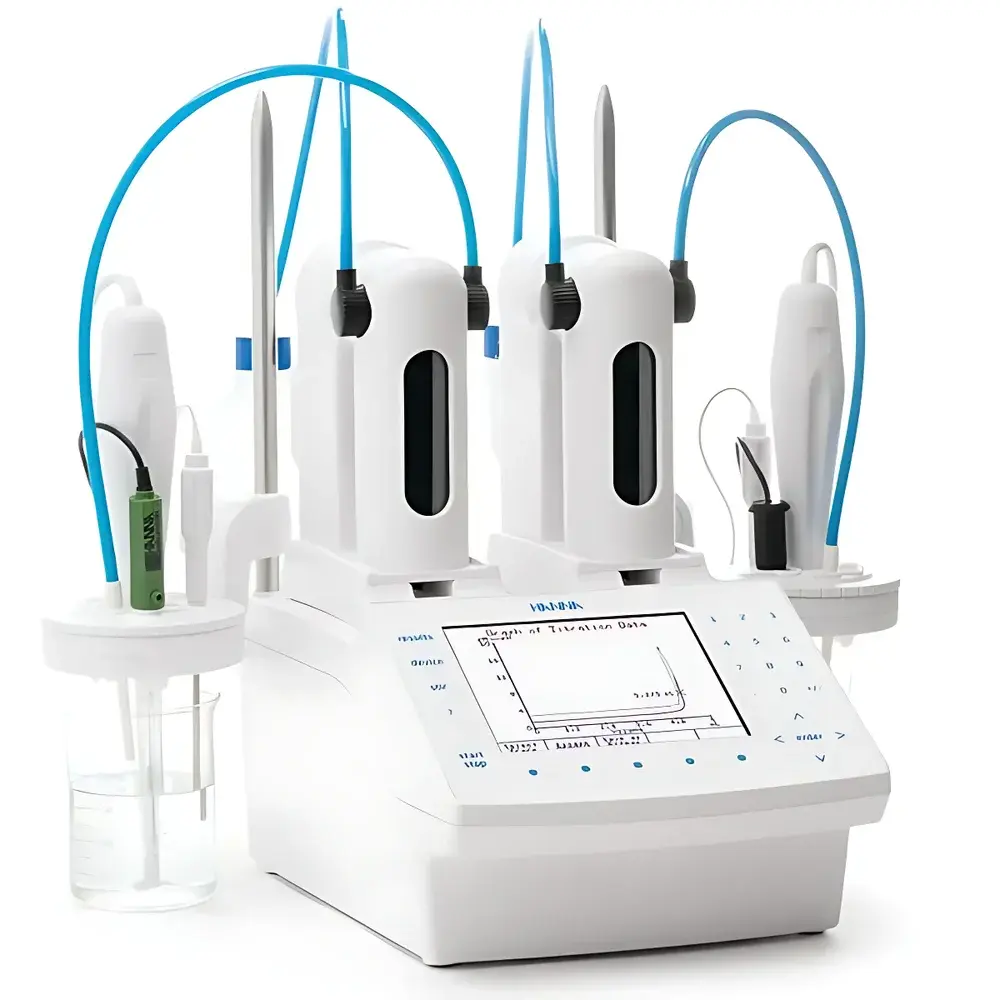
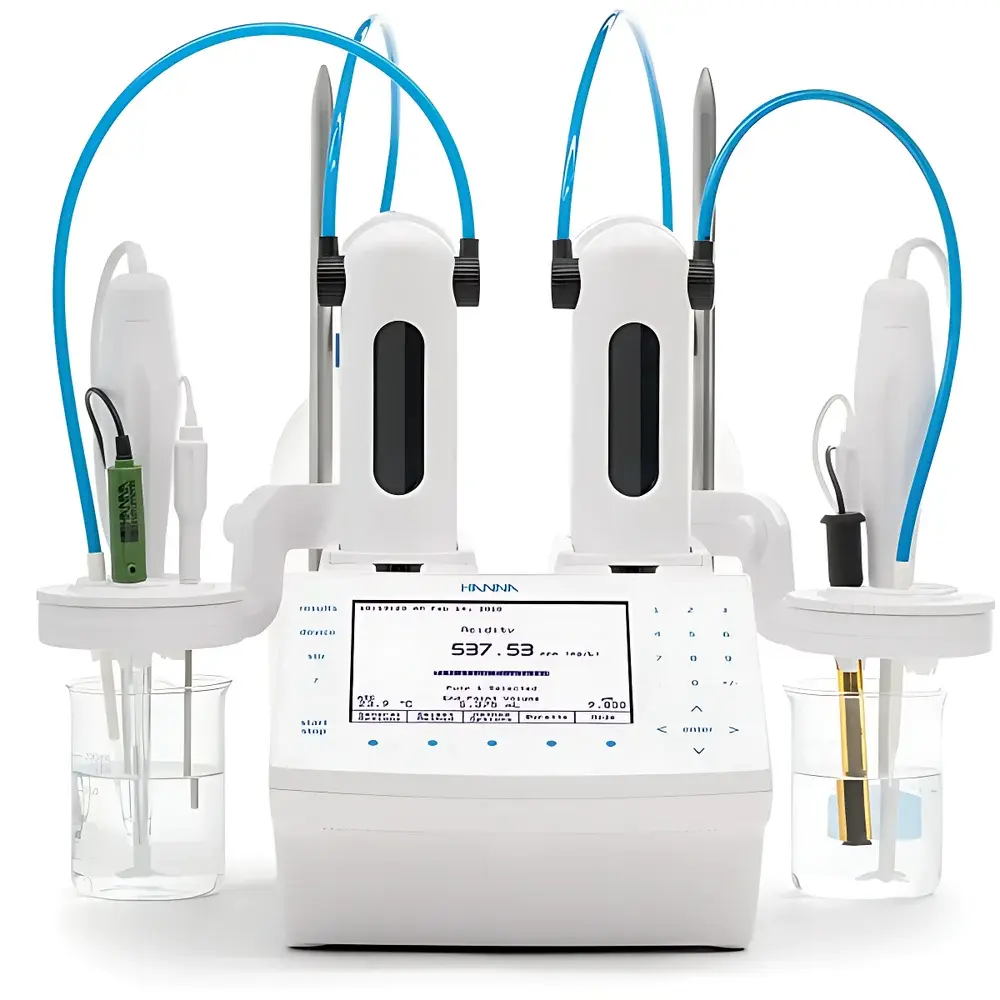
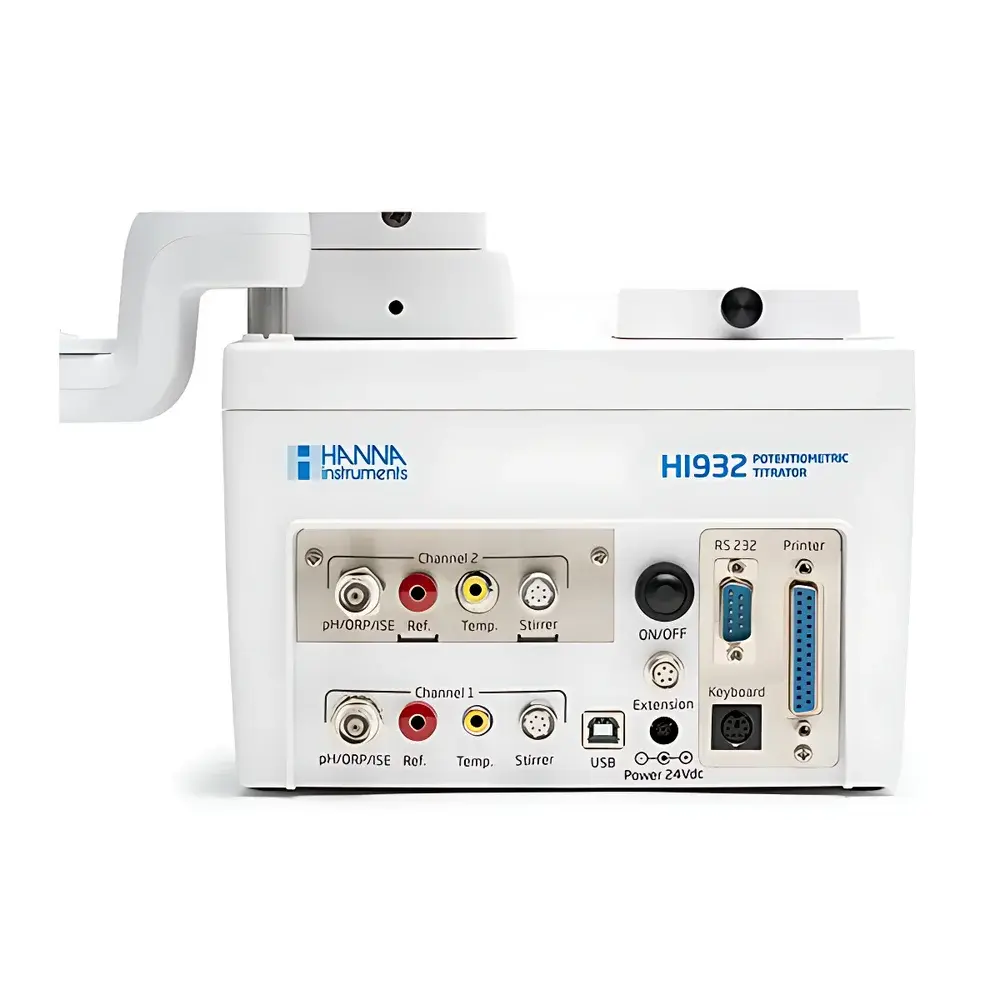
Hanna HI932 Advanced Automatic Potentiometric Titrator
| Brand | Hanna Instruments |
|---|---|
| Model | HI932 |
| Instrument Type | Universal Potentiometric Titrator |
| pH Range | –2.000 to 20.000 (selectable resolution: 0.001 / 0.01 / 0.1 pH) |
| mV Range | –2000.0 to 2000.0 mV |
| mV Resolution | 0.1 mV |
| mV Accuracy | ±0.1 mV (@25°C) |
| ISE Range | 1×10⁻⁶ to 9.99×10¹⁰ |
| ISE Accuracy | ±0.5% (monovalent), ±1% (divalent) |
| Temperature Range | –5.0 to 105.0 °C |
| Temperature Accuracy | ±0.1 °C (@25°C, excluding probe error) |
| Burette Resolution | 1/40000 |
| Dispensing Accuracy | ±0.1% of full burette volume |
| Display | 5.7″ color LCD (320 × 240 px) |
| GLP Compliance | Full audit trail, timestamped method & result storage, user access control |
Overview
The Hanna HI932 Advanced Automatic Potentiometric Titrator is a high-precision, modular benchtop instrument engineered for reproducible endpoint detection in potentiometric titration across diverse chemical and pharmaceutical laboratories. It operates on the fundamental principle of measuring potential difference (mV) between a reference electrode and an indicator electrode as titrant is incrementally added—enabling quantitative determination of analyte concentration via stoichiometric reaction kinetics. Designed for compliance with ISO 8655 (volumetric equipment), ASTM E2087 (standard practice for potentiometric titration), and USP <541> (titrimetry), the HI932 delivers traceable, GLP-ready data without compromising analytical flexibility. Its dual-channel architecture supports simultaneous pH/mV/ISE measurement and titration control, making it suitable for regulated environments requiring 21 CFR Part 11–compliant electronic records when paired with validated software protocols.
Key Features
- Triple-resolution pH measurement (0.001 / 0.01 / 0.1 pH) with five-point calibration capability using eight factory-defined and five user-defined buffer sets
- Dual independent burette control (two 25 mL burettes standard; optional 5, 10, or 50 mL configurations) with 1/40,000-step motorized precision and ±0.1% volumetric accuracy across full range
- Integrated 5.7″ color TFT display (320 × 240 px) with intuitive icon-driven interface, multilingual support (EN/DE/FR/ES/IT), and real-time titration curve visualization
- Rugged Cycloaliphatic polycarbonate (Cycoloy®) housing rated IP54 for chemical splash resistance and long-term durability in QC/QA labs handling aggressive reagents
- GLP-compliant data management: automatic timestamping, operator ID logging, method version tracking, and encrypted CSV export via USB or RS232
- Seamless interoperability with Hanna HI922 robotic autosampler for unattended batch processing of up to 18 samples—reducing manual intervention and inter-operator variability
Sample Compatibility & Compliance
The HI932 accommodates a broad spectrum of sample matrices including aqueous solutions, non-aqueous solvents (e.g., glacial acetic acid for perchloric acid titrations), suspensions, and viscous formulations common in API purity testing, food acidity profiling, and wastewater alkalinity assessment. It supports all major titration modes: acid-base (including weak acid/weak base), redox (e.g., Ce⁴⁺/Fe²⁺, I₂/ascorbic acid), precipitation (Ag⁺/Cl⁻), complexometric (EDTA/Mg²⁺), and non-aqueous (Karl Fischer coulometric adaptation via optional module). All measurements adhere to ISO/IEC 17025 documentation requirements, with built-in calibration verification routines, electrode diagnostics (impedance monitoring), and drift compensation algorithms. The system meets CE marking directives (2014/30/EU EMC, 2014/35/EU LVD) and RoHS 3 compliance.
Software & Data Management
Data integrity is enforced through embedded firmware supporting ALCOA+ principles (Attributable, Legible, Contemporaneous, Original, Accurate, Complete, Consistent, Enduring, Available). Each titration record stores raw mV/pH vs. volume data points, derivative curves (dE/dV), equivalence point algorithms (1st/2nd derivative, Gran plot, inflection), and user-annotated metadata. Up to 100 methods—including preloaded pharmacopeial templates (USP, EP, JP)—can be stored onboard. When connected to Hanna’s HI932 PC Software (Windows-based), users configure advanced reporting (PDF/Excel), perform statistical analysis (RSD, recovery %), and generate audit-ready reports compliant with FDA 21 CFR Part 11 when combined with digital signature modules and role-based access controls.
Applications
- Pharmaceutical QC: Assay of active ingredients (e.g., aspirin hydrolysis, amine salt quantification), residual chloride testing per ICH Q5C
- Food & Beverage: Total acidity (TA) in wines and juices, salt content in dairy products, preservative (sorbate/benzoate) titration
- Environmental Labs: Alkalinity and hardness in surface water per APHA 2320B, cyanide determination by pyridine-barbituric acid method
- Chemical Manufacturing: Saponification value of fats/oils (AOCS Cd 3d-63), free fatty acid titration, catalyst residue analysis
- Academic Research: Kinetic studies of slow-reacting systems, multi-step titrations (e.g., carbonate/bicarbonate mixtures), thermometric endpoint validation
FAQ
Does the HI932 support back-titration workflows?
Yes—the instrument includes dedicated back-titration mode with programmable excess reagent addition, waiting intervals, and secondary titrant delivery, fully documented in the GLP log.
Can I use non-Hanna electrodes with the HI932?
All standard BNC- or DIN-compatible pH, redox, and ISE electrodes may be used; however, Hanna-certified probes (e.g., HI1131B, HI3001D) ensure optimal signal stability and automatic recognition.
Is temperature compensation automatic during titration?
Yes—integrated Pt1000 sensor enables real-time temperature correction for electrode slope and activity coefficients, configurable per method.
What is the maximum number of titrations possible per day with the HI922 autosampler?
With optimized method parameters and 25 mL burettes, throughput exceeds 60 determinations in an 8-hour shift under routine QC conditions.
How is data security maintained during networked operation?
Local data remains isolated unless explicitly exported; no cloud connectivity is enabled by default. Network-enabled configurations require TLS 1.2 encryption and IEEE 802.1X authentication per institutional IT policy.
Related Products





