
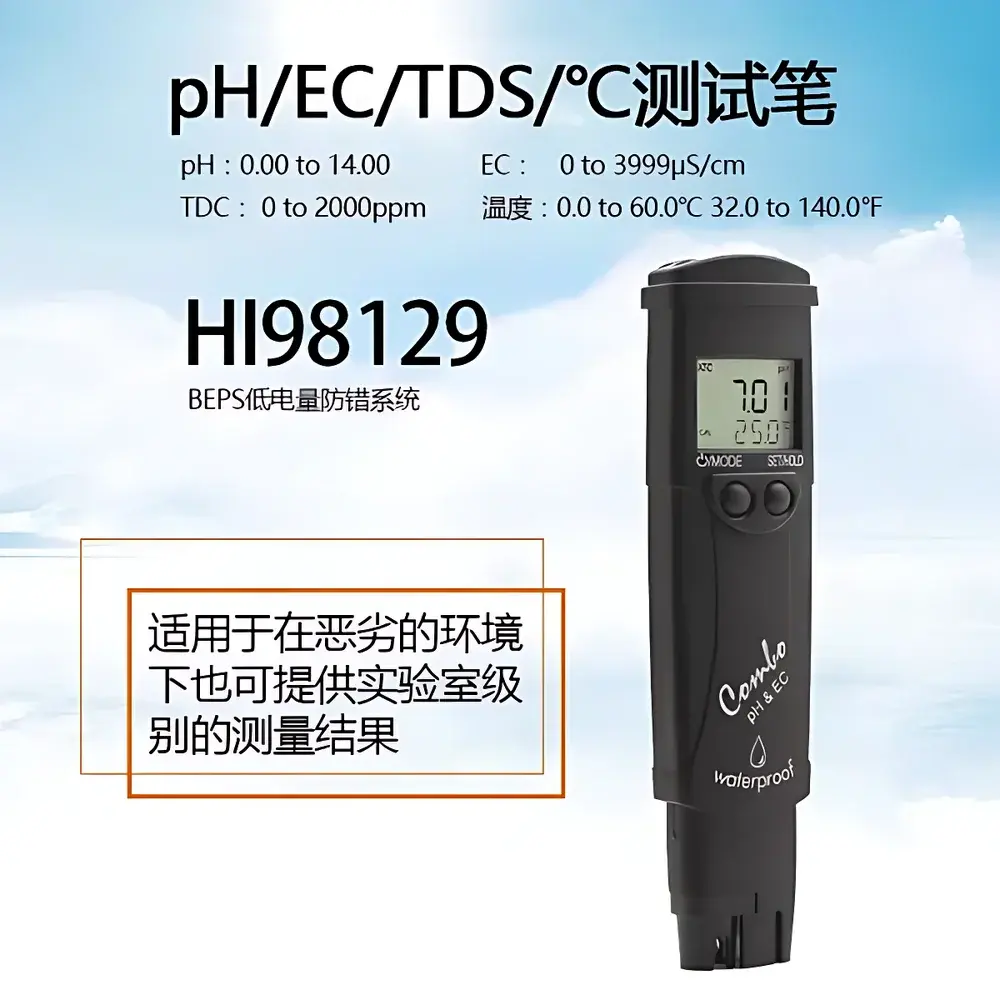
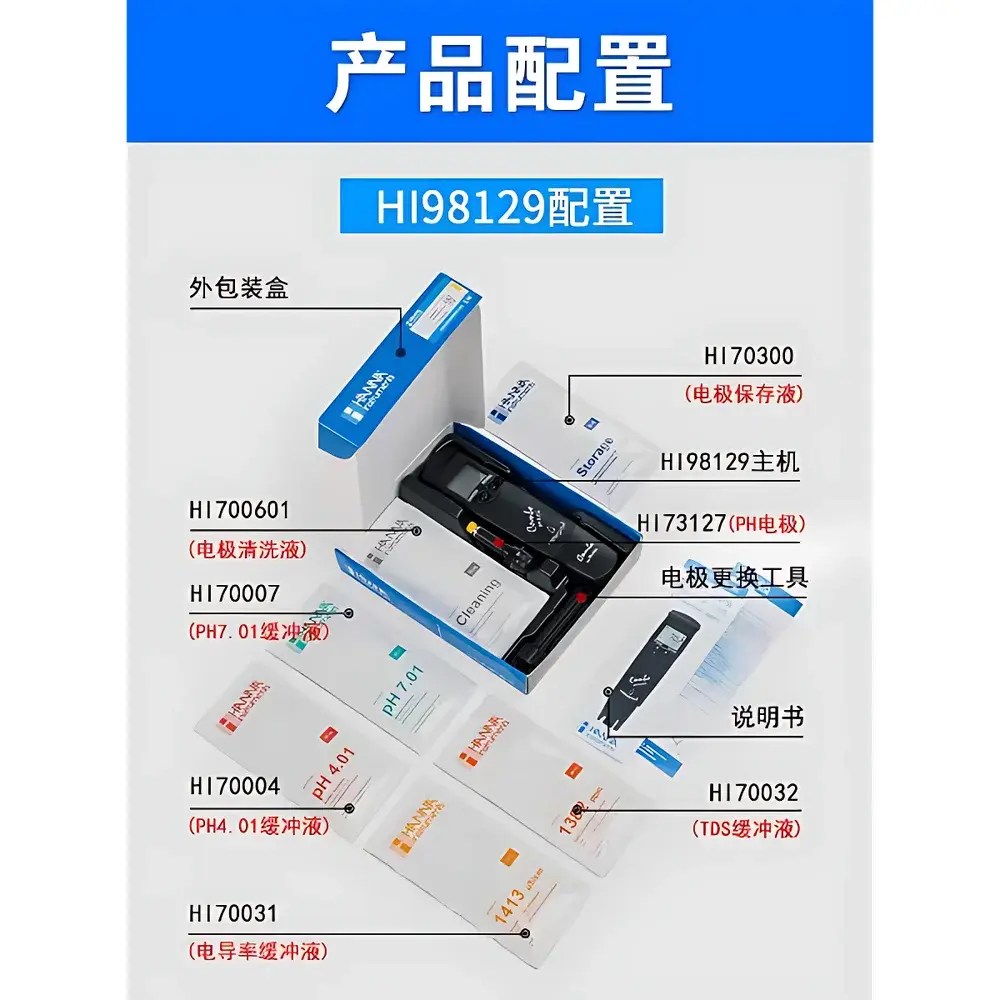
Hanna HI98130 & HI98129 Portable Multiparameter pH/EC/TDS/Temperature Pen Tester
| Brand | Hanna Instruments |
|---|---|
| Origin | Italy |
| Model | HI98130 / HI98129 |
| Instrument Type | Pen-style |
| Parameters Measured | pH, Electrical Conductivity (EC), Total Dissolved Solids (TDS), Temperature |
| pH Range | 0.00–14.00 |
| pH Resolution | 0.01 |
| pH Accuracy | ±0.05 |
| EC Range (HI98130) | 0.00–19.99 mS/cm |
| TDS Range (HI98130) | 0.0–19.99 g/L (ppm) |
| Temperature Range | 0.0–50.0 °C |
| Temperature Resolution | 0.1 °C |
| Temperature Accuracy | ±0.5 °C |
| Calibration | Auto-buffer recognition for pH (pH 4.01, 7.01, 10.01) |
| Power | 4 × AAA batteries (included) |
| IP Rating | IP67 dust- and water-resistant |
| Operating Environment | 0–50 °C, <95% RH non-condensing |
| Dimensions | 163 × 28 mm |
| Weight | 95 g |
Overview
The Hanna Instruments HI98130 and HI98129 are compact, field-deployable pen-style multiparameter testers engineered for rapid, reliable in-situ measurement of pH, electrical conductivity (EC), total dissolved solids (TDS), and temperature in aqueous solutions. Designed around a robust electrochemical sensor architecture, these instruments employ a combination of glass pH electrode technology, graphite conductivity cell, and precision NTC thermistor to deliver simultaneous, real-time readings with laboratory-grade traceability in portable form. The HI98130 features extended-range EC/TDS capability (up to 19.99 mS/cm and 19.99 g/L), while the HI98129 is optimized for general-purpose use with a narrower EC range (0.0–9.99 mS/cm) — both models share identical pH and temperature performance specifications. Their sealed, IP67-rated housing ensures operational integrity in humid, splash-prone, or outdoor environments common in environmental monitoring, aquaculture, hydroponics, and municipal water quality verification.
Key Features
- Integrated tri-sensor probe: pH-sensitive glass membrane, dual-graphite EC cell, and embedded NTC temperature sensor — all housed within a single, replaceable, field-serviceable probe assembly.
- Auto-buffer recognition during pH calibration: automatically detects and assigns calibration points at pH 4.01, 7.01, and 10.01 without manual input, reducing operator error and improving inter-user reproducibility.
- Temperature compensation: automatic (ATC) and manual (MTC) modes supported; EC and TDS values are compensated to 25 °C using built-in algorithms compliant with ISO 7888 and ASTM D1125 standards.
- One-button operation with intuitive LED status indicators: dedicated function keys for mode selection, calibration initiation, and data hold — no menu navigation required.
- Battery life optimization: intelligent power management delivers up to 200 hours of continuous operation on four standard AAA alkaline cells; low-battery indicator alerts prior to critical depletion.
- Calibration validation log: stores last calibration date, buffer IDs used, and slope/mV offset values — supports internal QA documentation and GLP-aligned recordkeeping.
Sample Compatibility & Compliance
These pens are validated for use with freshwater, wastewater effluents, nutrient solutions, swimming pool and spa water, drinking water sources, and low-ionic-strength surface waters. They are not intended for use in highly viscous, suspended-solid-laden, or strongly oxidizing media (e.g., concentrated chlorine solutions >5 ppm free Cl₂). All sensors comply with CE marking requirements under the EU Electromagnetic Compatibility Directive 2014/30/EU and Low Voltage Directive 2014/35/EU. While not certified to IEC 61000-4-x immunity levels for industrial EMI environments, their design meets typical field instrumentation EMC profiles per EN 61326-1:2013. Data output conforms to NIST-traceable metrology principles; calibration certificates (optional) reference NIST SRM 186, 188, and 191a buffers.
Software & Data Management
The HI98130 and HI98129 operate as standalone instruments with no onboard memory or digital interface — consistent with their purpose as rapid-check field tools. However, they support manual transcription into LIMS or electronic lab notebooks (ELN) via standardized reporting templates. For organizations requiring audit trails, the devices’ calibration history (date, buffer ID, slope %, offset mV) can be recorded in paper-based or digital QA logs aligned with ISO/IEC 17025 Clause 7.7 and FDA 21 CFR Part 11 Annex 11 expectations for non-electronic records. Optional Hanna HI76404A replacement probes include serialized calibration reports traceable to national metrology institutes.
Applications
- Environmental field surveys: rapid profiling of stream, lake, and groundwater pH and conductivity gradients during site assessments.
- Aquaculture management: daily monitoring of pond and recirculating aquaculture system (RAS) water to maintain optimal pH (6.5–8.5) and osmotic balance via EC/TDS trends.
- Hydroponic and aeroponic nutrient control: verification of reservoir pH stability and EC drift before and after dosing cycles.
- Drinking water distribution verification: spot-checks at entry points, storage tanks, and consumer taps per WHO Guidelines for Drinking-water Quality (4th ed.) and EPA Method 150.1.
- Educational laboratories: student-level experiments in general chemistry and environmental science where portability, safety, and ease of use are prioritized over high-resolution benchtop analysis.
FAQ
Can the HI98130 be used for seawater measurements?
Not recommended. Seawater’s high salinity (~50 mS/cm) exceeds the instrument’s EC range and may cause premature fouling of the graphite cell. Use HI98330 or HI98304 for marine applications.
Is probe replacement required after calibration?
No — the integrated probe is designed for recalibration and reuse. Replace only when slope falls below 85% or response time exceeds 15 seconds in buffer solution.
Does the device meet GLP requirements?
It supports GLP practices through documented calibration, defined operating ranges, and user-recorded traceability — though it lacks electronic audit trail functionality by design.
What is the recommended storage method for the probe?
Store immersed in HI70300 pH storage solution or 3 M KCl; never allow the glass bulb or junction to dry out.
Can TDS be converted to NaCl equivalence?
Yes — the HI98130 applies a fixed 0.5 factor (TDS = 0.5 × EC) per ISO 7888; for non-NaCl matrices, users must apply matrix-specific conversion factors manually.




