
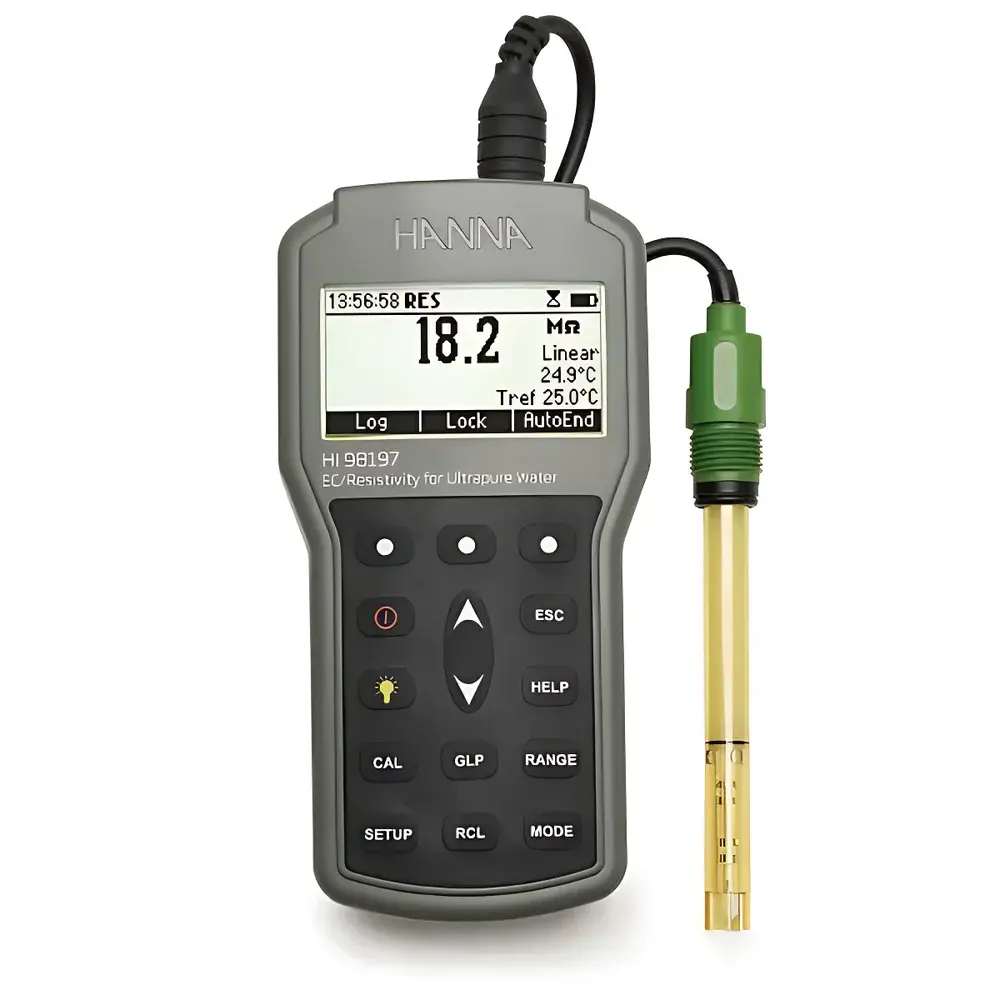
Hanna HI98197 Portable Multiparameter Conductivity Meter with EC, TDS, Resistivity, NaCl, and Temperature Measurement
| Brand | Hanna Instruments |
|---|---|
| Origin | Italy |
| Model | HI98197 |
| Portability | Handheld |
| Application | Laboratory & Field Use |
| Conductivity (EC) | 0.001 to 999.9 µS/cm |
| TDS | 0.00 to 999.9 mg/L (ppm) |
| Resistivity | 1.0 to 100.0 MΩ·cm |
| Temperature | −20.0 to 120.0 °C |
| Accuracy (EC) | ±1% of reading or ±0.01 µS/cm (whichever is greater) |
Overview
The Hanna HI98197 is a high-precision, handheld multiparameter conductivity meter engineered for rigorous electrochemical analysis in regulated laboratory, pharmaceutical, environmental, and industrial settings. It operates on the principle of four-electrode (tetrapolar) conductometric measurement—eliminating polarization effects and electrode fouling—to deliver stable, reproducible readings across an exceptionally wide dynamic range. Unlike two-electrode systems, the HI98197’s integrated HI763123 sensor employs dual current and dual potential platinum rings, enabling accurate measurement from ultrapure water (0.001 µS/cm) to highly concentrated brines (1000 mS/cm), while maintaining compliance with USP <645> for pharmaceutical water quality testing. Its temperature-compensated conductivity algorithm supports both linear (−20.0 to 120.0 °C) and non-linear (0 to 36 °C per ISO/DIN 7888) compensation modes, with selectable reference temperatures (15 °C, 20 °C, 25 °C) and adjustable temperature coefficients (0.00–10.00 %/°C). The instrument simultaneously computes and displays conductivity (EC), total dissolved solids (TDS), resistivity, salinity (as PSU, ppt, or % NaCl), and temperature—each derived from the same primary conductance measurement—ensuring internal consistency and traceable metrology.
Key Features
- Four-ring platinum sensor (HI763123) with integrated Pt1000 temperature probe for simultaneous, drift-free EC/T/compensation
- Automatic range selection and resolution switching: 0.001 µS/cm at low ranges up to 0.1 mS/cm at high ranges
- USP <645> compliance mode with three-stage conductivity verification protocol for Purified Water and Water for Injection (WFI)
- GLP-compliant data logging: stores calibration history (date/time, standards used), measurement metadata, and operator ID (via optional software)
- IP67-rated rugged housing with backlit graphical LCD, intuitive icon-driven interface, and multilingual on-screen prompts (English, Spanish, French, German, Italian, Chinese)
- Auto-endpoint detection with visual and audible confirmation, eliminating subjective endpoint judgment
- Configurable auto-power-off (5–60 min or disabled) and battery status indicator for extended field operation (4 × AA alkaline, ~200 hours typical life)
Sample Compatibility & Compliance
The HI98197 is validated for aqueous samples ranging from deionized water (≥10 MΩ·cm resistivity) to saturated NaCl solutions (≥400 g/L). Its stainless-steel flow cell design minimizes CO₂ absorption and thermal convection artifacts during open-vessel measurements. The instrument meets critical regulatory requirements including USP <645>, ASTM D1125 (Standard Test Methods for Electrical Conductivity and Resistivity of Water), ISO 7888 (Water Quality — Determination of Electrical Conductivity), and EN 27888. For GxP environments, its GLP functionality supports full audit trails: each stored measurement includes timestamp, sensor serial number, calibration verification status, temperature, and user-defined sample ID. Data export via USB adheres to FDA 21 CFR Part 11 principles when paired with Hanna’s HI98197-specific PC software (HI92000), enabling electronic signatures, role-based access control, and secure data archiving.
Software & Data Management
The HI98197 interfaces with Hanna’s HI92000 Windows-based software via standard USB-B connection. This platform enables bidirectional configuration (e.g., TDS factor adjustment, temperature coefficient setting, salinity unit selection), batch export of logged data (CSV, TXT), and generation of compliant reports with embedded calibration certificates. All stored data—up to 400 manual entries and 10,000 interval logs (programmable from 5 sec to 180 min)—retain full context: measured parameter, unit, temperature, conductivity cell constant (0.010–10.000 cm⁻¹), and real-time trend graphs for up to 10 measurement sessions. The software enforces data integrity through checksum validation and prevents post-acquisition editing of raw values—essential for ISO/IEC 17025-accredited laboratories.
Applications
- Pharmaceutical QC: USP <645> verification of Purified Water, Water for Injection, and Sterile Water
- Environmental monitoring: Surface water, groundwater, wastewater effluent, and seawater salinity profiling (PSU/ppt/NaCl%)
- Food & beverage: Brine concentration control, syrup density estimation, and rinse water conductivity validation
- Power generation: Monitoring condensate purity and boiler feedwater resistivity
- Academic research: Electrolyte characterization, membrane performance evaluation, and corrosion inhibitor efficacy studies
- Calibration labs: Transfer standard verification against NIST-traceable reference solutions (e.g., KCl standards at 25 °C)
FAQ
Does the HI98197 meet USP <645> requirements for pharmaceutical water testing?
Yes. It implements the full three-step conductivity test protocol—including uncorrected conductivity measurement, pH-adjusted conductivity assessment, and TOC correlation—and automatically flags noncompliance per USP monograph criteria.
Can the HI98197 be used for ultrapure water resistivity measurement?
Yes. With its 100.0 MΩ·cm upper range and low-noise four-electrode architecture, it achieves reliable resistivity readings down to 1.0 MΩ·cm, suitable for monitoring Type I and Type II laboratory water systems.
Is sensor calibration traceable to international standards?
All factory calibrations use NIST-traceable KCl reference solutions (e.g., 84.0 µS/cm, 1413 µS/cm, 12.88 mS/cm), and users may perform multi-point calibrations with certified standards; calibration records are permanently stored with timestamps and solution lot numbers.
How does temperature compensation work for non-aqueous or high-ionic-strength samples?
The instrument defaults to ISO/DIN 7888 nonlinear compensation for natural waters but allows manual entry of custom temperature coefficients (0.00–10.00 %/°C) for process-specific electrolytes, ensuring accuracy beyond standard aqueous models.
What data security features support 21 CFR Part 11 compliance?
When used with HI92000 software, the system supports electronic signatures, audit trail review, and permission-level controls—though standalone instrument operation does not require Part 11 enforcement unless integrated into a validated IT infrastructure.





