
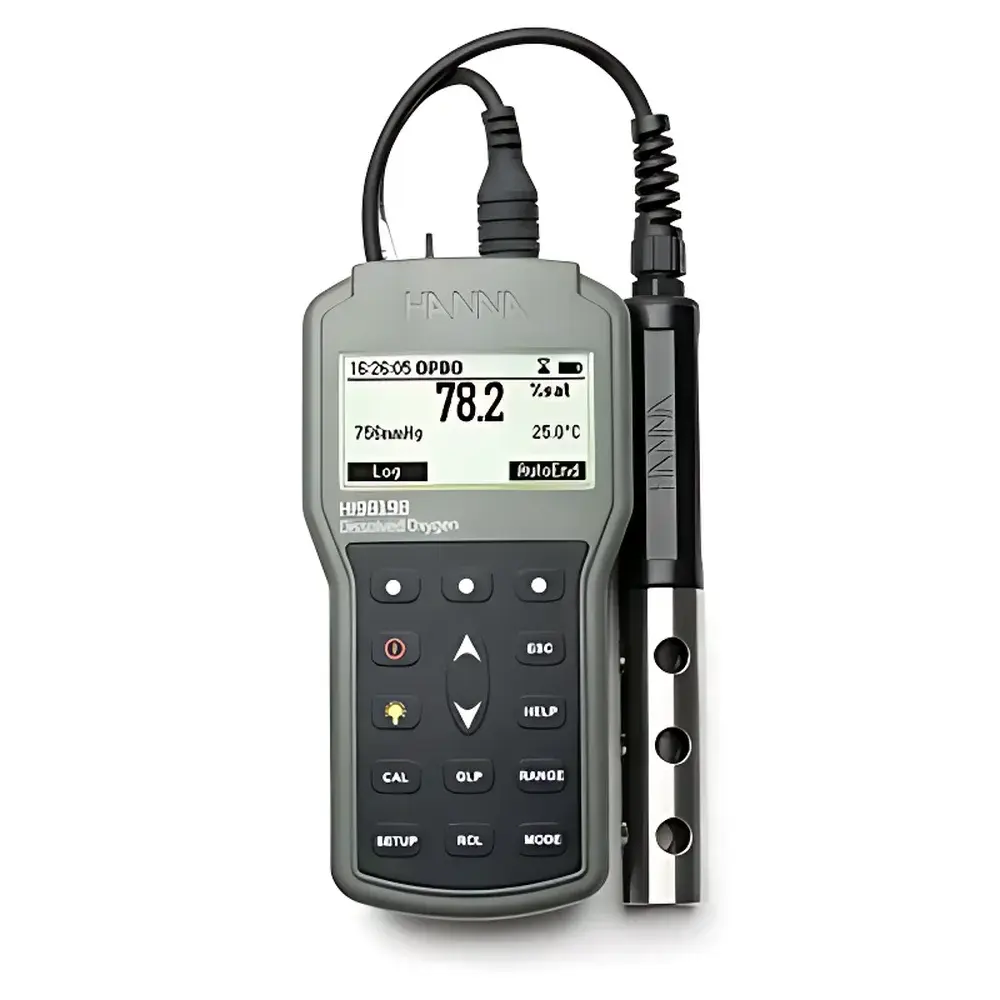
Hanna HI98198 Portable Optical Dissolved Oxygen (DO) and Saturation DO Meter
| Brand | Hanna Instruments |
|---|---|
| Origin | Italy |
| Model | HI98198 |
| Instrument Type | Portable |
| Parameter Type | Single-Parameter |
| DO Range | 0.00 to 50.00 mg/L (ppm) |
| Saturation DO Range | 0.0 to 500.0 % |
| Resolution | 0.01 mg/L (ppm) for DO |
| Accuracy | ±0.01 mg/L (ppm) or ±1.5% of reading (0.00–20.00 mg/L) |
| Saturation Accuracy | ±0.1% or ±1.5% of reading (0.0–200.0%) |
| Pressure Range | 420–850 mmHg |
| Temperature Range | –5.0 to 50.0 °C |
| Temperature Accuracy | ±0.3 °C |
| IP Rating | IP67 (meter), IP68 (HI764113 probe) |
| Data Storage | 4000 readings |
| Interface | USB-C (with optional HI920016 cable) |
| Power | 4 × 1.5 V AAA batteries |
| Dimensions | 185 × 93 × 35.2 mm |
| Weight | 450 g |
Overview
The Hanna HI98198 is a high-performance portable optical dissolved oxygen (DO) and saturation DO meter engineered for field-deployable, laboratory-grade accuracy in environmental monitoring, wastewater treatment, aquaculture, and industrial process control. Unlike traditional electrochemical Clark-type sensors, the HI98198 employs optical fluorescence quenching (OPDP—Optical Polarized Dynamic Phosphorescence) technology. This method relies on the principle that molecular oxygen quenches the phosphorescence lifetime of a luminescent ruthenium-based dye immobilized on a replaceable sensor cap. The instrument precisely measures the phase shift or decay time of emitted light—parameters directly correlated to dissolved oxygen concentration—eliminating dependence on sample flow rate, membrane permeability, electrolyte depletion, or electrode polarization. As a result, the HI98198 delivers rapid stabilization (<15 seconds), minimal drift over extended measurement periods, and consistent performance in low-flow, viscous, or particulate-laden samples where membrane-based probes fail.
Key Features
- Optical fluorescence (OPDP) sensing eliminates membrane replacement, electrolyte refills, and polarization delays—reducing maintenance and operational downtime.
- Integrated calculation modules for BOD (Biochemical Oxygen Demand), OUR (Oxygen Uptake Rate), and SOUR (Specific Oxygen Uptake Rate) per standardized protocols (e.g., ASTM D888, ISO 5814), with automatic temperature, salinity, and barometric pressure compensation applied in real time.
- Rugged dual-rated housing: IP67-rated main unit withstands immersion up to 1 m for 30 minutes and full dust ingress protection; HI764113 probe meets IP68 certification for continuous submersion at depths up to 20 meters (29 PSI).
- Large backlit LCD display with intuitive icon-driven interface ensures legibility under direct sunlight or low-light field conditions.
- AutoEnd function automatically locks stable readings upon signal convergence, minimizing user interpretation error during manual sampling.
- Smart sensor recognition: instrument auto-detects installation or replacement of the HI764113 probe and initiates optical initialization—no manual setup required.
- Real-time diagnostic alerts notify users when the fluorescent sensing cap (HI764113-1) requires replacement due to photobleaching or physical damage.
Sample Compatibility & Compliance
The HI98198 is validated for use across freshwater, seawater (0–70 PSU salinity), wastewater effluents, activated sludge, fermentation broths, and surface runoff. Its optical design ensures immunity to sulfide, chlorine, hydrogen sulfide, and heavy metal interference—common failure modes for amperometric DO sensors. Calibration conforms to EPA Method 360.1 and ISO 5814:2012 for optical DO determination. Barometric pressure compensation (420–850 mmHg) and automatic temperature compensation (–5.0 to 50.0 °C) support regulatory-compliant reporting under variable ambient conditions. GLP-compliant data logging includes timestamp, calibration history (date/time, reference values, pressure, temperature, salinity), operator ID (via optional key), and sensor status—fully traceable for audits under ISO/IEC 17025, USP , and FDA 21 CFR Part 11–enabled workflows when paired with validated data management software.
Software & Data Management
The HI98198 stores up to 4000 measurement records with full metadata—including DO concentration, saturation %, temperature, pressure, salinity, and calculated BOD/OUR/SOUR values. Data export is performed via USB-C interface using the optional HI920016 A-to-C cable; no proprietary drivers or applications are required. Exported files are native CSV format, compatible with Excel, LIMS platforms, and statistical analysis tools (e.g., JMP, Minitab). All stored entries include embedded GLP headers, enabling seamless integration into QA/QC documentation systems. Battery life exceeds 200 hours under typical field use (auto-off configurable at 5, 10, 30, 60 min, or disabled), and low-battery indicators prevent data loss during critical sampling campaigns.
Applications
- Environmental field surveys: stream health assessment, lake stratification profiling, wetland restoration monitoring.
- Wastewater treatment plants: aeration basin optimization, return activated sludge (RAS) monitoring, nitrification/denitrification control.
- Aquaculture operations: pond DO mapping, hatchery water quality assurance, feed-response studies.
- Pharmaceutical bioreactors: dissolved oxygen trending during mammalian cell culture or microbial fermentation.
- Educational laboratories: hands-on instruction in aquatic chemistry, respiration kinetics, and sensor physics principles.
FAQ
Does the HI98198 require zero-point calibration in nitrogen-saturated solution?
No—zero calibration is performed using the included HI7040 zero-oxygen standard (sodium sulfite solution), eliminating the need for nitrogen gas cylinders or inert atmosphere chambers.
Can the HI764113 probe be used in pressurized pipelines or recirculating systems?
Yes—the IP68-rated probe and 4 m or 10 m cable options (HI764113 vs. HI764113/10) support insertion into pressurized manifolds, provided mechanical protection (e.g., HI764113-3 stainless steel guard) is installed and depth limits are observed.
Is salinity compensation mandatory for accurate DO reporting in estuarine environments?
Yes—salinity directly affects oxygen solubility; the HI98198 applies manual salinity input (0–70 PSU) to correct saturation calculations per the Garcia & Gordon (1992) equation, ensuring compliance with APHA Standard Methods 4500-O G.
How often should the fluorescent cap (HI764113-1) be replaced?
Under normal field use, replacement is recommended every 12 months or after 500 hours of active exposure to UV light and oxidants—diagnostic alerts will trigger prior to performance degradation.
Does the instrument support multi-point DO calibration?
No—optical fluorescence technology uses single-point (air-saturated water at known T/P/S) or two-point (zero + air-sat) calibration per ISO 5814; multi-point linear fitting is neither necessary nor supported due to inherent nonlinearity of the Stern–Volmer relationship.
Related Products




