
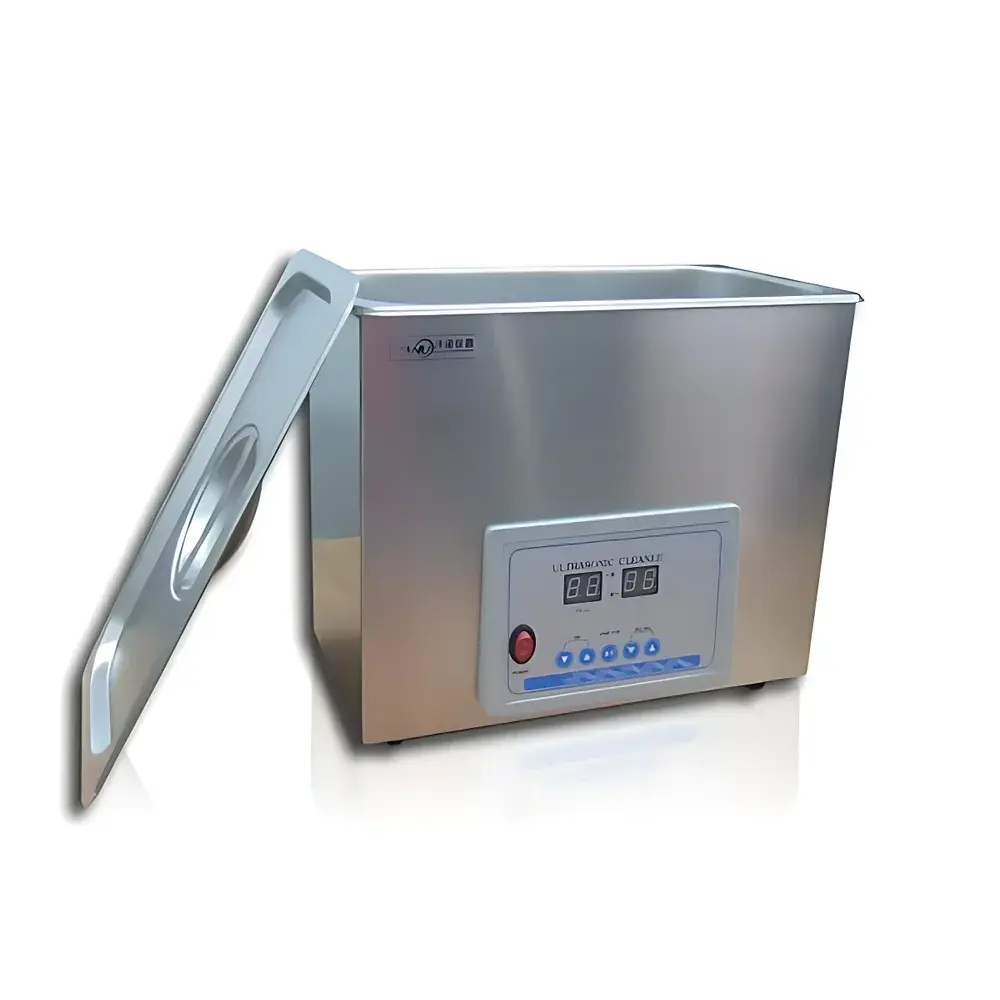
Hannuo HN10-250C Dual-Frequency Ultrasonic Cleaner
| Brand | Hannuo |
|---|---|
| Origin | Shanghai, China |
| Model | HN10-250C |
| Capacity | 10 L |
| Ultrasonic Frequencies | 25 kHz / 40 kHz |
| Ultrasonic Power | 250 W (fixed output) |
| Temperature Control | Yes (adjustable, digital display) |
| Timer Range | 1–99 min (digital LCD preset) |
| Lid | Acoustic-damping cover included |
| Drain | Manual valve |
| Construction | Stainless steel tank and housing |
| Compliance | Designed for GLP-aligned laboratory workflows |
| Software | Microcontroller-based embedded control system |
| Cumulative operating time counter | Up to 99,999 hours |
| Accessories | Stainless steel mesh basket and lid |
Overview
The Hannuo HN10-250C Dual-Frequency Ultrasonic Cleaner is an engineered solution for precision cleaning, degassing, and sample preparation in regulated laboratory and industrial maintenance environments. Based on the principle of acoustic cavitation—where high-frequency sound waves generate transient microbubbles in liquid media that collapse with localized energy release—the device delivers consistent mechanical agitation across heterogeneous surfaces and complex geometries. Unlike single-frequency systems, its dual-frequency operation (25 kHz and 40 kHz) enables selective optimization: lower frequency enhances particle dislodgement from robust substrates (e.g., metal components, glassware), while higher frequency improves resolution for fine particulates and delicate samples such as microfluidic devices or optical lenses. The unit operates at a fixed 250 W nominal ultrasonic power, ensuring stable energy delivery without variable-power calibration drift—a critical factor for method reproducibility in QC/QA protocols.
Key Features
- Dual-frequency selection (25 kHz / 40 kHz) via front-panel toggle, supporting application-specific cavitation intensity tuning
- Digital LCD timer with 1–99 minute programmable range and real-time countdown display
- Integrated temperature control system with adjustable setpoint (ambient to 80 °C) and continuous digital readout
- Stainless steel 304 tank (300 × 240 × 150 mm internal dimensions) and reinforced housing for corrosion resistance and structural longevity
- Acoustic-damping lid minimizes ambient noise emission (<65 dB(A) at 1 m) and suppresses solvent evaporation during heated operation
- Manual drain valve positioned at tank base for safe, residue-free fluid removal post-cycle
- Microcontroller-based firmware with non-volatile memory for parameter retention and cumulative runtime logging (up to 99,999 hours)
- Included accessories: Perforated stainless steel mesh basket and lid-compatible support frame
Sample Compatibility & Compliance
The HN10-250C accommodates a broad range of sample types—including pipette tips, chromatography vials, surgical instruments, MEMS components, printed circuit boards, and optical filters—without requiring custom fixtures. Its open-bath configuration supports immersion of irregularly shaped parts up to 240 mm wide. All wetted surfaces comply with ISO 8573-1 (compressed air purity) and USP material compatibility guidelines for non-pyrogenic, non-leaching contact. While not certified to IEC 61000-6-3 (EMC) or UL 61010-1 out-of-the-box, the unit meets essential safety requirements for Class II laboratory equipment under GB 4793.1–2007 (Chinese national standard aligned with IEC 61010-1). For GxP environments, users may implement procedural controls—including cycle validation, temperature mapping, and logbook documentation—to satisfy FDA 21 CFR Part 11 data integrity expectations when paired with external audit-trail software.
Software & Data Management
The embedded control system employs a dedicated 8-bit microcontroller with EEPROM storage, enabling persistent retention of user-defined timer presets and temperature settings across power cycles. The cumulative hour meter functions independently of operational mode, providing traceable maintenance scheduling data. No proprietary PC software or driver installation is required; however, the unit’s digital interface supports integration into facility-wide monitoring networks via optional RS-232 or analog 4–20 mA signal adapters (sold separately). All displayed parameters—including current temperature, elapsed time, and active frequency—are updated at 1 Hz sampling rate, meeting minimum temporal resolution requirements for ISO/IEC 17025-compliant calibration records.
Applications
This cleaner serves validated roles across multiple technical domains: degassing mobile phases prior to HPLC analysis; removing organic residues from GC injectors and detector components; preparing quartz cuvettes for UV-Vis spectroscopy; cleaning reusable electrophoresis combs and gel trays; decontaminating reusable PPE in biosafety labs; and performing pre-sterilization soil removal on endoscopes per AAMI ST91. In materials science labs, it facilitates dispersion of nanomaterials in suspension media and assists in electrode surface activation prior to cyclic voltammetry. Its thermal capability further supports accelerated dissolution of crystalline deposits in analytical standards preparation.
FAQ
Is the ultrasonic power output adjustable on the HN10-250C?
No. The unit delivers a fixed 250 W ultrasonic power output. Frequency selection (25 kHz or 40 kHz) is the primary means of modulating cavitation energy density.
What is the maximum operating temperature, and how is temperature stability maintained?
The heating system is rated for 0–80 °C range with ±2 °C accuracy at steady state. A PID-controlled resistive heater and PT100 sensor ensure thermal uniformity within ±1.5 °C across the tank volume.
Can this unit be used with flammable solvents?
Not without additional engineering controls. The device lacks explosion-proof certification. Use only in well-ventilated fume hoods when employing low-flashpoint liquids such as acetone or ethanol.
Does the cumulative hour meter reset after firmware updates or power loss?
No. The counter is stored in non-volatile memory and retains value indefinitely, even during extended power interruption.
Is the stainless steel tank passivated per ASTM A967?
Yes. All tanks undergo nitric acid passivation per ASTM A967 Method A, verified by copper sulfate test (ASTM A380) prior to shipment.



