
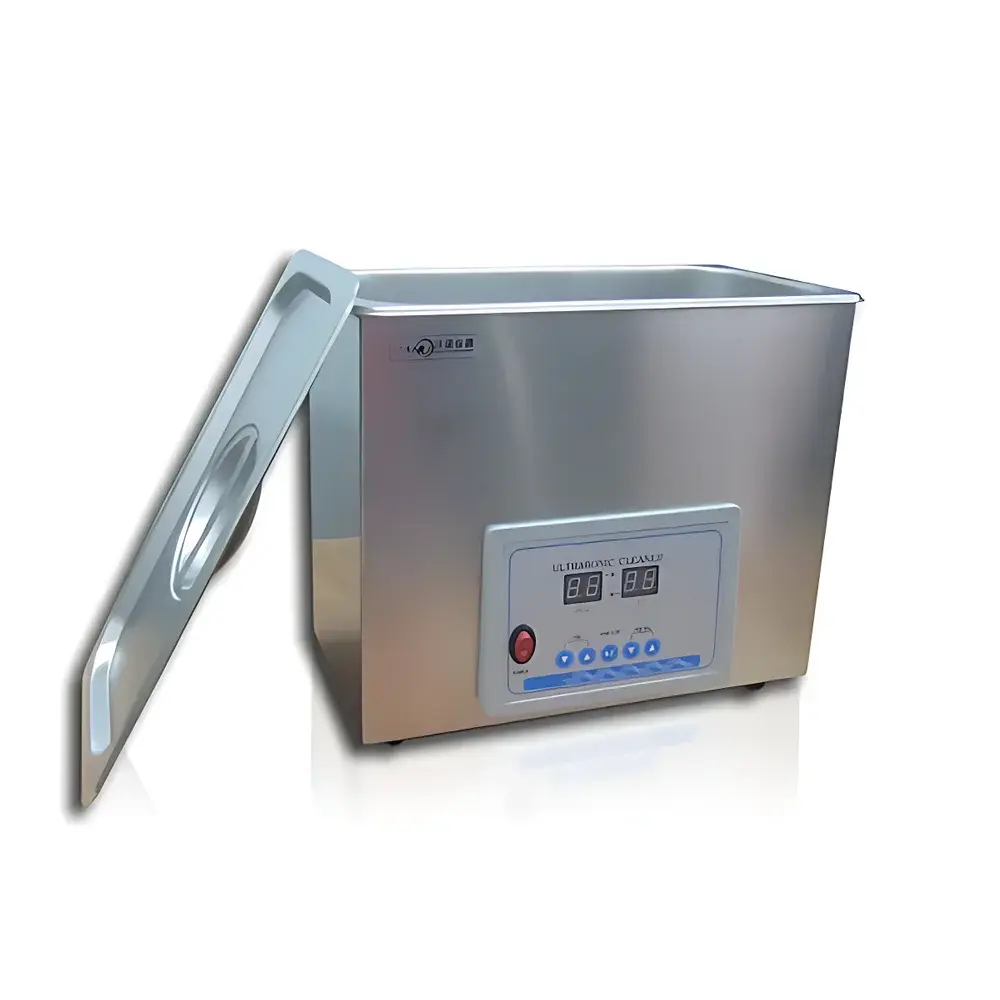
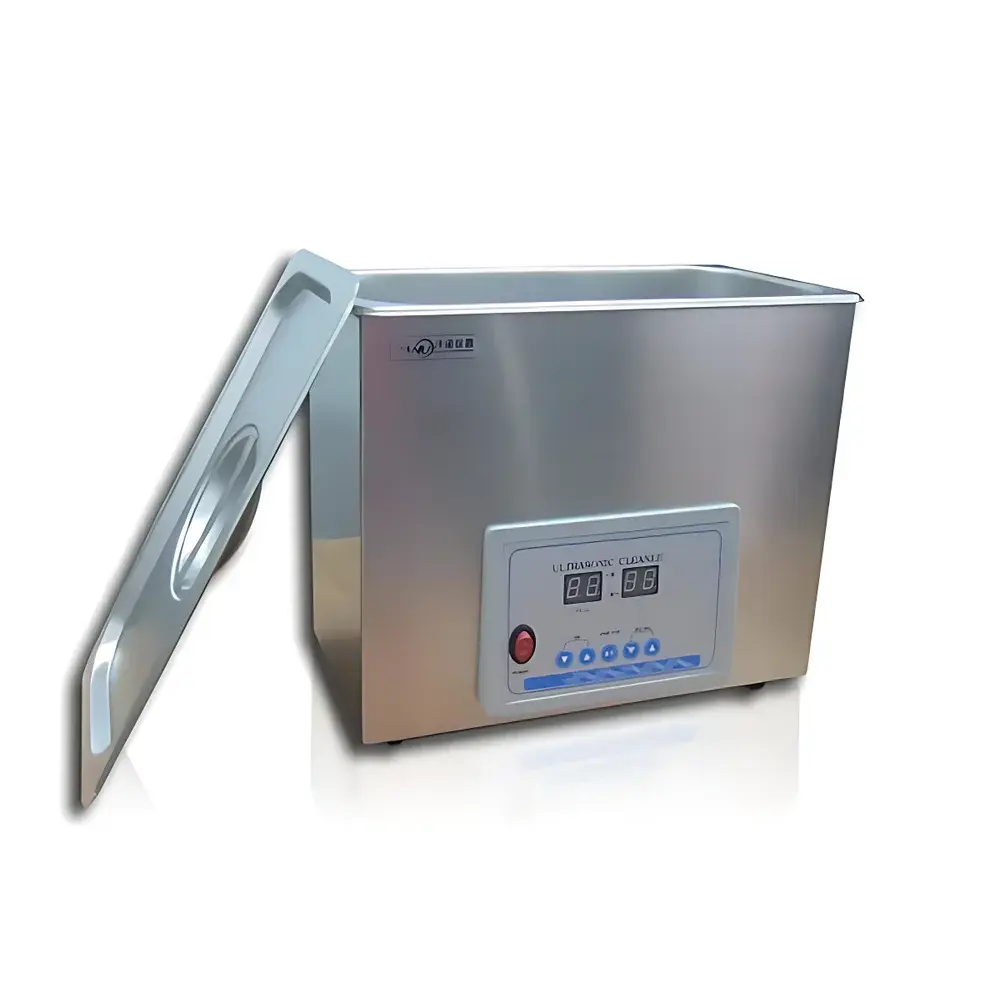
Hannuo HN10-300C Dual-Frequency Heated Ultrasonic Cleaner
| Brand | Hannuo |
|---|---|
| Origin | Shanghai, China |
| Model | HN10-300C |
| Capacity | 10 L |
| Ultrasonic Frequencies | 25 kHz / 45 kHz |
| Ultrasonic Power | 300 W (0–100% adjustable) |
| Heating Function | Yes (temperature adjustable, 0–80 °C) |
| Timer Range | 1–99 min (digital display with cumulative operation time up to 99,999 h) |
| Construction | Stainless steel tank and housing |
| Lid | Sound-dampening cover included |
| Drain Valve | Manual |
| Compliance | Designed for GLP-compliant laboratory environments |
| Software Control | Microcontroller-based embedded system |
| Accessories | Stainless steel mesh basket included |
Overview
The Hannuo HN10-300C Dual-Frequency Heated Ultrasonic Cleaner is an engineered solution for precision cleaning, degassing, extraction, and sample preparation in regulated laboratory and industrial settings. Based on the principle of cavitation—where high-frequency sound waves generate microscopic implosive bubbles in liquid media—the device delivers controlled mechanical energy to dislodge particulate contaminants, organic residues, and biofilms from complex surfaces. Its dual-frequency capability (25 kHz and 45 kHz) enables optimized performance across diverse sample types: lower frequency provides higher cavitation intensity suitable for robust components (e.g., metal parts, glassware, surgical instruments), while the higher frequency offers finer, more uniform energy distribution ideal for delicate substrates such as microfluidic chips, optical lenses, or chromatography vials. Integrated heating (0–80 °C, digitally regulated) enhances solvent activity and accelerates dissolution kinetics, particularly critical in applications involving waxy, viscous, or thermally responsive residues.
Key Features
- Dual-frequency operation (25 kHz / 45 kHz) with manual switching—enabling method-specific optimization without hardware modification
- 300 W ultrasonic power output, continuously adjustable from 0% to 100% via front-panel control for reproducible energy delivery
- Precision digital timer (1–99 minutes) with real-time display and non-volatile cumulative runtime logging (up to 99,999 hours)
- Stainless steel 304 tank (300 × 240 × 150 mm) and reinforced housing ensure corrosion resistance and long-term structural integrity
- Intelligent temperature regulation with ±1 °C stability over full 0–80 °C range; real-time digital readout eliminates guesswork during thermal-assisted cleaning
- Integrated sound-dampening lid reduces ambient noise to <55 dB(A) at 1 m—supporting compliance with occupational health guidelines (OSHA 29 CFR 1910.95)
- Manual drain valve facilitates safe, spill-free fluid disposal; compatible with waste containment protocols per EPA 40 CFR Part 261
- Microcontroller-based firmware supports stable, repeatable operation under continuous duty cycles typical in QC/QA laboratories
Sample Compatibility & Compliance
The HN10-300C accommodates a broad spectrum of labware and components—including pipette tips, NMR tubes, filter housings, electrophoresis combs, stainless-steel forceps, and silicone gaskets—without risk of surface pitting or dimensional distortion. Its stainless steel construction meets ASTM A240/A240M requirements for corrosion-resistant alloys used in analytical instrumentation. The unit is routinely deployed in facilities adhering to ISO/IEC 17025:2017 (General requirements for the competence of testing and calibration laboratories) and supports documented cleaning validation workflows. While not FDA-cleared as a medical device, its design aligns with AAMI ST79:2017 recommendations for ultrasonic cleaning of reusable medical devices prior to sterilization. All operational parameters (time, temperature, power level) are manually set and recorded—facilitating traceability in GLP and GMP environments where electronic audit trails are not mandated.
Software & Data Management
This model operates via embedded microcontroller firmware—no external PC connection or proprietary software required. All user inputs (timer setting, temperature target, frequency selection, power level) are retained in non-volatile memory after power cycling. Cumulative operational time is stored independently and serves as a maintenance indicator for transducer aging assessment. While lacking network connectivity or 21 CFR Part 11-compliant electronic signatures, the interface supports manual logbook integration: operators record settings and batch identifiers directly into laboratory notebooks or LIMS-compatible spreadsheets. Optional RS-232 output (available on request) permits basic serial logging for centralized equipment monitoring systems.
Applications
- Pre-analytical sample preparation: Degassing mobile phases prior to HPLC/UHPLC analysis; dispersing nanoparticle suspensions for DLS characterization
- Instrument maintenance: Cleaning LC column frits, ICP-MS nebulizers, and SEM sample stubs to prevent cross-contamination
- Pharmaceutical manufacturing: Removing residual active pharmaceutical ingredients (APIs) from stainless-steel contact surfaces in accordance with EMA Annex 15 cleaning validation guidance
- Medical device reprocessing: Pre-sterilization cleaning of endoscopic accessories, dental handpieces, and orthopedic implants per ISO 15883 standards
- Materials science: Debubbling polymer precursor solutions before spin-coating; cleaning MEMS sensors post-fabrication
- Academic research: Extraction of plant metabolites, cell lysis for proteomics, and homogenization of tissue lysates in buffer systems
FAQ
Is the ultrasonic power truly adjustable from 0% to 100%?
Yes—the front-panel rotary encoder allows continuous linear adjustment of RMS power delivered to the transducers, enabling fine-tuned optimization for sensitive samples.
Does the unit include a stainless steel mesh basket?
Yes—each HN10-300C ships with a corrosion-resistant 304 stainless steel basket sized to fit the tank dimensions.
Can this cleaner be used with flammable solvents?
No—operation with acetone, ethanol, or other volatile organic compounds is prohibited unless installed in an explosion-proof enclosure meeting NEC Class I, Division 1 requirements.
What is the expected service life of the transducers under normal use?
With proper maintenance (deionized water use, regular tank cleaning, avoidance of dry operation), transducers typically maintain ≥90% nominal output for 5,000+ operating hours.
Is calibration documentation provided with the unit?
Factory verification data (frequency output, temperature accuracy, timer deviation) is supplied in the user manual; third-party calibration services are available upon request.



