
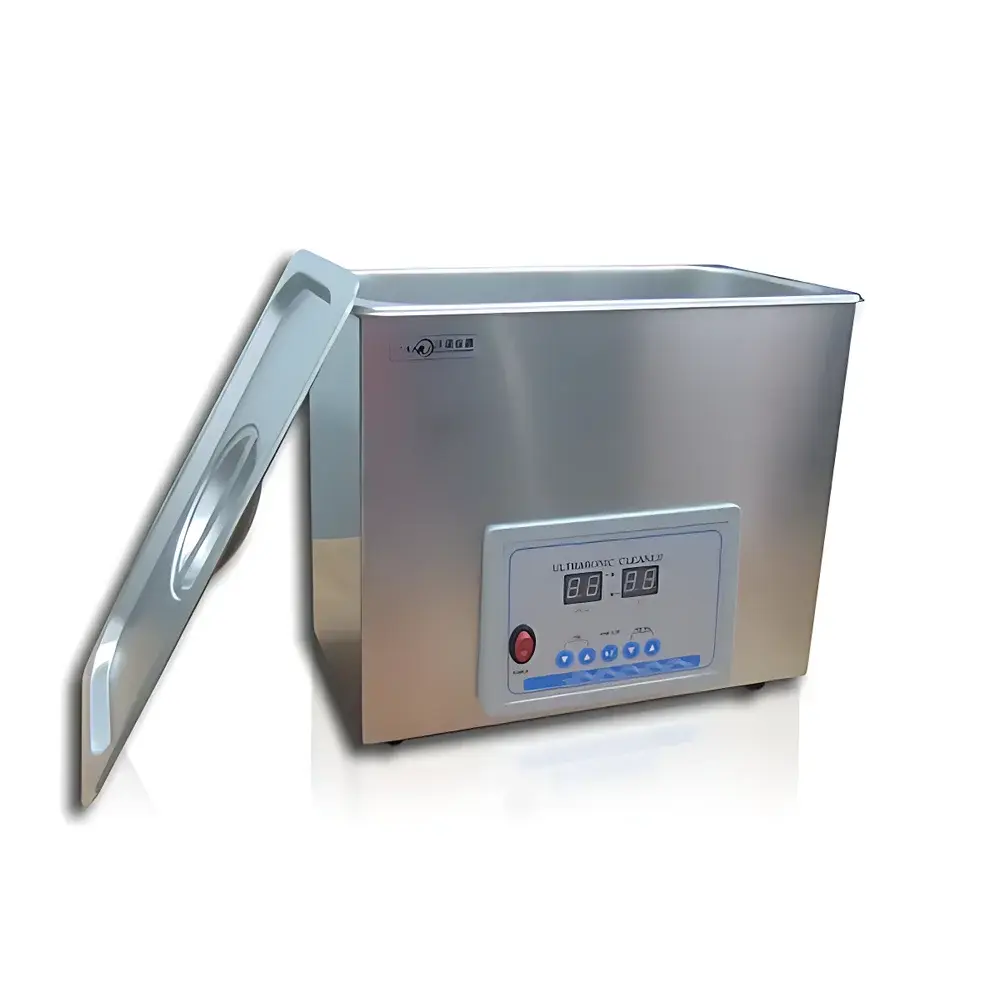
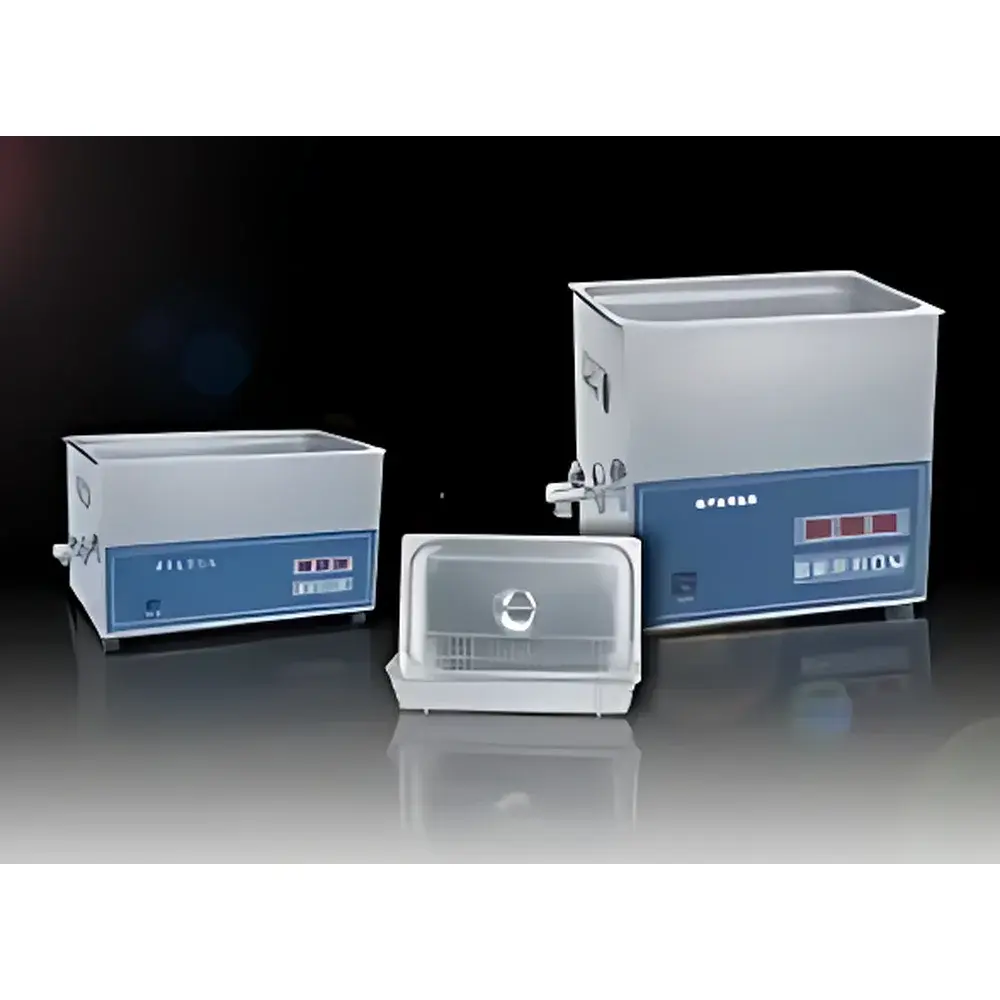
Hannuo HN30-800C Dual-Frequency Heated Ultrasonic Cleaner
| Brand | Hannuo |
|---|---|
| Origin | Shanghai, China |
| Model | HN30-800C |
| Capacity | 30 L |
| Ultrasonic Frequency | 25 / 45 kHz |
| Ultrasonic Power | 800 W (0–100% adjustable) |
| Heating Function | Yes (temperature adjustable, real-time digital display) |
| Timer Range | 1–99 min (digital LCD, cumulative operation time up to 99,999 h) |
| Construction | Stainless steel tank and housing |
| Lid | Sound-dampening cover included |
| Drain Valve | Manual |
| Compliance | Designed for GLP-compliant laboratory environments |
| Software Control | Microcontroller-based embedded system |
Overview
The Hannuo HN30-800C Dual-Frequency Heated Ultrasonic Cleaner is an engineered solution for precision cleaning, degassing, extraction, emulsification, and particle dispersion in research, quality control, and industrial maintenance laboratories. It operates on the principle of cavitation-induced acoustic energy transfer—generated by piezoelectric transducers bonded to the stainless steel tank bottom—producing controlled microbubble collapse at two discrete ultrasonic frequencies (25 kHz and 45 kHz). This dual-frequency capability enables optimized energy coupling across a broad range of sample viscosities, surface tensions, and particulate adhesion strengths. The integrated PTC heating system (adjustable from ambient to 80 °C) enhances solvent activity and accelerates contaminant removal without compromising thermal stability of sensitive substrates. Its 30-liter capacity and robust 800 W output support batch processing of large or multiple components—including glassware, metallic fixtures, optical lenses, surgical instruments, and composite materials—while maintaining consistent energy distribution throughout the cleaning bath.
Key Features
- Dual-frequency operation (25 kHz for high-energy macro-cavitation; 45 kHz for finer, more uniform micro-cavitation) selectable via front-panel interface
- 0–100% continuously adjustable ultrasonic power output, enabling method optimization for delicate versus heavily soiled samples
- Precision digital temperature control (±1 °C accuracy) with real-time LED display and auto-shutoff at setpoint
- Programmable timer (1–99 minutes) with non-volatile memory and cumulative operational hour counter (up to 99,999 h)
- 304 stainless steel tank (500 × 300 × 200 mm internal dimensions) and reinforced enclosure for corrosion resistance and mechanical durability
- Integrated sound-dampening lid compliant with ISO 9241-307 ergonomic noise reduction standards (reduces airborne noise to ≤65 dB(A) at 1 m)
- Manual drain valve with quick-connect fitting for safe, residue-free bath evacuation between cycles
- Microcontroller-based firmware supporting repeatable parameter recall and stable long-term operation under continuous duty cycles
Sample Compatibility & Compliance
The HN30-800C accommodates diverse sample geometries and material classes—including borosilicate glassware, stainless steel tools, silicone tubing, ceramic substrates, and polymer-based medical devices—without risk of ultrasonic erosion or thermal degradation when operated within validated parameters. It meets structural and electrical safety requirements per IEC 61010-1:2010 for laboratory equipment. While not certified as a medical device sterilizer, its cleaning performance aligns with ASTM D4299-22 (Standard Guide for Ultrasonic Cleaning of Laboratory Glassware) and supports preparatory steps required by ISO 15883-1 for reprocessing of reusable medical instruments. For regulated environments, the unit’s deterministic timer logic and non-volatile settings log enable traceability in GLP and GMP workflows where instrument qualification (IQ/OQ) is required.
Software & Data Management
The embedded control system utilizes a dedicated 8-bit microcontroller with EEPROM-based parameter storage, ensuring configuration persistence after power interruption. No external PC interface or proprietary software is required; all operational parameters—including frequency selection, power level, temperature setpoint, and cycle duration—are configured directly via tactile membrane keys and verified via 4-digit LED display. Cumulative runtime tracking serves as a maintenance indicator for transducer aging assessment. Though lacking network connectivity or electronic audit trail features, the unit’s deterministic behavior and physical parameter lockout (via optional key switch) satisfy baseline documentation needs for SOP-driven laboratories operating under FDA 21 CFR Part 11 Annex 11–aligned practices.
Applications
- Pre-analytical preparation: Degassing mobile phases prior to HPLC or GC analysis; cleaning volumetric flasks, pipette tips, and chromatography vials
- Materials science: Removing polishing residues from metallographic specimens; dispersing nanomaterials in suspension media
- Medical device manufacturing: Cleaning lumened instruments, endoscopic components, and implant-grade titanium parts prior to passivation
- Electronics: Debridement of flux residues from PCB assemblies and MEMS components without mechanical abrasion
- Jewelry and optics: Non-contact removal of organic films and particulates from sapphire watch crystals, coated lenses, and precious metal surfaces
- Environmental testing labs: Extraction of PAHs and PCBs from soil/sediment matrices using solvent-assisted sonication protocols
FAQ
What is the maximum recommended operating temperature for aqueous solutions?
The unit is rated for continuous operation up to 80 °C with water-based baths; higher temperatures require compatible solvents and validation of tank seal integrity.
Can both frequencies operate simultaneously?
No—frequency selection is mutually exclusive; users must choose either 25 kHz or 45 kHz per cleaning cycle to maintain transducer resonance stability.
Is the drain valve compatible with standard laboratory floor drain fittings?
Yes—the 1/2-inch NPT outlet accepts common PVC or stainless steel drainage hoses used in Class II biosafety cabinet installations.
Does the unit include calibration documentation?
Factory calibration certificates for temperature sensor and timer accuracy are available upon request and may be included in IQ/OQ packages for regulated facilities.
How often should the ultrasonic tank be descaled?
In hard-water regions, descaling with 5% citric acid solution is recommended every 200 operational hours or biweekly under daily use to preserve transducer efficiency and temperature uniformity.



