
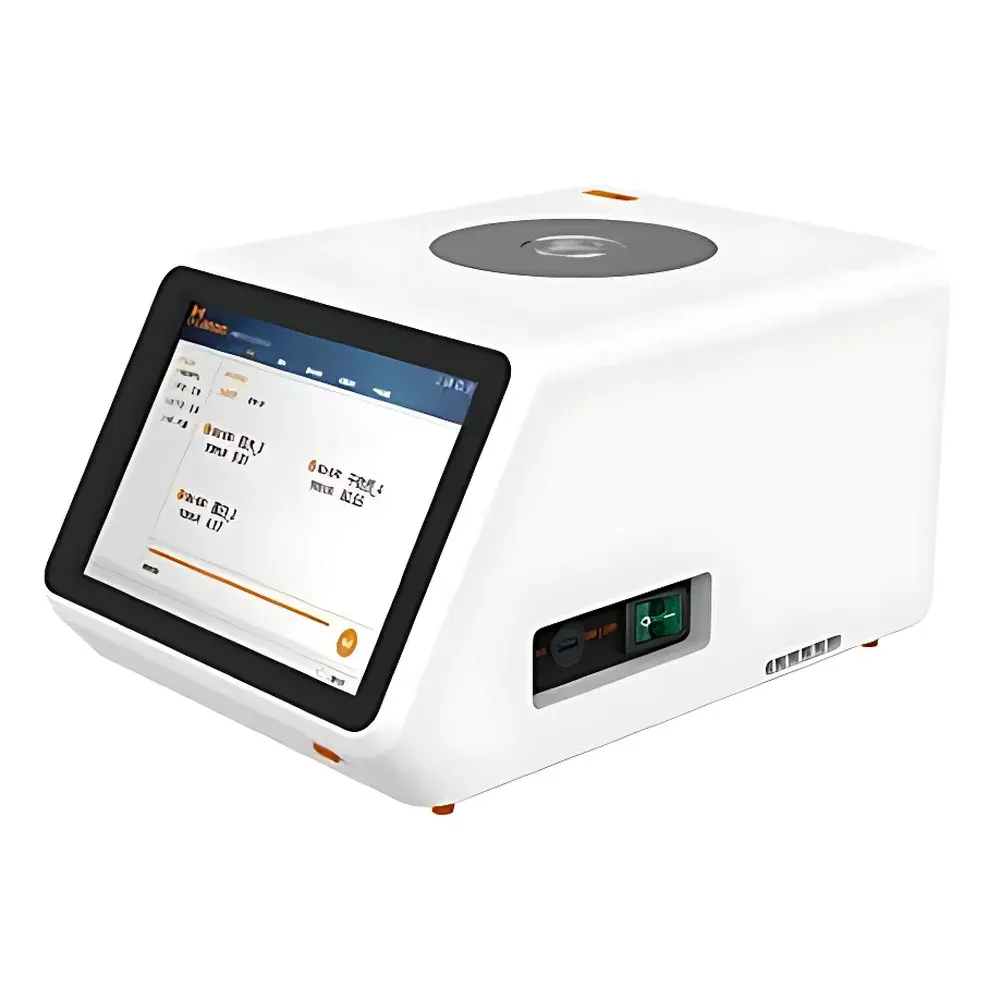
Hanon N500 Portable Near-Infrared Spectrometer
| Brand | Hanon |
|---|---|
| Origin | Shandong, China |
| Model | N500 |
| Instrument Type | Portable |
| Measurement Principle | MEMS-based Micro-FPI (Fabry–Pérot Interferometer) |
| Wavelength Range | 1750–2150 nm |
| Sampling Mode | Diffuse Reflectance |
| Detector Type | InGaAs |
| Spectral Resolution (FWHM) | ≤20 nm (≤1% of center wavelength) |
| Wavelength Accuracy | ±1 nm |
| Signal-to-Noise Ratio (SNR) | ≥3000 |
| Measurement Time per Sample | <30 s |
| Light Source Lifetime | 5000 h |
| Dimensions (L×W×H) | 395 × 280 × 215 mm |
| Weight | 5.5 kg |
| Integrated Computing Platform | Microsoft Surface Tablet |
| Software Suite | MEMS Chemometrics Platform (Model Management, Quantitative Analysis, Audit Trail, User Permissions) |
Overview
The Hanon N500 Portable Near-Infrared Spectrometer is an engineered solution for rapid, non-destructive, multi-component quantitative analysis in industrial and quality control laboratories. It operates on the principle of diffuse reflectance near-infrared spectroscopy (NIRS), leveraging a micro-electromechanical systems (MEMS)-based Fabry–Pérot interferometer (FPI) as its core spectral dispersion element. Unlike traditional grating- or prism-based NIR instruments, the MEMS-FPI architecture enables high optical stability, minimal inter-unit variability, and robust performance under field or production-floor conditions. The device captures spectral response in the short-wave near-infrared region (1750–2150 nm), a range particularly sensitive to overtones and combination bands of C–H, O–H, and N–H functional groups—making it ideal for quantifying moisture, protein, starch, fat, and fiber in organic matrices.
Key Features
- MEMS-FPI Optical Engine: Monolithic silicon-based interferometer ensures exceptional wavelength repeatability (<±1 nm accuracy) and long-term calibration stability without mechanical moving parts.
- High SNR Performance: InGaAs detector coupled with optimized thermal management delivers ≥3000:1 signal-to-noise ratio, enabling reliable low-concentration measurements even in heterogeneous samples.
- True Portability: Self-contained unit (5.5 kg) with integrated Surface tablet PC eliminates dependency on external computers; battery-operated operation supports mobile deployment across feed mills, grain silos, and food processing lines.
- Low Inter-Instrument Variability: Batch-calibrated MEMS sensors reduce unit-to-unit spectral deviation—critical for method transfer across multi-site QA networks compliant with ISO 17025 and ASTM E1655.
- Modular Sample Interface: Standardized optical port accommodates interchangeable accessories—including contact probes for solids, immersion probes for liquids, and powder cups—enabling method harmonization across raw materials and finished products.
Sample Compatibility & Compliance
The N500 is validated for routine analysis of granular, powdered, and semi-solid agricultural and food commodities—including corn, soybean meal, wheat flour, dairy powders, and pet food formulations. Its diffuse reflectance geometry minimizes particle-size effects when used with standardized sample presentation (e.g., rotating cup or vibrating tray). All firmware and software comply with data integrity requirements outlined in FDA 21 CFR Part 11: electronic records and signatures are secured via role-based access control, full audit trail logging (including model version, measurement timestamp, operator ID, and raw spectrum hash), and immutable result export (PDF/CSV with digital signature). The system supports GLP/GMP-aligned workflows through configurable user permissions (Administrator, Analyst, Reviewer) and encrypted local database storage.
Software & Data Management
The MEMS Chemometrics Platform provides a unified interface for method development, deployment, and routine operation—all accessible via intuitive touchscreen navigation. Core capabilities include: (1) drag-and-drop model import (PLS, PCR, SVM formats); (2) real-time spectral preview with baseline correction and scatter correction tools; (3) automated outlier detection using Mahalanobis distance; (4) batch reporting with customizable templates and barcode-linked sample metadata; and (5) secure cloud sync (optional) for centralized model library management across enterprise sites. Raw spectra and processed results are stored in a tamper-evident SQLite database with SHA-256 checksums. Exported reports include full traceability: instrument ID, calibration date, model build parameters, prediction confidence intervals, and measurement uncertainty estimates per ISO/IEC 17025 Annex A.5.
Applications
- Feed & Grain Industry: Rapid quantification of crude protein, moisture, oil, and fiber in incoming raw materials and finished pellets—reducing reliance on wet chemistry and accelerating release testing.
- Food Manufacturing: In-line verification of blend uniformity, shelf-life indicator monitoring (e.g., Maillard reaction products), and authenticity screening (e.g., adulteration detection in spices or milk powder).
- Research & Method Development: Supports spectral library curation, PLS regression optimization, and transfer learning between instruments—facilitating collaborative NIR network studies aligned with AOAC Official Method 2011.02.
- Contract Laboratories: Validated for ISO/IEC 17025 accreditation scope expansion, especially where turnaround time and instrument uptime are critical KPIs.
FAQ
What spectral range does the N500 cover, and why is this range selected?
The N500 operates from 1750 to 2150 nm—a region rich in first-overtone C–H stretching vibrations and combination bands of O–H and N–H. This window balances sensitivity to key macronutrients with sufficient photon flux for high-SNR measurements using uncooled InGaAs detectors.
Can models developed on other NIR instruments be transferred to the N500?
Yes—provided the source instrument’s spectral resolution and sampling geometry are comparable. The MEMS-FPI’s narrow FWHM (≤20 nm) and high wavelength fidelity support successful model porting with minor bias correction, as verified per ASTM E1655 Annex A3.
Is the system suitable for regulated environments requiring audit trails?
Yes—the MEMS platform enforces ALCOA+ principles (Attributable, Legible, Contemporaneous, Original, Accurate) with full electronic audit trail, electronic signatures, and role-based access controls meeting FDA 21 CFR Part 11 and EU Annex 11 requirements.
What maintenance is required for long-term reliability?
No routine optical alignment or lamp replacement is needed. The solid-state MEMS-FPI and 5000-hour LED light source eliminate consumables; only periodic verification using NIST-traceable ceramic standards (e.g., SRM 2036) is recommended every 6 months.
Does the N500 support remote diagnostics or firmware updates?
Yes—via secure TLS-encrypted connection to Hanon’s authorized service portal. Updates preserve all user models and calibration history; version-controlled firmware rollbacks are supported for validation continuity.
Related Products





