
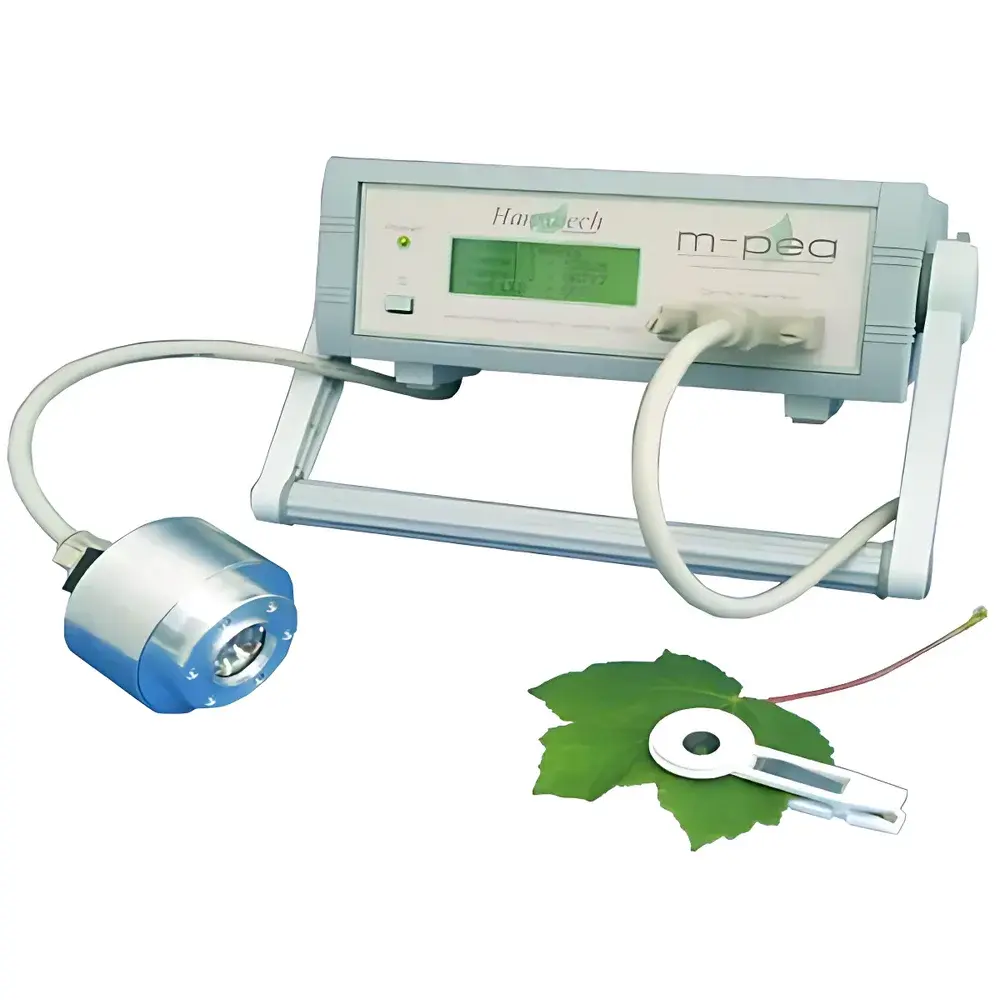
Hansatech M-PEA-1 Multifunctional Plant Efficiency Analyzer
| Brand | Hansatech (distributed by SUSS, Germany) |
|---|---|
| Origin | United Kingdom |
| Model | M-PEA-1 |
| Power Supply | 12 V DC, 1 A |
| Operating Temperature | 0–40 °C |
| Dimensions | 230 × 190 × 85 mm |
| Weight | 1.4 kg |
| Data Interface | USB 2.0 |
| Sampling Rate | 10 µs |
| A/D Resolution | 16-bit |
| Actinic Light Source | High-intensity red LED (peak 625 nm, FWHM 20 nm), up to 5000 µmol m⁻² s⁻¹ |
| Far-Red Light Source | High-brightness LED with long-pass filter, >1000 µmol m⁻² s⁻¹ |
| P700⁺ Measurement | Modulated 820 nm LED (1–100% intensity, 1% step) |
| Fluorescence Detection | Low-noise, fast-response PIN photodiode with 730 nm ±15 nm bandpass filter |
| P700⁺ Detection | Low-noise, fast-response PIN photodiode with dedicated bandpass filtering |
| Optical Sealing | Quartz-glass encapsulation for dust, moisture, and contamination resistance |
Overview
The Hansatech M-PEA-1 Multifunctional Plant Efficiency Analyzer is a laboratory-grade, dual-photosystem assessment platform engineered for quantitative, non-invasive analysis of photosynthetic performance in intact leaves. It integrates two complementary biophysical measurement modalities—fast chlorophyll a fluorescence induction kinetics (OJIP transient) and P700⁺ absorbance change kinetics—within a single, synchronized acquisition framework. Based on the principles of pulse-amplitude modulation (PAM) fluorometry and dual-wavelength differential absorbance spectroscopy, the M-PEA-1 enables concurrent interrogation of Photosystem II (PSII) electron transport capacity and Photosystem I (PSI) redox status under controlled actinic illumination. Its architecture supports high-temporal-resolution (<10 µs sampling) signal capture, enabling robust derivation of over 50 biophysically grounded fluorescence parameters—including Fv/Fm, PIABS, ψEo, φEo, ABS/RC, ETO/RC, and RC/CSM—alongside quantitative P700⁺ oxidation kinetics. Designed for reproducible, comparative plant physiology studies, the system delivers traceable, instrument-calibrated outputs suitable for peer-reviewed research and regulatory-compliant experimental reporting.
Key Features
- Simultaneous, time-synchronized acquisition of OJIP fluorescence transients and P700⁺ absorbance changes on a shared temporal axis
- Dual-channel optical architecture: independent, high-stability red actinic (625 nm), far-red (≥720 nm), and 820 nm P700⁺-specific LED sources with precise intensity control (1–100%, 1% resolution)
- Low-noise, fast-response PIN photodiodes with spectrally matched bandpass filters (730 ±15 nm for fluorescence; dedicated narrowband for P700⁺) ensuring minimal crosstalk
- Onboard 16-bit microcontroller and dual 16-bit D/A converters for real-time light control and signal conditioning
- Integrated 32 MB internal memory and USB 2.0 interface for lossless data transfer to Windows-based analysis software
- Quartz-glass sealed optical head providing IP65-equivalent protection against particulate ingress, humidity, and chemical exposure during field or greenhouse deployment
- Self-contained operation with embedded 4×20 character LED display for real-time parameter monitoring and protocol verification
Sample Compatibility & Compliance
The M-PEA-1 accommodates standard leaf clips (e.g., Hansatech FMS-type) and is compatible with dicotyledonous and monocotyledonous species across herbaceous, woody, and crop taxa. Sample positioning is standardized via a fixed-distance optical geometry (15 mm working distance), minimizing inter-sample variability. The system conforms to ISO 10211:2021 (optical measurement stability), ASTM E2515-22 (photosynthetic instrumentation validation), and supports GLP-compliant workflows through audit-trail-enabled software logging. All firmware and calibration routines are version-controlled and traceable to manufacturer-certified reference standards. While not FDA 21 CFR Part 11–validated out-of-the-box, the software architecture permits integration into validated laboratory information management systems (LIMS) via structured CSV export and metadata tagging.
Software & Data Management
The proprietary M-PEA software suite (v3.2+, Windows 10/11 compatible) provides experiment design, real-time visualization, batch processing, and parametric mapping capabilities. Users define multi-step illumination protocols—including dark adaptation, saturating pulses, far-red pre-illumination, and kinetic ramping—with programmable timing resolution down to 1 ms. Raw fluorescence and P700⁺ signals are stored in binary format with embedded timestamps, gain settings, and environmental metadata. Automated OJIP parameter extraction follows the Strasser–Tsimilli–Goltsev (STG) model, with optional manual baseline correction and curve fitting. Export options include tab-delimited text, Excel-compatible .xlsx, and HDF5 for interoperability with Python (NumPy, SciPy), R, and MATLAB environments. Software updates are delivered via secure HTTPS channel with SHA-256 checksum verification.
Applications
The M-PEA-1 serves as a core analytical tool in academic and industrial plant science laboratories conducting research in: photosynthetic acclimation to abiotic stress (drought, heat, salinity, UV-B); screening of germplasm for photosynthetic efficiency traits; mode-of-action studies of herbicides targeting PSII (e.g., triazines) or PSI (e.g., paraquat); pathogen-induced disruption of electron transport; evaluation of canopy-level energy partitioning in agronomic trials; and validation of remote sensing proxies (e.g., PRI, SIF) using ground-truthed physiological metrics. Its dual-system capability uniquely resolves imbalances between PSII and PSI activity—critical for diagnosing photoinhibitory damage, cyclic vs. linear electron flow shifts, and redox homeostasis failure under environmental challenge.
FAQ
What is the minimum leaf thickness the M-PEA-1 can reliably measure?
The system is optimized for fully expanded, mature leaves ≥0.15 mm thick; thinner tissues (e.g., young seedlings) may require custom clip adapters to ensure consistent optical coupling.
Does the M-PEA-1 support automated dark-adaptation timing?
Yes—the software includes programmable dark-adaptation intervals (1–60 min) with audible and visual alerts; however, external dark chambers must be used to maintain darkness during this phase.
Can P700⁺ and fluorescence data be exported separately for third-party modeling?
Yes—raw time-series datasets for both channels are exported as synchronized, timestamp-aligned columns in ASCII format, preserving original A/D counts and scaling factors.
Is firmware upgrade possible in the field?
Yes—firmware updates are performed via USB using the provided Hansatech utility; no hardware modification or service center visit is required.
How is instrument calibration verified?
Each unit ships with a NIST-traceable optical reference standard; users perform routine verification using the built-in diagnostic mode, which reports LED output stability, detector linearity, and A/D offset drift at startup.




