
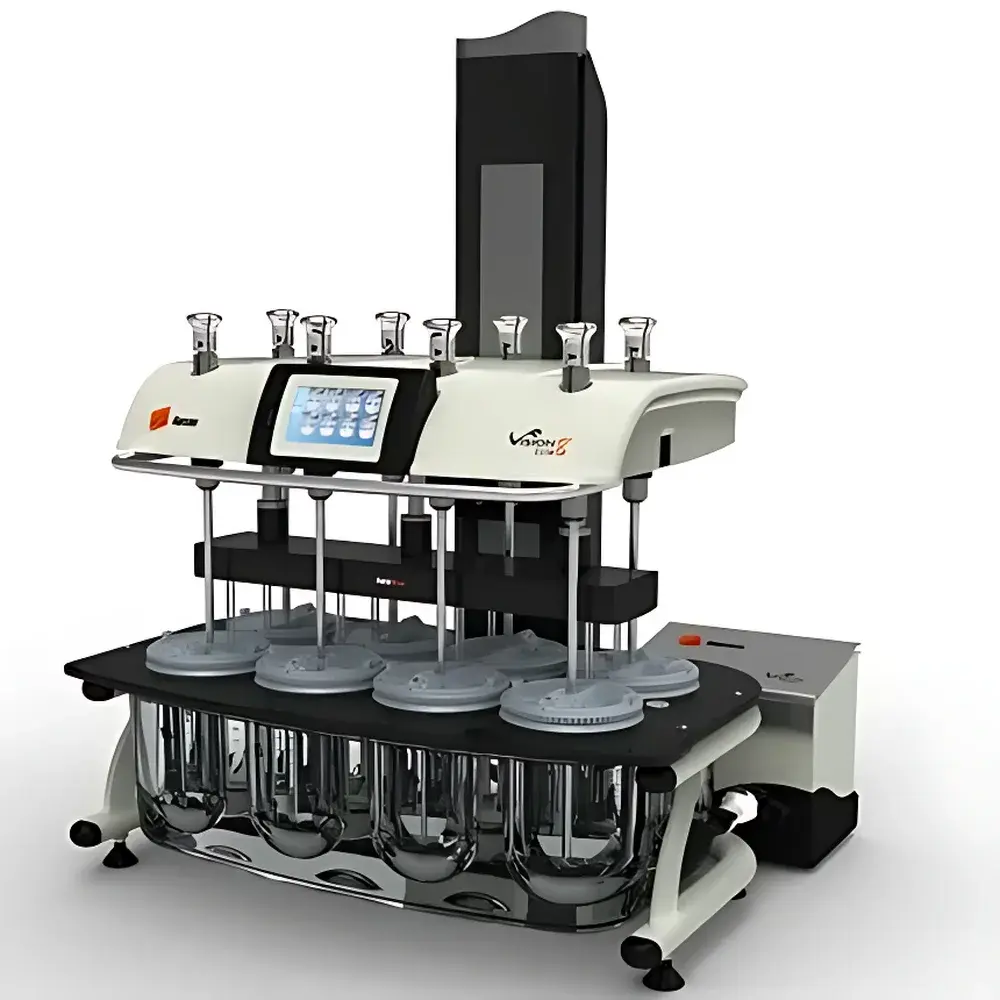
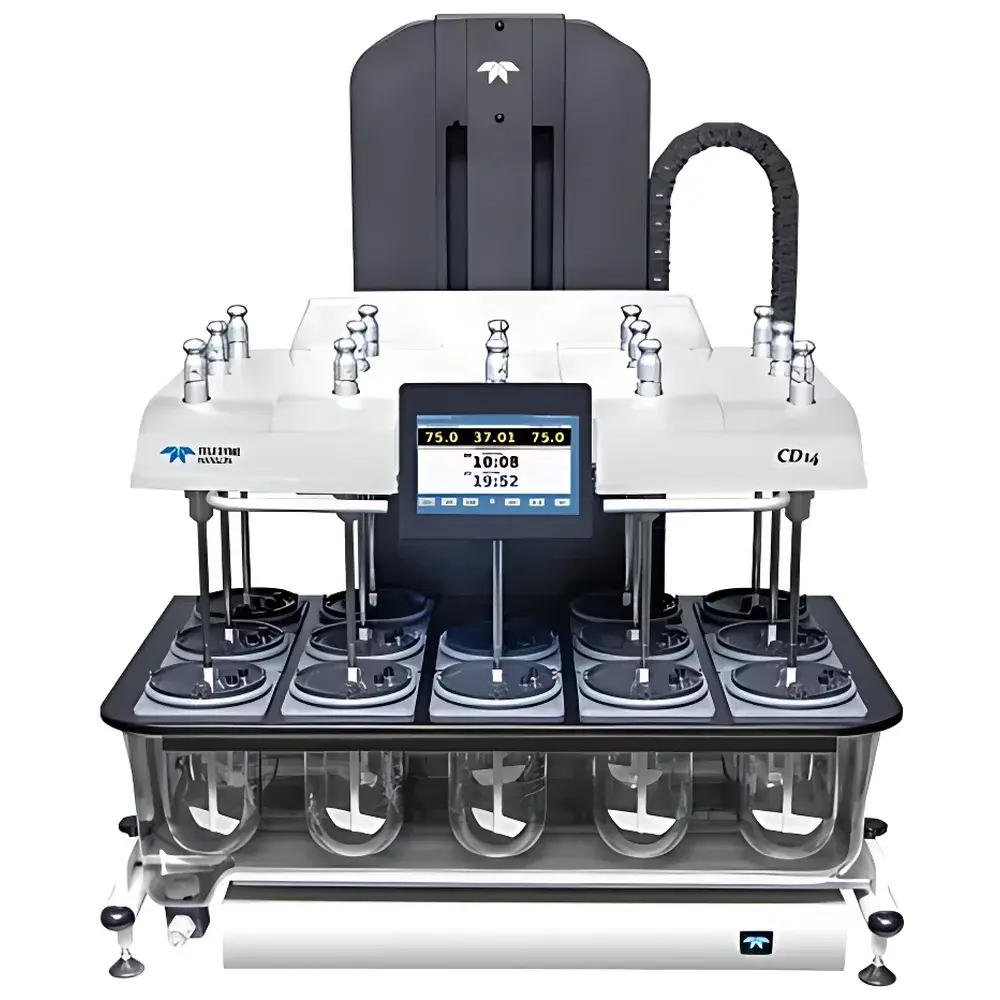
Hanson CD14 14-Position Offline Dissolution Tester
| Brand | Hanson |
|---|---|
| Origin | USA |
| Model | CD14 |
| Instrument Type | Offline Dissolution Tester |
| Vessel Capacity | 14 vessels |
| Temperature Range | 25.0–50.0 °C |
| Temperature Accuracy | ±0.1 °C (at 37 °C) |
| Rotational Speed Range | 25–250 rpm |
| Speed Accuracy | ±1 rpm |
| Display Resolution | 0.1 rpm |
| Compliance | USP <711>, <724>, EP 2.9.3, JP XVII, ChP, ASTM E2503, FDA Mechanical Calibration Guidance, 21 CFR Part 11 |
Overview
The Hanson CD14 is a high-precision, 14-position offline dissolution testing system engineered for pharmaceutical quality control laboratories, formulation development groups, and regulatory compliance units operating under cGMP, GLP, and ISO/IEC 17025 frameworks. Based on the rotating basket (USP Apparatus 1) and paddle (USP Apparatus 2) principles—fully compatible with USP , , European Pharmacopoeia 2.9.3, Japanese Pharmacopoeia XVII, and Chinese Pharmacopoeia—the CD14 delivers reproducible hydrodynamic conditions across all 14 vessels. Its design adheres to the mechanical performance criteria defined in ASTM E2503 and FDA’s 2022 Guidance for Dissolution Apparatus Calibration, ensuring traceable, auditable, and metrologically sound operation. Unlike modular or hybrid systems, the CD14 is purpose-built as a dedicated offline platform—eliminating cross-contamination risk between runs and enabling full method independence per vessel pair.
Key Features
- Compact footprint (85 cm × 61 cm) — the smallest 14-vessel dissolution system in its class, optimized for space-constrained QC labs.
- Precision centering mechanism meeting and exceeding ASTM E2503 radial runout and wobble tolerances (<0.2 mm lateral deviation at 100 rpm).
- Programmable dual-zone agitation: Vessels 1–12 operate in standard dissolution mode; positions 13–14 support configurable roles—including heated blank controls, reference standards, or alternative media reservoirs.
- Integrated digital temperature control with dual-sensor validation: primary immersion probe (±0.1 °C accuracy from 30–55 °C) and secondary bath sensor, both logged with timestamped calibration history.
- High-resolution 10.1-inch color touchscreen with adjustable tilt angle (15°–30°), supporting glove-compatible operation and multi-user accessibility.
- Onboard storage for up to 500 validated test methods and 50 completed run reports, each with embedded metadata (operator ID, timestamp, environmental log, calibration status).
- Optional integrated filtration module (0.45 µm or 0.22 µm PES membrane) with pressure monitoring and automatic shutoff to prevent membrane rupture.
Sample Compatibility & Compliance
The CD14 supports all USP-defined apparatus types (1, 2, 5, and 6) via interchangeable shaft assemblies and vessel adapters. It accommodates standard 1000 mL USP vessels, mini-vessels (250 mL), and custom geometries under validated configurations. All mechanical parameters—including shaft verticality, centering, wobble, vibration, and temperature uniformity—are verified against USP Annex and ASTM E2503 Annex A protocols. System-level compliance extends to 21 CFR Part 11 through role-based electronic signatures (biometric fingerprint + password), audit-trail-enabled event logging (including failed login attempts, parameter changes, and report exports), and immutable SQL database archiving with SHA-256 hash verification. Full documentation packages—including IQ/OQ/PQ templates, calibration certificates, and mechanical verification records—are provided for FDA, EMA, PMDA, and NMPA inspections.
Software & Data Management
The embedded Hanson Dissolution Software Suite (v5.2+) provides context-aware method editing, real-time graphical overlay of dissolution profiles, and automated pass/fail evaluation per ICH Q5C and USP . Data export conforms to ALCOA+ principles: raw sensor logs, processed curves, and metadata are exportable as PDF/A-2b (with embedded digital signatures) or structured CSV/Excel files. The relational SQL database supports indexed search by batch number, product code, analyst ID, or dissolution timepoint. Network printing (Epson-certified or generic IPP-compatible) and local thermal printing options ensure GxP-aligned hardcopy generation. Custom report templates—configured per departmental SOP—support up to three authorized signatories with timestamped approval fields.
Applications
- Comparative dissolution profiling of generic and innovator products per FDA Guidance on Modified Release Dosage Forms.
- Excipient interaction studies under variable pH and surfactant conditions using programmable multi-stage temperature and agitation protocols.
- Stability-indicating method development for extended-release tablets, transdermal patches, and multiparticulate systems.
- Biorelevant dissolution testing (FaSSIF/FeSSIF) requiring precise thermal and mechanical consistency across ≥12 replicates.
- Regulatory submission support—including ANDA, MA, and BLA dossiers—with fully traceable, 21 CFR Part 11-compliant data packages.
FAQ
Does the CD14 support USP Apparatus 6 (rotating cylinder)?
Yes—via optional cylinder shaft kits and calibrated vessel inserts, validated per USP mechanical specifications.
Can vessel pairs operate with independent agitation profiles?
Yes—positions 1–6 and 7–12 may be assigned distinct rpm and sampling schedules within a single run, enabling parallel evaluation of two formulations.
Is third-party software integration possible?
The system exposes RESTful API endpoints for LIMS and ELN synchronization; certified integrations include LabVantage, Thermo Fisher SampleManager, and Agilent OpenLab.
What calibration documentation is included?
Each unit ships with NIST-traceable calibration certificates for temperature, rotation, and timing subsystems, plus a full ASTM E2503 mechanical verification report.
How is user access managed under 21 CFR Part 11?
Three-tier permission model (Admin, Supervisor, Analyst) with customizable rights per module; biometric authentication logs are cryptographically signed and retained for ≥15 years.




