
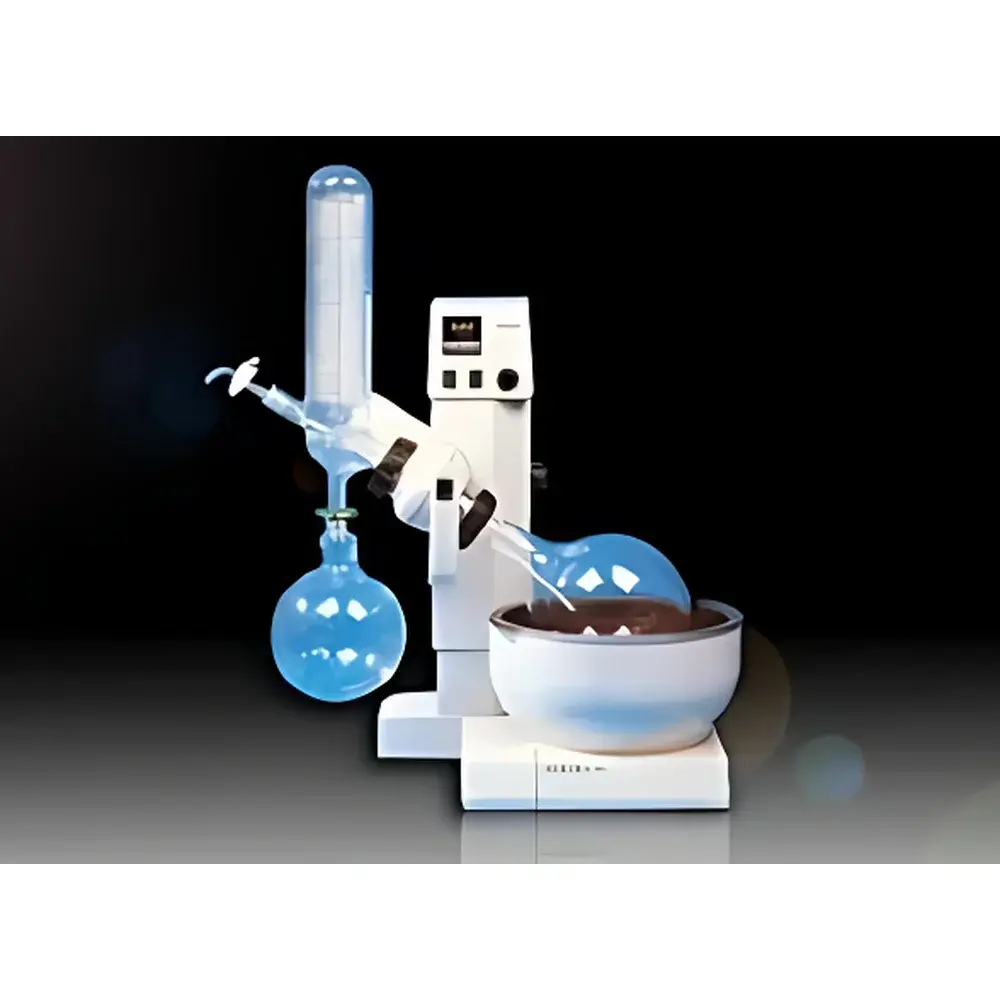
Hanuo RE-3000A Benchtop Rotary Evaporator
| Brand | Hanuo |
|---|---|
| Origin | Shanghai, China |
| Model | RE-3000A |
| Evaporation Flask Capacity | 3 L |
| Ultimate Vacuum | 0.098 MPa (≈740 mmHg) |
| Rotational Speed Range | 20–200 rpm (digital display, stepless adjustment) |
| Bath Temperature Control Range | Ambient to 90 °C (PID-controlled, digital readout) |
| Heating Bath | PTFE-coated stainless steel, 1.4 kW |
| Condenser | Vertical double-surface reflux condenser with ground-glass joints, large-diameter vapor duct |
| Cooling Surface Area | 0.11 m² |
| Total Power Consumption | 1.5 kW |
| Voltage | 220 V AC |
Overview
The Hanuo RE-3000A is a benchtop rotary evaporator engineered for reliable, scalable solvent removal under reduced pressure. It operates on the principle of thin-film evaporation: a motor-driven rotating flask immersed in a thermostatically controlled water bath generates a uniform, high-surface-area liquid film along the inner wall. Under vacuum (down to 0.098 MPa), the boiling point of solvents is significantly lowered—enabling gentle, efficient concentration of thermally labile compounds such as proteins, enzymes, natural extracts, and pharmaceutical intermediates. Its vertical condenser design with dual-surface reflux geometry maximizes heat exchange efficiency, while the PTFE-coated heating bath ensures corrosion resistance and stable thermal performance across repeated cycles. Designed for continuous operation in academic labs, QC facilities, and pilot-scale production environments, the RE-3000A meets functional requirements aligned with ISO/IEC 17025-compliant laboratory workflows.
Key Features
- Stepless speed control (20–200 rpm) with real-time digital RPM display for precise film formation and reproducible evaporation kinetics.
- PTFE-coated stainless steel heating bath (1.4 kW) with PID temperature regulation and digital readout—maintains ±0.5 °C stability from ambient to 90 °C.
- Vertical dual-surface reflux condenser fabricated from borosilicate glass (3.3), featuring precision-ground ball-and-socket joints and oversized vapor ducts to minimize back-pressure and enhance condensate recovery.
- Quick-release rotating shaft mechanism with knurled ring nut: clockwise rotation secures the flask; counterclockwise disengages it in seconds—no tools required.
- Counterbalanced lift system with rocker-switch actuation: enables smooth, tool-free vertical adjustment of the main unit over a 150 mm range (0–150 mm).
- Integrated vacuum-compatible sealing: all ground-glass interfaces conform to ISO 3585 standards; condenser and collection flask assemblies are rated for sustained operation at ≤0.1 MPa absolute pressure.
Sample Compatibility & Compliance
The RE-3000A accommodates standard 3 L round-bottom flasks (ISO 2977-1 compliant) and is compatible with common organic solvents (e.g., ethanol, acetone, ethyl acetate, dichloromethane) and aqueous systems. Its temperature-limited operating envelope (≤90 °C bath) makes it suitable for applications governed by USP , ICH Q5C, and ASTM E2654–19 guidelines for thermal-sensitive biomolecule handling. While not certified to UL/CE or FDA 21 CFR Part 11 out-of-the-box, its analog control architecture supports integration into GLP/GMP environments when paired with external data loggers meeting audit-trail and electronic signature requirements.
Software & Data Management
The RE-3000A operates via standalone analog electronics with digital displays—no embedded firmware or network interface. All operational parameters (rotational speed, bath temperature, lift position) are manually set and visually monitored. For laboratories requiring traceable process records, third-party USB-connected temperature and RPM data loggers (e.g., Omega OM-DAQPRO-5300 series) may be deployed in parallel. The device’s open-loop control architecture allows full manual override at all stages—a design choice prioritizing operational transparency and maintenance simplicity over automated protocol scripting.
Applications
- Concentration of heat-sensitive natural product extracts (e.g., plant alkaloids, terpenes, polyphenols) without degradation.
- Removal of low-boiling solvents post-SPE or liquid–liquid extraction in environmental and food safety testing (e.g., pesticide residue analysis per AOAC 2007.01).
- Recovery and recycling of reaction solvents in fine chemical synthesis—reducing waste disposal costs and improving EHS compliance.
- Preparative-scale dehydration of peptide solutions prior to lyophilization in biopharmaceutical development labs.
- Standardized solvent removal in undergraduate and graduate teaching laboratories, supporting curriculum-aligned experiments in organic chemistry and analytical method validation.
FAQ
What is the maximum recommended vacuum level for continuous operation?
The system is rated for sustained use at ≤0.098 MPa (740 mmHg); prolonged operation below this threshold may compromise seal integrity or condenser efficiency.
Can the RE-3000A be used with corrosive solvents such as concentrated HCl or HF?
No—only chemically resistant solvents compatible with borosilicate glass 3.3 and PTFE seals should be processed. Hydrochloric acid, hydrofluoric acid, and strong oxidizers require specialized corrosion-resistant evaporators.
Is the heating bath fill volume adjustable, and what is the recommended water level?
Yes—the bath includes a calibrated fill line. Optimal operation requires water level between 30–80% capacity to ensure full immersion of the flask base while preventing overflow during rotation.
Does the unit include a vacuum controller or pressure sensor?
No—the RE-3000A requires an external vacuum source (e.g., diaphragm pump) and optional vacuum gauge or regulator for precise pressure management.
What maintenance intervals are recommended for long-term reliability?
Inspect ground-glass joints monthly for scoring; lubricate with silicone grease before each use. Clean condenser surfaces after every 10 runs using warm detergent and lint-free wipes. Verify bath heater calibration annually using a NIST-traceable thermometer.
Related Products



