
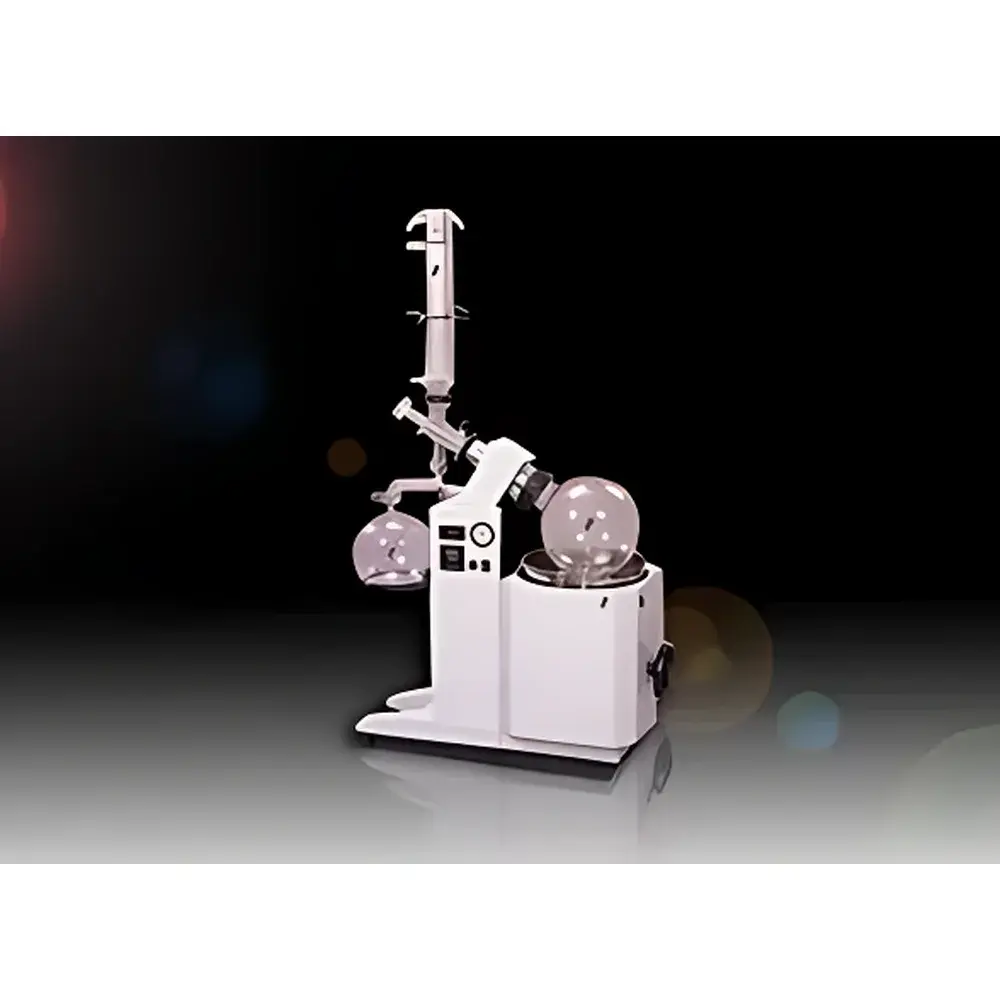
Hanuo RE-5210A Motorized Rotary Evaporator
| Brand | Hanuo |
|---|---|
| Model | RE-5210A |
| Rotational Speed Range | 20–110 rpm (digital display, frequency-controlled) |
| Heating Bath Temperature Range | RT to 98 °C (water bath) |
| Rotary Flask Capacity | 10 L |
| Collection Flask Capacity | 5 L (standard taper joint) |
| Cooling System | Vertical high-density dual-coil condenser |
| Power Consumption | 3180 W |
| Dimensions (W×D×H) | 950 × 500 × 1600 mm |
| Lift Mechanism | Motorized vertical lift |
Overview
The Hanuo RE-5210A Motorized Rotary Evaporator is an industrial-grade benchtop-to-floor-standing purification system engineered for efficient, scalable solvent removal under reduced pressure. It operates on the fundamental principle of rotary vacuum distillation: a rotating evaporation flask immersed in a thermostatically controlled water bath generates a thin, uniform liquid film across its inner surface, significantly increasing the effective evaporation area while minimizing thermal degradation. This configuration enables rapid, gentle concentration of heat-sensitive compounds—including natural extracts, pharmaceutical intermediates, polymer solutions, and chromatographic fractions—without localized overheating or bumping. Designed for continuous operation in R&D laboratories, quality control environments, and pilot-scale production settings, the RE-5210A integrates precise rotational control, stable temperature regulation, and robust mechanical lift functionality to support reproducible, operator-safe workflows.
Key Features
- Motorized vertical lift mechanism with smooth, programmable positioning—eliminates manual cranking and ensures repeatable flask alignment during setup and solvent transfer.
- 10 L pear-shaped rotary flask with standard ISO 29/32 ground-glass joint, optimized for high-surface-area film formation and low-residue evaporation.
- Digital frequency-controlled drive delivering consistent rotational speeds from 20 to 110 rpm; speed stability maintained ±1 rpm under load for uniform film thickness and vapor flux.
- Water bath heating system with PID temperature control (RT to 98 °C), calibrated to ±0.5 °C accuracy at setpoint, compatible with both aqueous and low-boiling organic solvents.
- Vertical dual-coil condenser with high-density copper tubing and borosilicate glass construction—provides superior heat exchange efficiency and minimizes condensate backflow under high-vapor-load conditions.
- 5 L collection flask with standard taper joint (29/32) and integrated drain valve for rapid, spill-free solvent recovery and system cleaning.
- Integrated safety interlocks: overtemperature cutoff, motor overload protection, and vacuum release delay logic to prevent flask ejection during venting.
Sample Compatibility & Compliance
The RE-5210A accommodates a broad range of sample matrices, including polar and non-polar organic solvents (e.g., ethanol, acetone, ethyl acetate, dichloromethane), aqueous buffers, and viscous solutions up to ~500 cP. Its all-glass fluid path (excluding seals) ensures chemical inertness and compatibility with USP Class VI elastomers where applicable. The system meets general laboratory equipment safety requirements per IEC 61010-1 and conforms to CE marking directives for electrical safety and electromagnetic compatibility (EMC). While not certified for GMP manufacturing environments out-of-the-box, its design supports audit-ready documentation practices—including logbook-integrated operation records and traceable parameter settings—aligning with GLP principles for method validation and QC batch processing.
Software & Data Management
The RE-5210A operates as a standalone instrument with local digital interface only; no embedded software or network connectivity is provided. All operational parameters—rotational speed, bath temperature, and lift position—are manually set and monitored via front-panel LED displays and tactile controls. For laboratories requiring electronic data capture, integration with external data acquisition systems (e.g., LabVIEW, SCADA, or LIMS) is achievable via optional analog output modules (0–10 V or 4–20 mA) for temperature and speed signals. Users maintaining 21 CFR Part 11 compliance may implement procedural controls—including dual-operator verification, handwritten log entries with timestamps, and periodic calibration records—to satisfy audit requirements for validated evaporation protocols.
Applications
- Concentration of crude natural product extracts prior to HPLC fractionation or bioassay screening.
- Removal of volatile solvents following solid-phase extraction (SPE) or liquid–liquid partitioning steps.
- Recovery and recycling of high-value solvents (e.g., THF, toluene) in synthetic chemistry workflows.
- Dehydration of thermolabile biopolymers, peptides, and enzyme formulations under mild vacuum and low bath temperatures.
- Scale-up of purification processes from analytical to preparative volumes—enabling direct translation from 50 mL to 10 L batch sizes without re-optimization.
- Environmental analysis: concentration of water samples for PAH, PCB, or pesticide residue detection per EPA Method 3510C.
FAQ
What vacuum level is required for optimal performance?
The RE-5210A is designed for use with external vacuum sources capable of achieving ≤10 mbar (7.5 Torr); actual operating pressure depends on solvent boiling point, bath temperature, and condenser efficiency. A diaphragm pump or circulating chiller-cooled water aspirator is recommended.
Is the heating bath compatible with oil media?
No—the RE-5210A’s bath is rated exclusively for water-based heating. Use of silicone oil or other high-temperature fluids voids warranty and risks thermal runaway due to absence of oil-level sensors or overtemp cutouts specific to oil baths.
Can the condenser be upgraded to a dry-ice or refrigerated coolant system?
Yes—the vertical dual-coil condenser accepts standard 10/30 mm outer/inner diameter coolant tubing; users may integrate it with recirculating chillers (e.g., −20 °C to 25 °C range) for enhanced recovery of low-boiling solvents such as diethyl ether or pentane.
What maintenance intervals are recommended?
Daily: inspect PTFE seals and ground-glass joints for debris; weekly: verify bath water pH and replace if >8.5; annually: calibrate temperature sensor against NIST-traceable reference and lubricate lift gear train with food-grade silicone grease.
Does the unit include vacuum gauge or pressure control?
No—vacuum monitoring and regulation require external instrumentation. We recommend pairing with a digital vacuum controller (e.g., MKS Baratron series) for closed-loop pressure management during sensitive distillations.



