
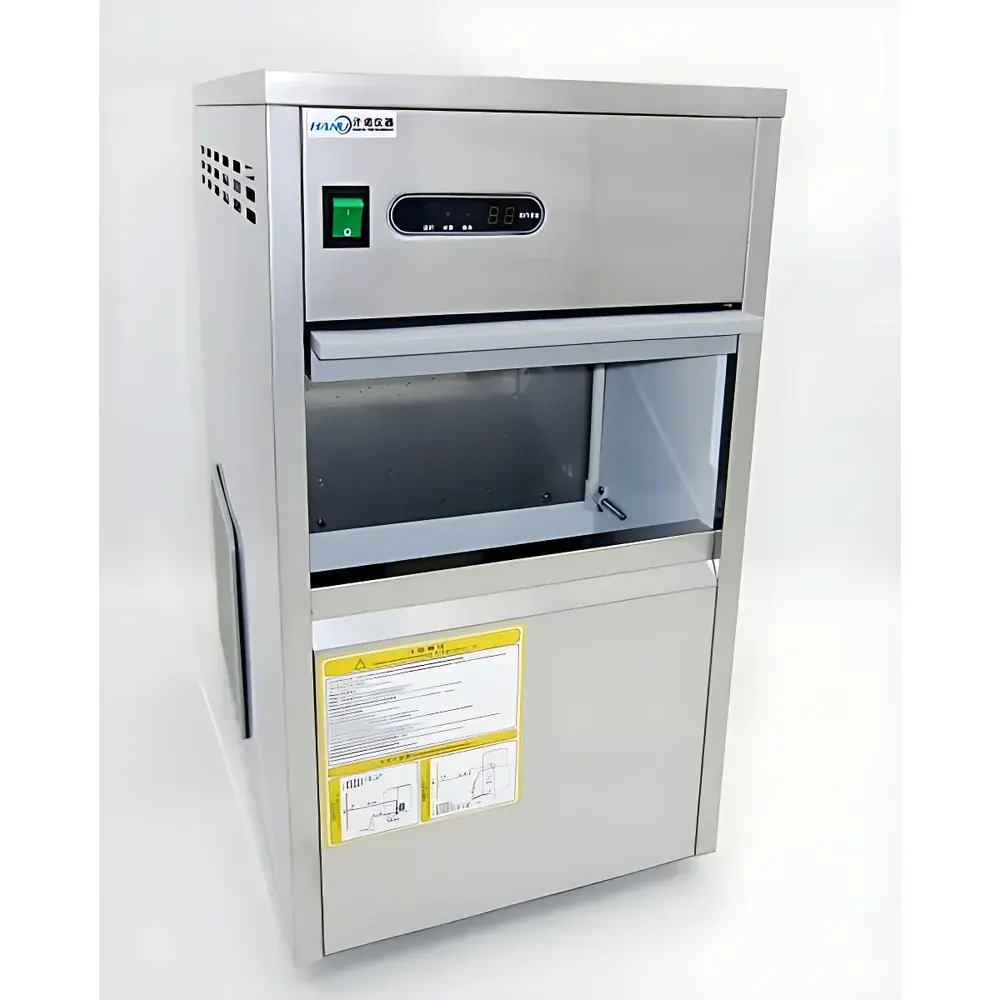
Hanuo FM120 Integrated Flake Ice Machine
| Brand | Hanuo |
|---|---|
| Origin | Shanghai, China |
| Manufacturer Type | Direct Manufacturer |
| Regional Classification | Domestic (China) |
| Model | FM120 |
| Ice Production Capacity | 120 kg/24 h |
| Ice Storage Capacity | 40 kg |
| Water Consumption | 5 kg/h |
| Cooling Method | Air-Cooled |
| Ice Form | Irregular, Fine Flake Ice |
| Ice Making Principle | Dual-Screw Extrusion |
| Power Supply | 550 W / 220 V AC |
| Dimensions (W×D×H) | 500 × 611 × 940 mm |
| Refrigerant | R134a |
| Housing Material | Full Stainless Steel (AISI 304) |
| Control System | Microprocessor-Based Full Digital Control |
| Display & Monitoring | Real-Time Status Indicators for Operation, Full Ice Bin, Low Water, and Fault Conditions |
Overview
The Hanuo FM120 Integrated Flake Ice Machine is an air-cooled, self-contained laboratory-grade flake ice generator engineered for consistent, hygienic, and on-demand production of irregular, fine-textured flake ice. Unlike cubed or nugget ice systems, the FM120 employs a dual-screw extrusion mechanism — a robust mechanical process in which water is frozen against a refrigerated drum surface and continuously scraped off by counter-rotating stainless-steel augers. This method yields thin, dry, high-surface-area flakes (typically 1–3 mm in thickness and sub-10 mm in lateral dimension) with rapid thermal transfer characteristics, making them ideal for temperature-sensitive biological sample handling, cold-chain maintenance during transport, and low-temperature process cooling in analytical workflows. Designed for continuous 24/7 operation in controlled environments, the unit complies with fundamental safety and electromagnetic compatibility requirements per IEC 61000-6-3 and IEC 61000-6-1, and its sealed refrigeration circuit using R134a refrigerant meets current global ozone-depletion potential (ODP = 0) and low-global-warming-potential (GWP = 1430) regulatory frameworks.
Key Features
- Full stainless-steel (AISI 304) enclosure and internal components — corrosion-resistant, non-porous, and compliant with basic hygiene standards for cleanroom-adjacent and GLP-aligned lab spaces.
- Dual-screw extrusion system — ensures uniform flake morphology, minimal ice bridging, and stable output across ambient temperatures up to 32°C.
- Microprocessor-based digital control panel — provides real-time status feedback including operational mode, ice bin full detection, low-water alarm, and fault code diagnostics (e.g., compressor overheat, sensor failure).
- Automatic water feed via municipal tap connection — integrated float valve and flow limiter prevent overflow and optimize water usage at 5 kg/h under nominal load.
- Air-cooled condensing system — eliminates need for external water drainage or chiller integration; suitable for labs without dedicated cooling water infrastructure.
- Compact footprint (500 × 611 × 940 mm) — designed for placement under standard lab benches or adjacent to cold rooms, biosafety cabinets, or sample preparation stations.
Sample Compatibility & Compliance
The FM120 produces flake ice with high surface-area-to-volume ratio and low residual moisture content (<5% free water), minimizing dilution risk when used for chilling centrifuge tubes, electrophoresis gels, PCR reagents, or tissue specimens. Its stainless-steel ice contact surfaces meet ISO 8573-1 Class 4 purity requirements for compressed air–adjacent equipment and are compatible with routine cleaning protocols using 70% ethanol or alkaline detergents. While not certified to ISO 22000 or NSF/ANSI 12 for food service, the unit satisfies baseline material and construction criteria referenced in CLSI GP26-A4 (Laboratory Equipment Maintenance) and supports traceability in GxP environments when paired with documented preventive maintenance logs and calibration of onboard temperature sensors (±1.0°C accuracy, NIST-traceable verification recommended annually).
Software & Data Management
The FM120 operates as a standalone hardware system with no embedded software architecture, cloud connectivity, or data export capability. All operational parameters are managed locally via the front-panel LCD interface and non-volatile memory retains last-run settings across power cycles. For laboratories requiring audit trails, integration into facility monitoring systems (e.g., Vaisala viewLinc, SensiNet) can be achieved via optional dry-contact relay outputs (available upon request), enabling remote status logging of “running”, “ice full”, and “fault” states. No FDA 21 CFR Part 11 compliance is claimed, as the device lacks electronic records or signature functionality — consistent with its classification as a Class I general-purpose refrigeration appliance per IVD and laboratory equipment regulatory interpretations.
Applications
- Biological sample stabilization during dissection, homogenization, or aliquoting — especially for enzymes, RNA, and primary cell suspensions requiring sub-10°C surface contact.
- Cold chain buffering in QC/QA labs performing stability testing of pharmaceutical intermediates or diagnostic reagents.
- Temperature moderation in chromatography mobile phase reservoirs and electrophoresis buffer tanks.
- On-site ice supply for field-deployable analytical kits (e.g., portable PCR, lateral flow assays) where portability and rapid cooldown are critical.
- Supporting cryopreservation workflows — flake ice serves as an interim thermal mass between liquid nitrogen dewars and -80°C freezers during sample transfer.
FAQ
What type of water supply is required?
Standard municipal tap water (pressure: 0.1–0.6 MPa; temperature: 5–32°C) is sufficient. A sediment filter (5 µm) is recommended upstream to protect the solenoid valve and drum surface.
Can the FM120 operate continuously in a 30°C ambient environment?
Yes — rated performance (120 kg/24 h) is guaranteed at 25°C ambient; output reduces to ~105 kg/24 h at 30°C and ~90 kg/24 h at 32°C per ISO 8560 test conditions.
Is R134a refrigerant serviceable in the field?
Refrigerant charging and leak repair must be performed only by certified HVAC-R technicians holding EPA Section 608 or equivalent national certification; the sealed system is not user-serviceable.
Does the unit include automatic defrost?
Yes — a timed hot-gas defrost cycle initiates every 6–8 hours of compressor runtime, with duration optimized to prevent ice buildup on the evaporator drum without compromising flake quality.
How often should the stainless-steel interior be cleaned?
Weekly wipe-down with food-grade sanitizer is recommended; full sanitization (including auger and drum inspection) should occur monthly or after any extended idle period (>72 h).



