
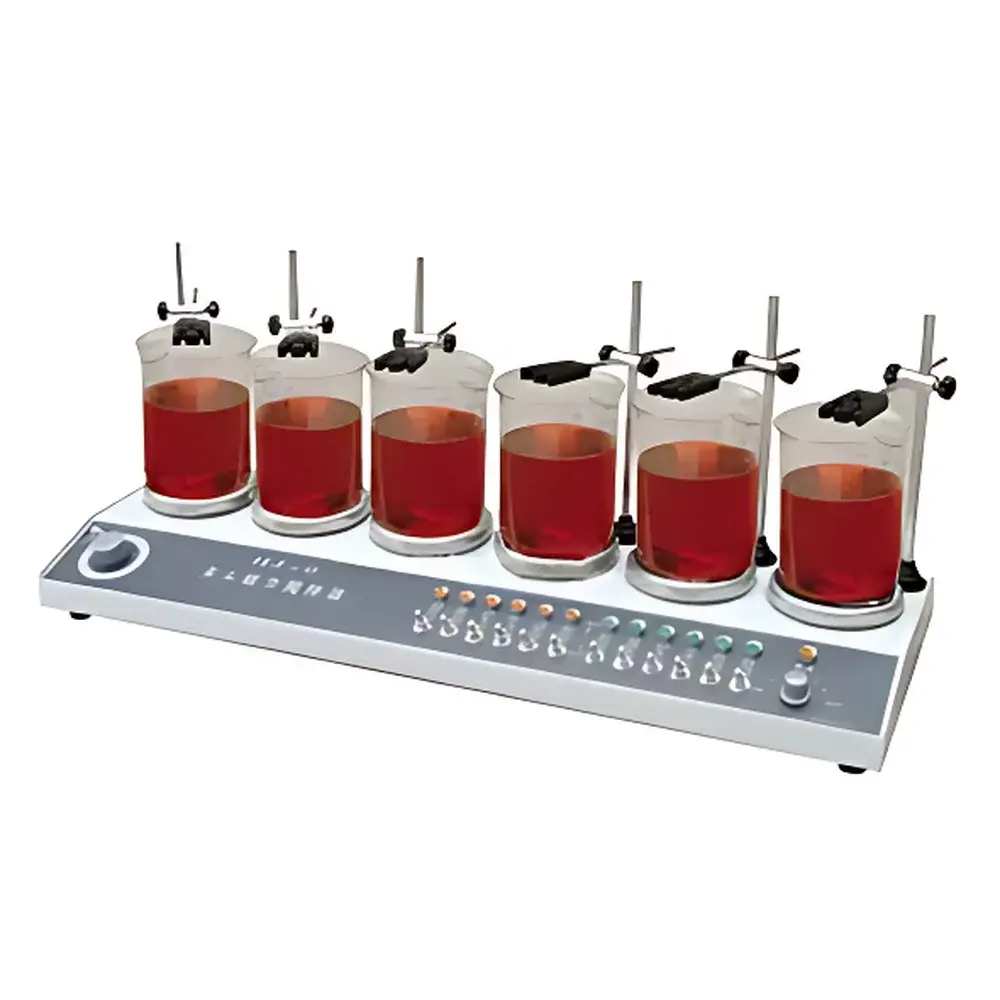
Hanuo HJ-6A Six-Position Digital Temperature-Controlled Magnetic Stirrer
| Brand | Hanuo |
|---|---|
| Origin | Shanghai, China |
| Model | HJ-6A |
| Instrument Type | Magnetic Stirrer |
| Max. Stirring Volume | 6 × 1000 mL |
| Speed Range | 0–2400 rpm |
| Temperature Control Range | Ambient to 100 °C |
| Heating Power | 6 × 200 W |
| Display | Digital LED for speed and temperature |
| Warranty | 12 months parts and labor |
Overview
The Hanuo HJ-6A is a six-position digital temperature-controlled magnetic stirrer engineered for high-throughput laboratory workflows requiring simultaneous, independent thermal and mechanical control across multiple samples. It operates on the principle of magnetic coupling: a rotating permanent magnet array beneath the ceramic-coated heating plate generates a time-varying magnetic field that induces synchronous rotation of PTFE- or glass-coated magnetic stir bars immersed in each vessel. This non-contact drive mechanism eliminates mechanical wear, ensures leak-free operation, and enables precise agitation of low-to-medium viscosity liquids and homogeneous solid–liquid suspensions. Unlike single- or dual-position units, the HJ-6A integrates six fully isolated heating/stirring stations—each with independent PID-based temperature regulation and digital speed control—making it ideal for comparative studies, reaction optimization, dissolution testing, and standardized sample preparation under reproducible thermal-mechanical conditions.
Key Features
- Six independent stirring positions with individual digital setpoint control for both speed (0–2400 rpm) and temperature (ambient to 100 °C), minimizing cross-talk and enabling parallel experimental design.
- Ceramic-coated aluminum heating plates offering uniform thermal distribution, rapid heat-up response (<6 min to 100 °C), and chemical resistance to common solvents and aqueous reagents.
- Digital LED display showing real-time speed and temperature values for each station; intuitive rotary encoder interface for precise parameter adjustment.
- Integrated over-temperature protection and auto-shutdown functionality compliant with IEC 61000-4-2 ESD immunity standards.
- Robust chassis with non-slip silicone feet, reinforced housing, and optimized airflow channels for continuous-duty operation at full load.
- Modular design supporting optional accessories including stainless-steel sample trays, external PT100 probe inputs (for enhanced temperature validation), and RS-232/USB data logging modules.
Sample Compatibility & Compliance
The HJ-6A accommodates standard laboratory glassware including beakers (50–1000 mL), Erlenmeyer flasks, and round-bottom flasks up to 1000 mL per position. It supports stirring of aqueous buffers, organic solvents (e.g., ethanol, acetone, ethyl acetate), polymer solutions, catalyst slurries, and biopolymer dispersions—provided magnetic stir bar orientation remains stable under rotational shear. The unit conforms to EN 61326-1:2013 for electromagnetic compatibility (EMC) and EN 61010-1:2010 for electrical safety in laboratory environments. While not certified for Class I Division 1 hazardous locations, its sealed electronics and thermal cutoffs meet general-purpose GLP-compliant lab requirements. Temperature accuracy is ±1.5 °C within the 40–90 °C range (calibrated per ISO/IEC 17025 traceable procedures), and speed stability is maintained within ±2% of setpoint under constant load.
Software & Data Management
The base HJ-6A operates as a standalone instrument with no embedded software. However, optional firmware upgrades support ASCII protocol communication via RS-232 or USB virtual COM port, enabling integration into LIMS or ELN platforms. Compatible with third-party scripting tools (e.g., Python pySerial, LabVIEW VIs), the device transmits live speed and temperature readings per channel, along with status flags (heating active, error code, standby). Audit trail functionality—including timestamped parameter changes, session start/stop events, and thermal deviation alerts—can be implemented using external data acquisition systems compliant with FDA 21 CFR Part 11 when paired with appropriate electronic signature and archival protocols.
Applications
- Pharmaceutical QA/QC: Simultaneous dissolution testing of six tablet batches per USP , buffer equilibration for HPLC mobile phase preparation, and excipient dispersion studies.
- Materials science: Controlled synthesis of metal oxide nanoparticles, sol-gel processing, and rheological preconditioning of precursor suspensions prior to casting or extrusion.
- Environmental analysis: Homogenization of soil leachates, sediment slurry digestion (EPA Method 3050B), and pH-adjusted extraction protocols requiring consistent agitation across replicates.
- Academic research: Kinetic profiling of multi-variable reactions, enzyme activity assays under thermal gradient conditions, and teaching labs emphasizing experimental replication and statistical power analysis.
- Food & beverage R&D: Viscosity stabilization trials, emulsion formation optimization, and thermal holding tests for shelf-life modeling.
FAQ
What is the maximum recommended viscosity for reliable stirring with the HJ-6A?
For optimal performance and stir bar stability, the unit is rated for Newtonian fluids up to ~500 mPa·s (e.g., 1% CMC solution at 25 °C); higher viscosities may require larger-diameter stir bars and reduced speed settings.
Can the HJ-6A maintain temperature uniformity across all six positions?
Yes—each station features independent PID control with thermistor feedback; inter-position temperature deviation is ≤±0.8 °C at 80 °C steady state (measured per ASTM E220-17 calibration practice).
Is the unit compatible with non-magnetic vessels such as aluminum or thick-walled glass?
No. Magnetic coupling requires ferromagnetic transparency; aluminum, stainless steel, or >6 mm borosilicate glass will attenuate the field and prevent effective stir bar rotation.
Does the HJ-6A support external temperature probes for improved accuracy?
Yes—optional PT100 input jacks allow connection of calibrated immersion probes, enabling direct sample temperature monitoring and closed-loop correction independent of plate surface sensing.
What maintenance is required for long-term reliability?
Routine cleaning of the ceramic plate with isopropanol; annual verification of thermal and speed calibration using NIST-traceable references; inspection of stir bar integrity before each use to avoid chipping or demagnetization.



