
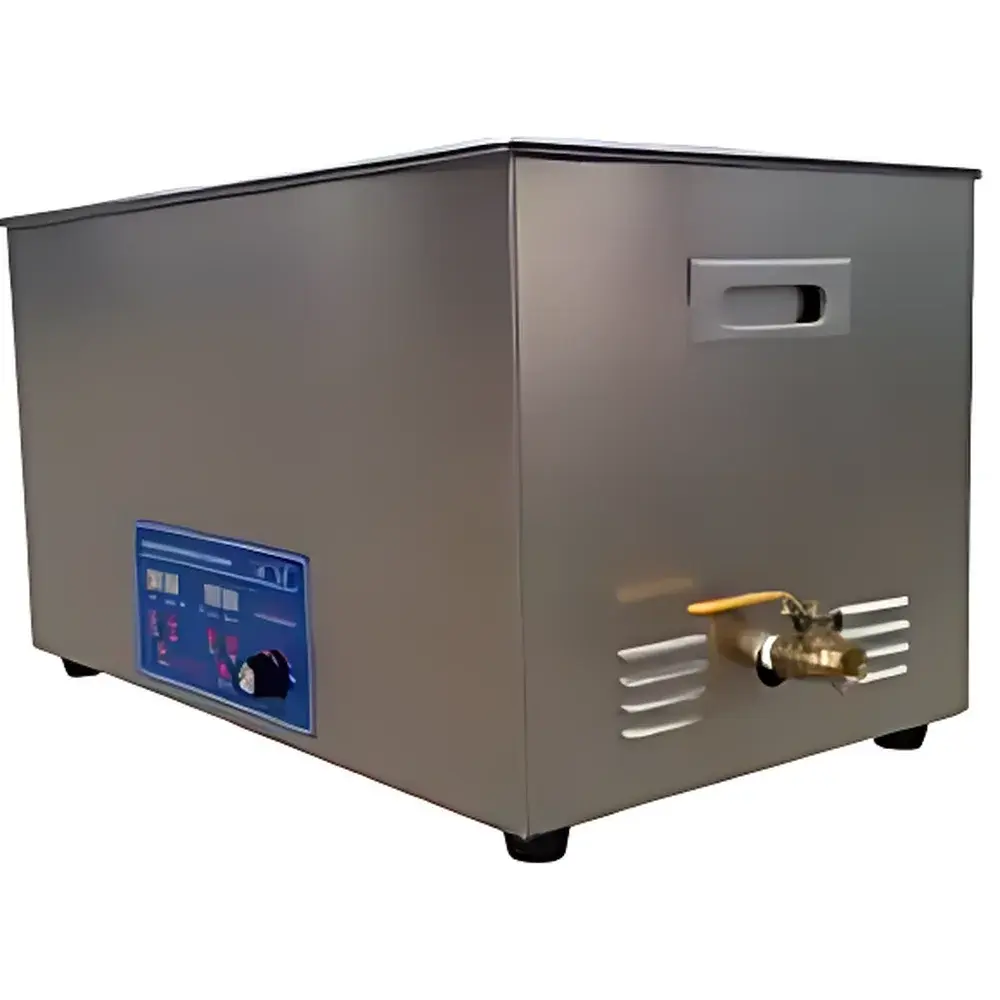
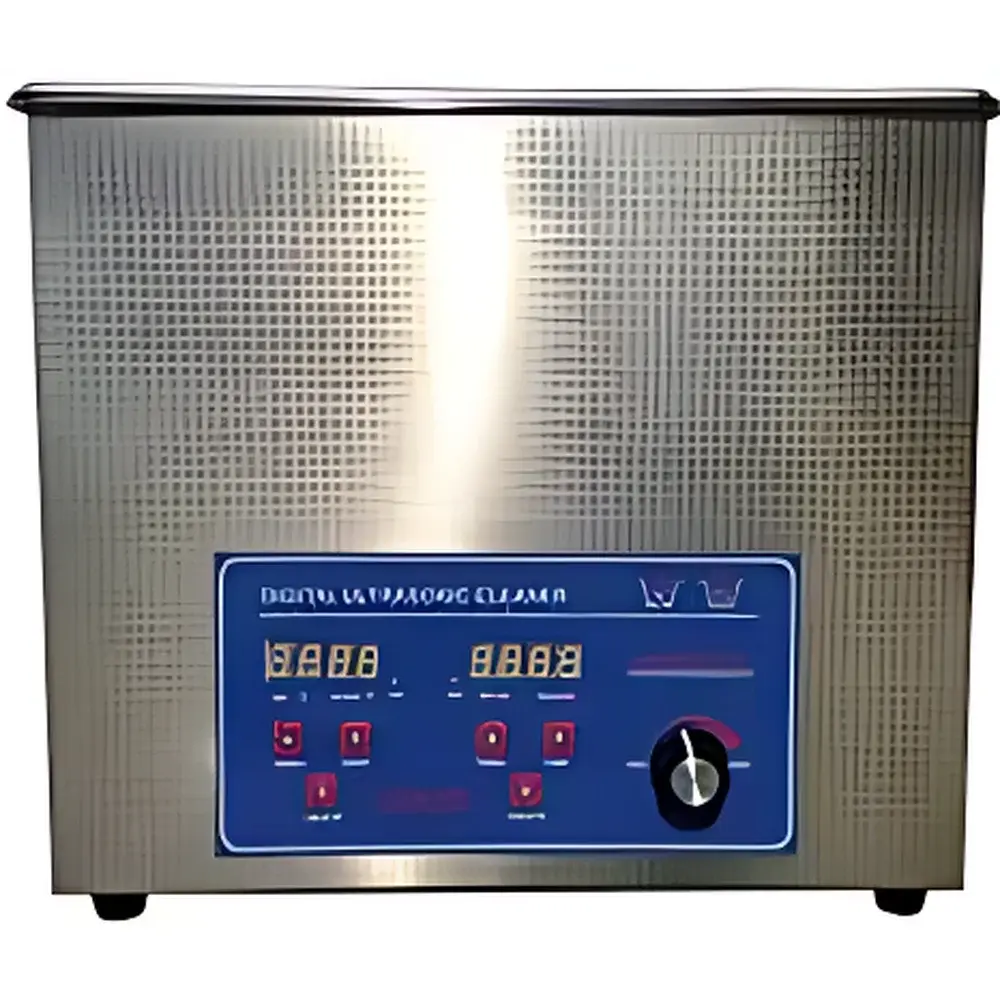
Hanuo HN-10A Benchtop Heated Ultrasonic Cleaner
| Brand | Hanuo |
|---|---|
| Origin | Shanghai, China |
| Model | HN-10A |
| Capacity | 10 L |
| Ultrasonic Frequency | 40 kHz |
| Ultrasonic Power | 300 W |
| Adjustable Power | Yes |
| Heating Function | Yes (20–80 °C) |
| Timer Range | 0–30 min |
| Sound-Dampening Lid | Included |
| Drain Valve | Manual |
| Construction | Stainless Steel Tank (304) |
| Dimensions (L×W×H) | 300 × 240 × 150 mm (tank) |
| Net Weight | 8.3 kg |
Overview
The Hanuo HN-10A is a benchtop heated ultrasonic cleaner engineered for precision cleaning, degassing, and auxiliary sample preparation tasks in regulated laboratory and light industrial environments. It operates on the principle of high-frequency cavitation—generating microscopic implosions in liquid media via 40 kHz transducers bonded to the stainless steel tank base. These transient cavitation events produce localized pressures exceeding 1000 atm and temperatures above 5000 K, enabling efficient removal of particulate contaminants, organic residues, and thin oxide layers from complex geometries—including blind holes, crevices, and microfluidic channels. Unlike immersion-only or spray-based methods, ultrasonic cleaning delivers uniform energy distribution across submerged surfaces without mechanical abrasion. The integrated PTC heating system enables precise thermal control between 20 °C and 80 °C, enhancing solvent activity and accelerating dissolution kinetics for stubborn soils such as fluxes, greases, and proteinaceous films. Designed for ISO/IEC 17025-compliant labs, the HN-10A supports reproducible cleaning validation protocols when paired with standardized test soils (e.g., ASTM F2469-05) and gravimetric residue analysis.
Key Features
- Stainless steel 304 tank (300 × 240 × 150 mm internal dimensions) with reinforced transducer mounting for long-term acoustic stability
- Digitally adjustable ultrasonic power output (0–100% in 10% increments), allowing optimization for delicate substrates (e.g., optical lenses, MEMS devices) or heavily soiled components
- Precise digital temperature control (±1 °C accuracy) with real-time LED display and over-temperature cut-off protection
- Programmable timer (0–30 minutes) with auto-shutdown and audible end-of-cycle alert
- Integrated sound-dampening lid with ergonomic latch mechanism, reducing ambient noise to ≤55 dB(A) at 1 m distance
- Manual drain valve located at tank bottom for safe, residue-free fluid evacuation—compatible with waste solvent recovery workflows
- Front-panel membrane keypad with tactile feedback and IP54-rated enclosure for splash resistance
Sample Compatibility & Compliance
The HN-10A accommodates a wide range of sample types: glassware (vials, cuvettes, pipette tips), metal parts (stainless steel surgical instruments, calibration weights), ceramic substrates, and polymer components (PC, PTFE, PMMA). It is routinely deployed in QC laboratories adhering to USP (Cleaning Validation of Laboratory Equipment) and ISO 13485 (Medical Device Manufacturing). While not certified to UL/CSA or CE for standalone medical device reprocessing, its design aligns with key elements of EN ISO 15883-1 for washer-disinfectors—particularly in thermal stability, material compatibility, and repeatable energy delivery. All wetted surfaces are electropolished 304 stainless steel, ensuring corrosion resistance against aqueous alkaline, acidic, and mild organic cleaning solutions (e.g., 1–3% sodium hydroxide, 0.5–2% citric acid, or isopropanol/water blends).
Software & Data Management
The HN-10A operates as a standalone instrument with no embedded software or network interface. However, its analog/digital hybrid control architecture supports external documentation requirements under GLP and GMP frameworks: all operational parameters (temperature setpoint, duration, power level) are manually entered and visually confirmed on the front panel display prior to initiation. For audit-trail compliance, users may log settings and cycle outcomes in paper-based or validated electronic lab notebooks (ELN) per FDA 21 CFR Part 11 guidelines. Optional accessories—including calibrated PT100 probe kits and time-stamped data loggers—enable traceable temperature profiling during qualification (IQ/OQ/PQ) and routine performance verification.
Applications
- Pre-analytical sample preparation: cleaning HPLC vials, autosampler needles, and ICP-MS nebulizers to prevent cross-contamination
- Electronics manufacturing: removing rosin flux and solder paste residues from PCB assemblies prior to AOI inspection
- Pharmaceutical R&D: degassing mobile phase solvents and conditioning filtration membranes
- Materials science: dispersing nanomaterials (e.g., graphene oxide, TiO₂ nanoparticles) in aqueous or ethanolic suspensions
- Mechanical engineering labs: cleaning precision gauges, micrometers, and surface roughness standards to ISO 5725 repeatability thresholds
- Academic teaching labs: demonstrating cavitation physics, sonochemistry fundamentals, and cleaning efficacy metrics (e.g., contact angle restoration)
FAQ
What is the maximum operating temperature, and how is thermal safety ensured?
The unit supports a temperature range of 20–80 °C. A redundant PTC thermistor and independent bimetallic thermal cutoff (100 °C trip point) prevent overheating under dry-run or low-fluid conditions.
Can the HN-10A be used with flammable solvents?
No. This model is rated for aqueous and water-miscible solutions only. Use in flammable solvent environments requires explosion-proof certified equipment (e.g., Class I, Division 1 rated units) and strict adherence to NFPA 30 and OSHA 1910.106 standards.
Is the stainless steel tank passivated per ASTM A967?
Yes—the 304 SS tank undergoes nitric acid passivation post-fabrication to maximize chromium oxide layer integrity and minimize metallic ion leaching during prolonged exposure to warm cleaning agents.
Does the unit include a degas mode?
While not labeled as “degas mode,” the 40 kHz frequency and variable power control allow manual optimization for degassing: operate at 30–50% power for 5–10 minutes before analytical use to minimize dissolved gas interference in spectroscopic or chromatographic applications.
What maintenance is required to sustain acoustic performance?
Transducer coupling integrity should be verified annually via impedance sweep testing (using a network analyzer). Daily cleaning of the tank interior with deionized water prevents scale buildup; quarterly descaling with 5% citric acid solution is recommended in hard-water regions.



