
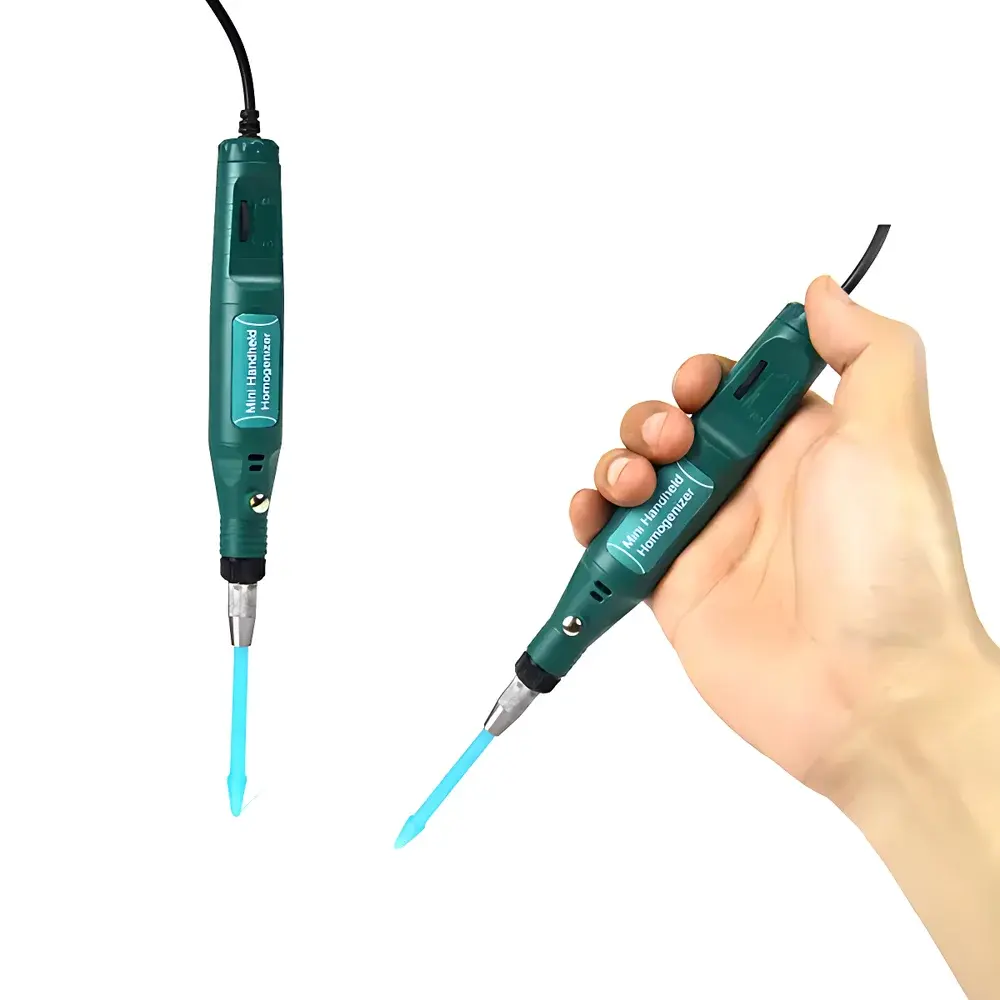
Hanuo HN-13K Handheld Micro Homogenizer
| Brand | Hanuo |
|---|---|
| Origin | Shanghai, China |
| Manufacturer Type | Authorized Distributor |
| Country of Origin | China |
| Model | HN-13K |
| Instrument Type | Probe-type Rotating Blade Homogenizer |
| Dimensions (W×D×H) | 25 mm × 25 mm × 160 mm |
| Sample Volume Range | 1–1.5 mL |
| Speed Range | 5,000–18,000 rpm |
| Input Voltage | AC 220 V |
| Noise Level | ≤60 dB(A) |
| Net Weight | 0.1 kg |
| Sterilization Compatibility | Autoclavable, Ethanol, UV, and Dry Heat |
Overview
The Hanuo HN-13K Handheld Micro Homogenizer is a compact, ergonomically engineered instrument designed for rapid, reproducible mechanical disruption of biological samples at the microliter scale. It operates on the principle of high-speed rotational shearing—utilizing a precision-machined stainless-steel probe driven by a brushless DC motor—to generate controlled hydrodynamic forces within small-volume containers (1–1.5 mL microcentrifuge tubes). Unlike ultrasonic or bead-beating systems, this probe-based homogenizer delivers direct energy transfer with minimal heat accumulation and no cross-contamination risk when using single-use or properly sterilized probes. Its sub-100 g mass and pencil-like form factor enable precise one-handed operation in biosafety cabinets, cold rooms, or field-deployable lab settings. The device is optimized for applications requiring intact subcellular fractionation, RNA/DNA preservation, or protein extraction from delicate tissues—where thermal denaturation or foaming must be avoided.
Key Features
- Brushless DC motor delivering stable speed control across 5,000–18,000 rpm with ±2% speed accuracy at setpoint
- Ergonomic handheld housing (25 × 25 × 160 mm) fabricated from chemical-resistant, autoclavable polypropylene
- Interchangeable, lightweight stainless-steel probes (diameter: 5 mm; length: 45 mm) compatible with standard 1.5 mL microcentrifuge tubes
- Noise emission limited to ≤60 dB(A) under full-load operation—suitable for shared laboratory environments
- Integrated thermal protection circuitry prevents motor overheating during extended use cycles
- Probe sterilization support: validated for steam autoclaving (121°C, 20 min), 70% ethanol immersion, UV-C irradiation (254 nm, 30 min), and dry-heat treatment (160°C, 2 h)
Sample Compatibility & Compliance
The HN-13K demonstrates broad compatibility with plant, animal, and microbial matrices—including fibrous root tissue, lipid-rich liver, calcified bone fragments, and dense bacterial pellets—without requiring cryogenic pre-treatment. It maintains structural integrity of nucleic acids and native proteins under optimized dwell times (<30 s per sample at 12,000 rpm). While not certified to ISO/IEC 17025 or FDA 21 CFR Part 11 out-of-the-box, its operational consistency supports GLP-compliant workflows when integrated into documented SOPs. All materials contacting samples comply with USP Class VI biocompatibility standards and EU Regulation (EC) No 1935/2004 for food-contact polymers.
Software & Data Management
As a manually operated, non-digital instrument, the HN-13K does not incorporate embedded firmware, touch interfaces, or data logging capabilities. Speed selection is performed via analog rotary dial with tactile detents for repeatable setting recall. For traceability in regulated environments, users are advised to record operational parameters (speed, duration, probe lot number, sterilization method) in electronic lab notebooks (ELNs) compliant with 21 CFR Part 11 requirements. Optional external tachometers (e.g., optical or contact-type) may be employed for independent speed verification during IQ/OQ validation protocols.
Applications
- Pre-analytical processing for qPCR, RNA-Seq, and Western blotting—especially where RNase inhibition and low-shear lysis are critical
- Routine homogenization of biopsy specimens prior to immunoassay or ELISA analysis
- Cell lysis for plasmid isolation from E. coli cultures grown in small-volume deep-well plates
- Extraction of metabolites from Arabidopsis thaliana leaf discs or Drosophila whole-body homogenates
- Preparation of antigen suspensions for polyclonal antibody production in rabbits or goats
- Field-deployable tissue disruption in veterinary diagnostic labs operating without access to benchtop centrifugal homogenizers
FAQ
Is the HN-13K suitable for lysing Gram-positive bacteria?
Yes—when used with lysozyme pre-treatment and optimized speed/duration (e.g., 15,000 rpm for 20 s), it achieves >95% lysis efficiency for Bacillus subtilis and Staphylococcus aureus.
Can the probe be used interchangeably between different HN-series models?
No—the HN-13K probe features a proprietary 3.2 mm hex-shank interface; it is mechanically incompatible with HN-10 or HN-20 series units.
What is the recommended cleaning protocol between samples?
Rinse probe thoroughly with deionized water, followed by 70% ethanol immersion for 2 min and air-drying in laminar flow; autoclave only when cross-sample contamination risk is unacceptable.
Does the device require calibration?
While no user-accessible calibration is provided, annual speed verification using a NIST-traceable tachometer is recommended for ISO 17025-accredited laboratories.
Is the HN-13K CE-marked or FDA-listed?
It is manufactured in accordance with GB/T 19001–2016 (equivalent to ISO 9001:2015) but carries no CE marking or FDA 510(k) clearance, as it falls outside the regulatory definition of an IVD or medical device under current EU MDR or US FD&C Act provisions.



