
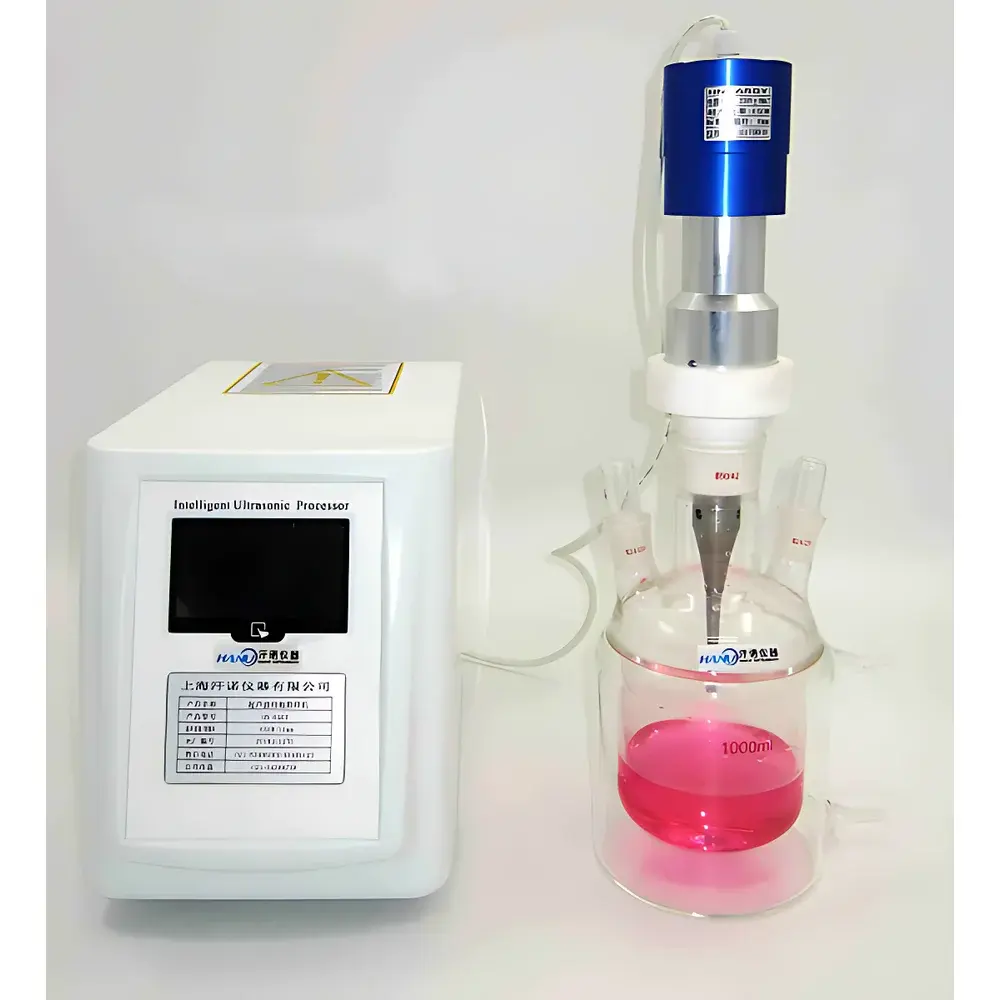
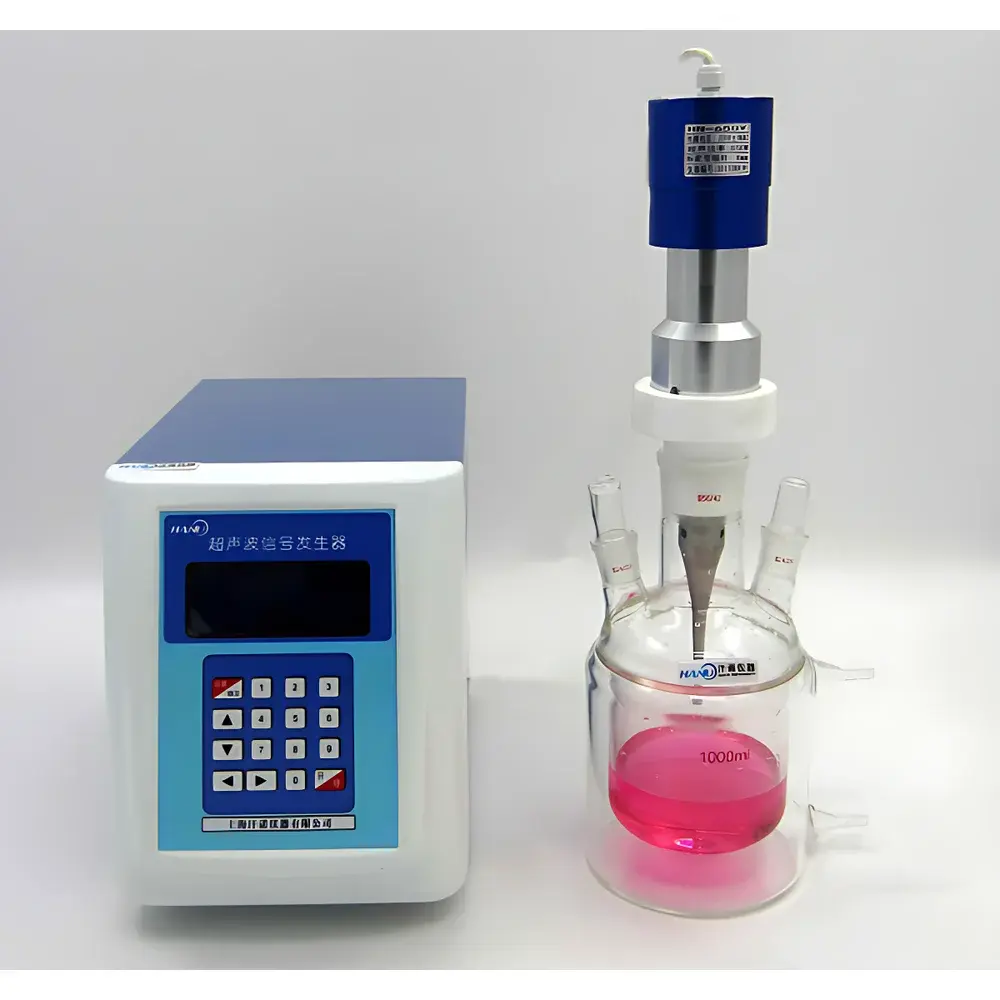
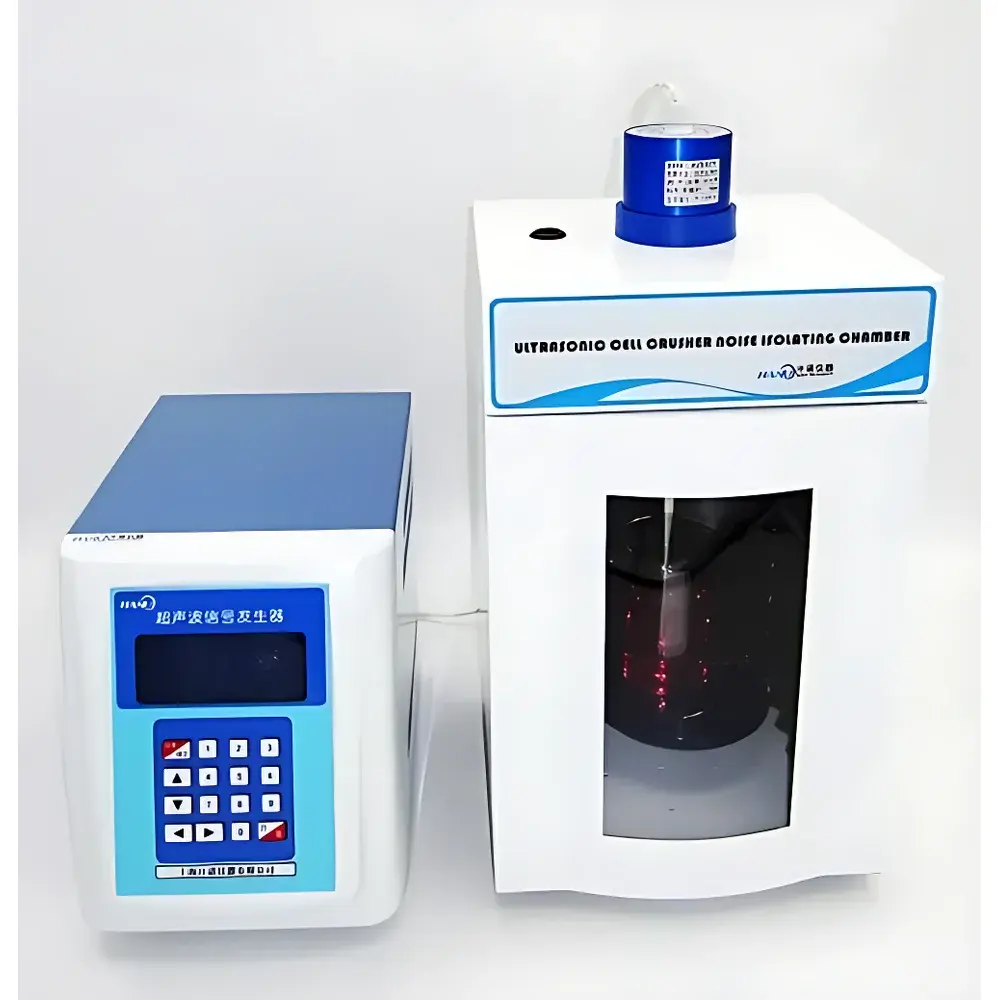
Hanuo HN-1500D Closed-Loop Temperature-Controlled Immersion Ultrasonic Reactor
| Brand | Hanuo |
|---|---|
| Origin | Shanghai, China |
| Model | HN-1500D |
| Ultrasonic Power | 50–1500 W (continuously adjustable) |
| Ultrasonic Frequency | 22 ± 1 kHz (auto-tuned, LCD-displayed) |
| Heating Power | 300 W |
| Temperature Range | −5 to 100 °C (optional −120 to 300 °C) |
| Reaction Vessel Capacity | 50–500 mL (standard glass double-jacketed, ground-glass joints: 50/24/24) |
| Stirring Speed | 0–2400 rpm (magnetic coupling, continuously adjustable) |
| Probe Diameter | Φ10 mm (titanium alloy, immersion-type) |
| Pulse Mode | Independent on/off control, programmable pulse duration and cycle count |
| Cooling/Heating Medium | Circulating water or thermal oil via jacket |
Overview
The Hanuo HN-1500D Closed-Loop Temperature-Controlled Immersion Ultrasonic Reactor is an engineered platform for reproducible sonochemical synthesis, extraction, and catalytic reaction studies under precisely regulated thermal and acoustic conditions. It operates on the principle of high-intensity ultrasonic cavitation—generated by a piezoelectric transducer coupled to a titanium alloy probe—inducing localized hotspots (>5000 K), extreme pressures (>1000 atm), and microturbulence within the liquid phase. Unlike bath-type systems, the immersion configuration ensures direct energy transfer with minimal attenuation, enabling consistent spatial distribution of acoustic intensity across variable sample volumes (50–500 mL). The reactor’s fully sealed architecture supports inert-atmosphere reactions (e.g., N₂, Ar, H₂), oxidative processes, or gas-liquid heterogeneous catalysis—critical for air-sensitive organometallic syntheses, nanoparticle nucleation, and green solvent-based extractions.
Key Features
- Immersion-mode titanium alloy ultrasonic probe (Φ10 mm) with corrosion-resistant surface finish, optimized for long-term stability in acidic, basic, and organic media.
- Hermetically sealed double-jacketed borosilicate glass reactor (50/24/24 standard taper joints), rated for vacuum and positive pressure up to 0.3 MPa.
- Independent ultrasonic pulse modulation: user-defined on-time (10 ms–99 s), off-time (10 ms–99 s), and total cycle count (1–999), with real-time digital counter and audible feedback.
- Integrated high-torque magnetic stirring (0–2400 rpm, closed-loop speed regulation) ensuring homogenous suspension of solids and uniform cavitation field distribution.
- Direct-in-solution Pt100 temperature sensor with ±0.2 °C accuracy, coupled to a PID-controlled heating/cooling system managing jacket fluid flow for dynamic thermal response (±0.3 °C setpoint stability over 6 h).
- Dual-interface design: top port accommodates condenser, dropping funnel, or gas dispersion tube; side ports support pressure-equalized sampling valves and inline IR/UV flow cells (optional).
- LCD control panel displaying real-time ultrasonic amplitude (%), frequency (kHz), temperature (°C), stirring speed (rpm), and pulse status—data exportable via RS-485 to LabVIEW or custom SCADA systems.
Sample Compatibility & Compliance
The HN-1500D accommodates aqueous, ethanolic, chlorinated, and ionic liquid matrices without probe degradation. Its Class I, Division 2 (CID2)-compatible electrical enclosure meets IEC 61000-6-3 EMC standards. Reaction vessels comply with ASTM E2877-22 for volumetric calibration of laboratory glassware. When operated with validated SOPs, the system supports GLP-compliant documentation workflows—including electronic audit trails for parameter changes, temperature logs, and pulse event timestamps—aligning with FDA 21 CFR Part 11 requirements when paired with compliant LIMS integration. All wetted materials (titanium probe, PTFE-sealed joints, borosilicate glass) conform to USP extractables profiling guidelines.
Software & Data Management
The reactor includes embedded firmware supporting time-stamped parameter logging at 1 Hz resolution (stored internally for ≥30 days). Optional PC software (Windows/Linux) enables remote operation, multi-step protocol scripting (e.g., ramped power + staged cooling + pulsed sonication), and CSV export compatible with MATLAB, OriginLab, and JMP for statistical process analysis. Raw thermal and acoustic datasets are annotated with ISO/IEC 17025 traceable calibration metadata, facilitating method validation per ISO 17025:2017 Clause 7.7.
Applications
- Sonochemical synthesis of metal–organic frameworks (MOFs) and perovskite nanocrystals under controlled O₂/N₂ atmospheres.
- Accelerated solid–liquid extraction of polyphenols from botanical matrices (e.g., green tea, grape pomace) with reduced solvent consumption vs. Soxhlet.
- In situ monitoring of palladium-catalyzed cross-coupling kinetics via integrated sampling ports and offline HPLC/GC-MS correlation.
- Cell disruption and protein solubilization in native buffers, minimizing thermal denaturation through pulsed low-duty-cycle protocols.
- Emulsion polymerization of acrylic monomers with narrow PDI (<1.15) achieved via cavitation-induced radical initiation uniformity.
FAQ
What safety certifications does the HN-1500D hold for international laboratory use?
It carries CE marking per Machinery Directive 2006/42/EC and Electromagnetic Compatibility Directive 2014/30/EU. Electrical insulation complies with IEC 61010-1:2010 for Laboratory Equipment.
Can the system be integrated into automated synthesis platforms?
Yes—RS-485 Modbus RTU interface enables bidirectional communication with PLCs and robotic liquid handlers for unattended multi-reactor campaigns.
Is calibration documentation provided with shipment?
Each unit ships with a factory-issued calibration certificate for temperature (NIST-traceable Pt100), ultrasonic power (calorimetrically verified), and stirring torque (load-cell referenced), valid for 12 months.
What maintenance intervals are recommended for sustained performance?
Ultrasonic transducer impedance verification every 500 operating hours; probe tip inspection for pitting or erosion every 1000 hours; jacket seal O-rings replaced annually or after exposure to halogenated solvents.
Does the system support external temperature controllers?
Yes—the jacket inlet/outlet ports accept standard 1/4″ NPT fittings compatible with Julabo, Huber, or LAUDA recirculating chillers/heaters with analog 0–10 V or 4–20 mA setpoint inputs.



