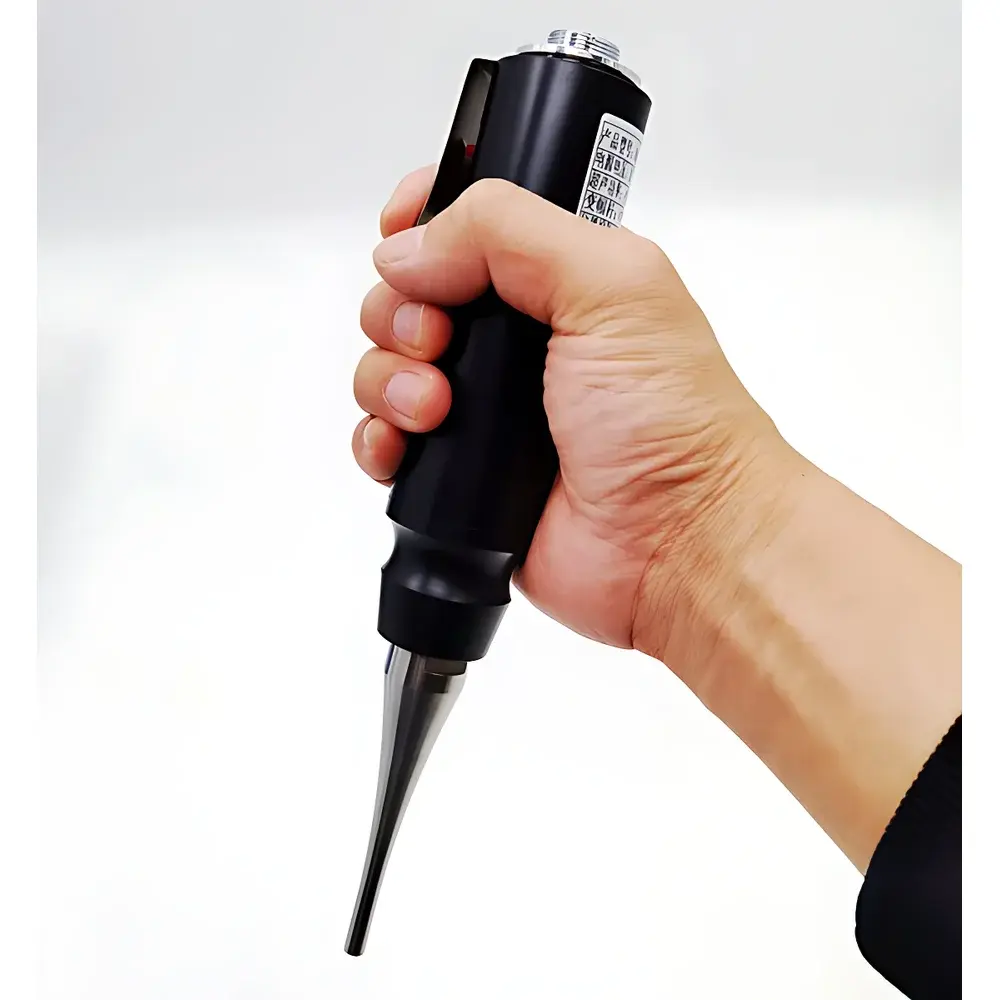
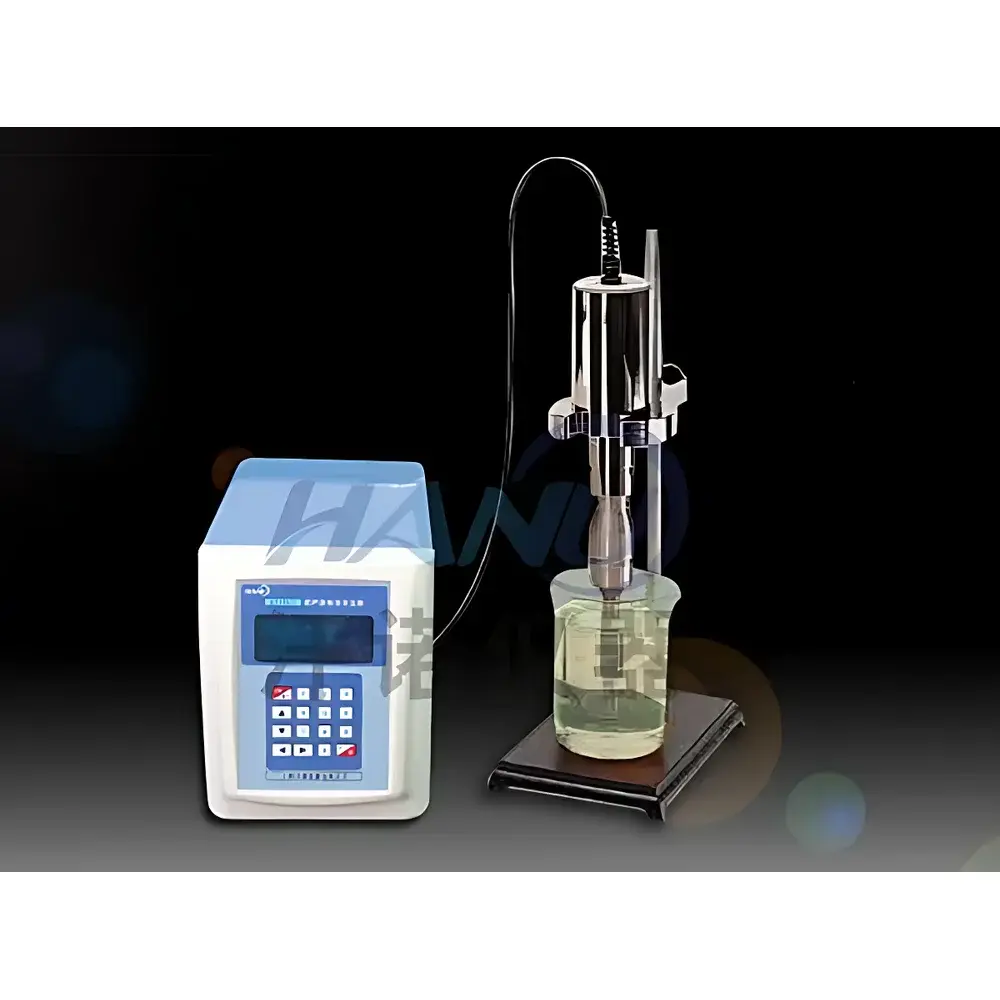
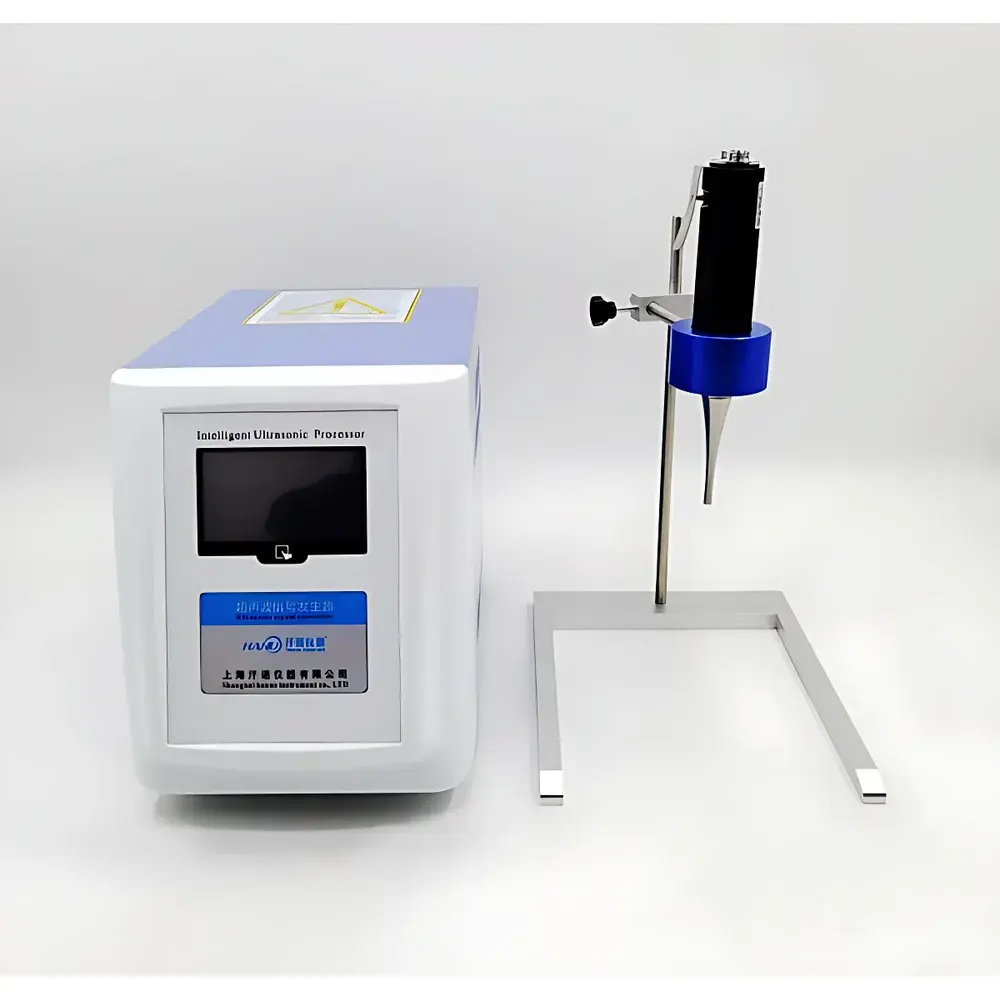
Hanuo HN-250M Handheld Ultrasonic Homogenizer
| Brand | Hanuo |
|---|---|
| Origin | Shanghai, China |
| Manufacturer Type | Authorized Distributor |
| Country of Origin | China |
| Model | Daxluot-250 |
| Instrument Type | Ultrasonic Cell Disruptor |
| Ultrasonic Power Output | 2.5–250 W (adjustable in 1% increments) |
| Operating Frequency | 20–30 kHz (frequency-tracking microprocessor control) |
| Temperature Monitoring Range | 0–100 °C (with real-time digital display) |
| Sample Volume Capacity | 0.1–150 mL (dependent on horn probe selection) |
| Probe Options | Standard Φ3 mm or Φ5 mm titanium alloy horn |
| Display | 4.3-inch full-color capacitive TFT touchscreen |
| Sonication Time per Cycle | 0.1–99.9 s |
| Interval Time per Cycle | 0.1–99.9 s |
| Total Process Duration | Up to 99 h 59 min 59 s |
| Safety Alarms | Over-temperature, overload, no-load, and time-out |
| Data Storage | 20 programmable protocols |
| Power Supply | 220 V / 110 V, 50 / 60 Hz |
| Compliance | CE-marked design architecture |
Overview
The Hanuo HN-250M Handheld Ultrasonic Homogenizer is an engineered solution for precise, scalable cell disruption and sample homogenization in life science laboratories. It operates on the principle of high-intensity ultrasonic cavitation—where rapid pressure fluctuations generated by piezoelectric transduction at 20–30 kHz induce transient microbubble formation and collapse in liquid media. This process delivers localized shear forces exceeding 104 g, enabling efficient lysis of bacterial, yeast, mammalian, and plant cells—without significant thermal degradation when operated under pulsed mode. Unlike fixed-platform sonicators, the HN-250M’s ergonomic handheld design allows direct, real-time manipulation over small-volume samples (0.1–150 mL), making it particularly suitable for low-throughput R&D, pilot-scale optimization, and field-deployable applications where spatial constraints or workflow flexibility are critical.
Key Features
- Ergonomic handheld transducer unit with integrated titanium alloy probe (standard Φ3 mm or Φ5 mm), weighing under 650 g for fatigue-free operation during extended use.
- Microprocessor-controlled frequency tracking ensures stable acoustic output across variable load conditions—critical for reproducible energy delivery in viscous or particulate-laden suspensions.
- True-color 4.3-inch capacitive TFT touchscreen interface supports intuitive parameter entry, real-time temperature monitoring (0–100 °C), and visual feedback for sonication status and alarm triggers.
- Pulse-mode operation with independently adjustable sonication duration (0.1–99.9 s) and off-interval (0.1–99.9 s) minimizes thermal accumulation—essential for heat-sensitive proteins, nucleic acids, or membrane vesicles.
- 20 programmable protocols enable method standardization across users and shifts, supporting audit-ready documentation requirements under GLP or internal QA frameworks.
- Comprehensive safety system includes automatic shutdown upon detection of over-temperature, no-load (air exposure), overload (impedance mismatch), or timer expiration.
Sample Compatibility & Compliance
The HN-250M accommodates a broad range of biological matrices—including E. coli cultures, CHO cell suspensions, tissue homogenates, viral lysates, and lipid nanoparticle dispersions—when paired with appropriate probe geometries. Its modular probe system (Φ2, Φ3, Φ5, Φ6 mm) permits optimization of energy density (W/mm²) relative to sample viscosity and target particle size. While not certified to ISO/IEC 17025 as a testing laboratory instrument, its hardware architecture aligns with foundational elements of FDA 21 CFR Part 11 readiness: electronic records are timestamped, user-accessible protocols are non-editable post-execution, and all alarms generate immutable event logs. The device meets CE electromagnetic compatibility (EN 61326-1) and low-voltage directive (2014/35/EU) requirements for laboratory equipment.
Software & Data Management
The embedded firmware supports protocol-based execution without external PC dependency. All 20 stored methods retain full parameter sets—including power level (% of 250 W), cycle timing, temperature thresholds, and probe ID—for traceability. Optional RS-232 or USB-to-serial interface enables integration with LIMS or custom Python/Matlab scripts for automated data logging. Exported CSV files include timestamps, actual delivered power (monitored via impedance feedback), and thermal deviation metrics—facilitating retrospective analysis of process consistency across batches. No proprietary software installation is required for basic operation; advanced export functionality requires vendor-provided terminal utility (Windows/macOS compatible).
Applications
- Preparative lysis of Gram-negative and Gram-positive bacteria for recombinant protein extraction.
- Disruption of adherent mammalian cells directly in culture plates or tubes prior to subcellular fractionation.
- Emulsification of oil-in-water nanoemulsions for drug delivery formulation development.
- Chromatin shearing in native ChIP-seq workflows requiring minimal DNA fragmentation bias.
- Rapid cleaning of microfluidic channels and capillary surfaces via acoustic streaming-induced particle removal.
- Accelerated solvent extraction of secondary metabolites from plant tissues under ambient or chilled conditions.
FAQ
Is the HN-250M suitable for RNA isolation protocols?
Yes—when operated in pulse mode with ice-cooled sample vessels and Φ3 mm probe, it achieves efficient lysis while maintaining RNA integrity (RIN > 8.5) in most vertebrate cell types.
Can the device be used with corrosive solvents like chloroform or phenol?
Titanium alloy probes resist mild organic solvents; however, prolonged exposure to strong oxidizers (e.g., concentrated HNO₃) or halogenated hydrocarbons is not recommended—consult chemical compatibility charts before use.
Does the unit support continuous operation beyond 5 minutes?
Continuous duty is limited to ≤3 minutes at ≥80% power to prevent transducer overheating; pulsed operation (e.g., 5 s on / 10 s off) enables indefinite runtime with thermal stabilization.
How is calibration verified?
Hanuo provides factory calibration certificates referencing ASTM E2810-11 (Standard Practice for Calibration of Ultrasonic Power Meters); end-users may perform routine verification using calorimetric methods per ISO 140-3.
Is remote monitoring supported?
Not natively—but the serial interface allows third-party SCADA integration for real-time power and temperature telemetry in controlled environments.