
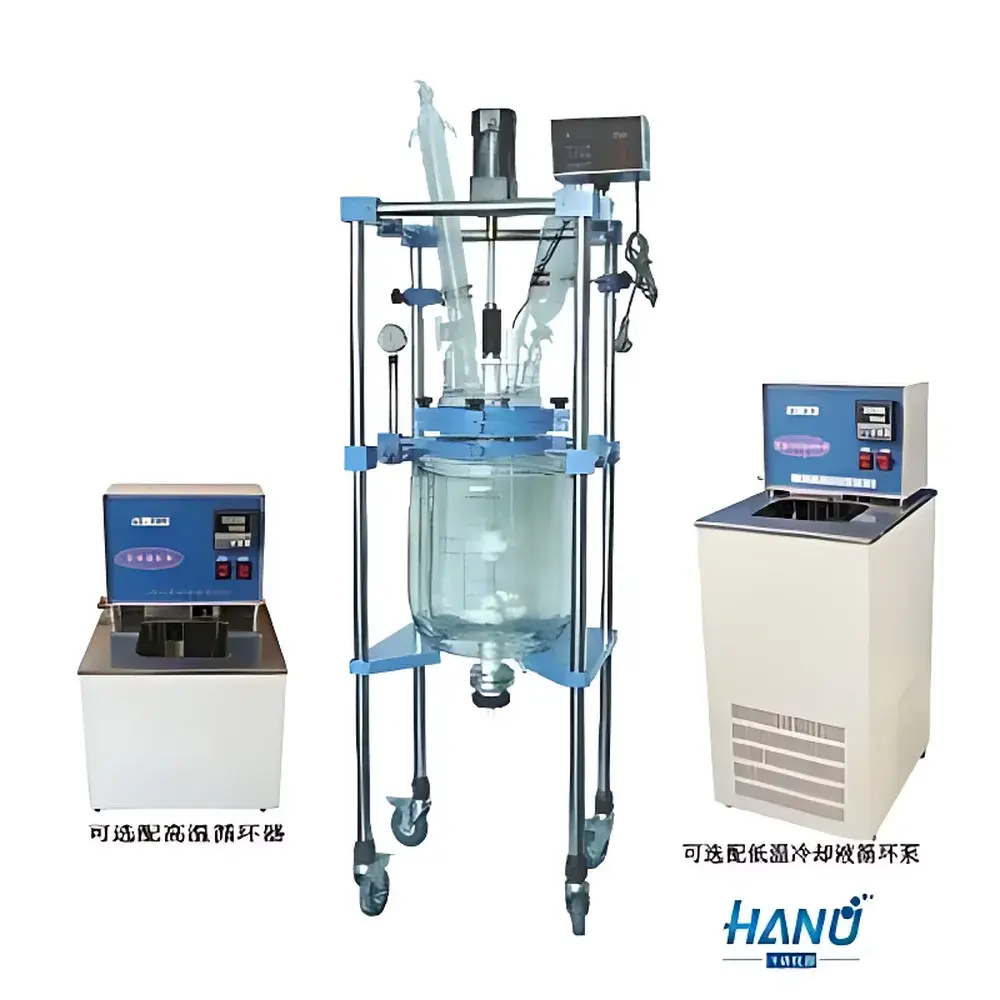
Hanuo HN-Series Jacketed Glass Reactor (10–50 L)
| Brand | Hanuo |
|---|---|
| Capacity | 10–50 L |
| Construction Material | Borosilicate Glass 3.3 (DIN ISO 3585) |
| Operating Pressure | Low-pressure, Vacuum-Compatible |
| Maximum Vacuum | −0.096 MPa (≈ 96 kPa absolute) |
| Stirring Speed Range | 50–600 rpm |
| Motor Type | Brushless AC Induction Motor |
| Power Input | 120–180 W (model-dependent) |
| Torque Output | 162–300 N·cm |
| Voltage | 220 V AC, 50 Hz |
| Jacket Inlet/Outlet | Standard G1/2″ or G3/4″ BSP |
| Lid Diameter | 265 mm |
| Port Configuration | 5 standard NS29/32 ground-glass joints |
| Bottom Discharge | PTFE-lined stainless steel valve with ISO-KF or DN25 flange interface |
| Cooling/Heating Medium Compatibility | Water, glycol/water mixtures, silicone oil, thermal oils (−80 °C to +200 °C) |
Overview
The Hanuo HN-Series Jacketed Glass Reactor is a modular, vacuum-rated, double-walled laboratory reactor system engineered for scalable synthesis, process development, and pilot-scale reaction studies. Designed around the principles of controlled heat transfer and inert, transparent reaction monitoring, it employs a concentric jacketed vessel architecture where the inner vessel contains the reaction mixture while the annular space accommodates circulating thermal fluids—enabling precise temperature control from sub-zero cryogenic conditions to elevated heating regimes. Its borosilicate glass 3.3 construction (compliant with DIN ISO 3585) ensures high chemical resistance to acids, alkalis, and organic solvents, as well as superior thermal shock tolerance (ΔT ≥ 120 °C). The system operates under ambient pressure or reduced pressure (down to −0.096 MPa), supporting reflux, distillation, solvent removal, and gas-phase reactions—making it suitable for applications in fine chemical process optimization, API intermediate synthesis, polymerization kinetics, and biocatalytic transformations.
Key Features
- Double-wall borosilicate glass 3.3 vessel with precision-ground joints (NS29/32) for leak-tight, repeatable assembly of condensers, addition funnels, thermometers, and gas inlets.
- Brushless AC induction motor drive with digital frequency converter—provides stable, spark-free operation across 50–600 rpm; eliminates brush wear and electromagnetic interference in sensitive environments.
- High-torque stirring system (162–300 N·cm) compatible with anchor, paddle, and turbine impellers; optimized for viscous media and heterogeneous slurries.
- Integrated bottom discharge port featuring PTFE-sealed stainless steel valve and ISO-KF/DN25 flanged interface—ensures complete, residue-free solid or slurry evacuation without vessel disassembly.
- Five-port standardized lid (265 mm diameter) enables simultaneous integration of temperature probe, mechanical stirrer, reflux condenser, dropping funnel, and inert gas purge line—supporting complex multi-step protocols per GLP-compliant workflows.
- Jacket fluid connections conform to industrial BSP threading (G1/2″ or G3/4″), allowing direct coupling to external chillers, heating circulators, or dual-temperature units operating between −80 °C and +200 °C.
Sample Compatibility & Compliance
The HN-Series is chemically compatible with a broad spectrum of reagents including halogenated solvents (e.g., DCM, chloroform), strong acids (H₂SO₄, HNO₃ ≤ 65%), caustic solutions (NaOH ≤ 30%), and polar aprotic media (DMF, DMSO). It is not recommended for use with hydrofluoric acid, hot concentrated phosphoric acid, or alkaline peroxides. All glass components meet ASTM E438 Type I, Class A specifications for laboratory glassware. The reactor system supports compliance with ISO 17025 documentation requirements when paired with calibrated temperature sensors and traceable pressure transducers. Vacuum performance aligns with ISO 2859-1 sampling plans for leak integrity verification at −0.096 MPa.
Software & Data Management
While the base configuration is manually operated, optional digital controllers (e.g., Hanuo TC-3000 series) provide PID-regulated jacket temperature setpoint control with ±0.3 °C stability and real-time logging via RS485/Modbus RTU. When integrated with third-party SCADA or LIMS platforms, the system supports audit-trail-enabled data capture compliant with FDA 21 CFR Part 11 requirements—including user authentication, electronic signatures, and immutable timestamped records of temperature, pressure, and agitation parameters.
Applications
- Process development of Grignard, lithiation, and hydrogenation reactions under inert atmosphere or controlled vacuum.
- Thermal profiling of exothermic polymerizations (e.g., epoxy curing, polyacrylate chain growth) with real-time visual monitoring.
- Solvent-sensitive crystallization trials requiring gradual cooling ramps and nucleation observation.
- Distillative workup of reaction mixtures using integrated vertical condensers and fractional adapters.
- Photochemical reactions utilizing UV-transparent glass walls and optional quartz-jacketed variants.
- Education and training in unit operations—demonstrating mass/energy balance, reaction kinetics, and scale-up principles from lab to pilot scale.
FAQ
What temperature range can the jacket accommodate?
The jacket accepts thermal fluids ranging from −80 °C (using ethylene glycol/dry ice or liquid nitrogen cryocoolers) to +200 °C (with silicone or mineral oils), subject to circulator compatibility and glass thermal stress limits.
Is the reactor suitable for corrosive halogenated solvents?
Yes—borosilicate glass 3.3 exhibits excellent resistance to chlorinated and fluorinated solvents under standard operating temperatures and pressures; however, prolonged exposure to boiling chloroform above 60 °C is not advised due to potential stress corrosion.
Can the system be validated for GMP manufacturing environments?
The reactor itself is not GMP-certified as a standalone unit; however, its design—traceable materials, cleanable geometry, and compatibility with IQ/OQ protocols—enables qualification as part of a validated process train when installed with calibrated instrumentation and documented SOPs.
What maintenance is required for long-term reliability?
Routine inspection of ground-glass joints for scoring, periodic torque verification of PTFE valve seals, and annual calibration of external temperature sensors are recommended. Motor and controller electronics require no scheduled maintenance under continuous operation.
Are custom port configurations or larger capacities available?
Yes—Hanuo offers OEM engineering services for non-standard lid layouts (e.g., 7-port or side-inlet variants), vacuum-distillation-ready configurations, and vessels up to 100 L upon request, subject to structural validation and shipping constraints.



