
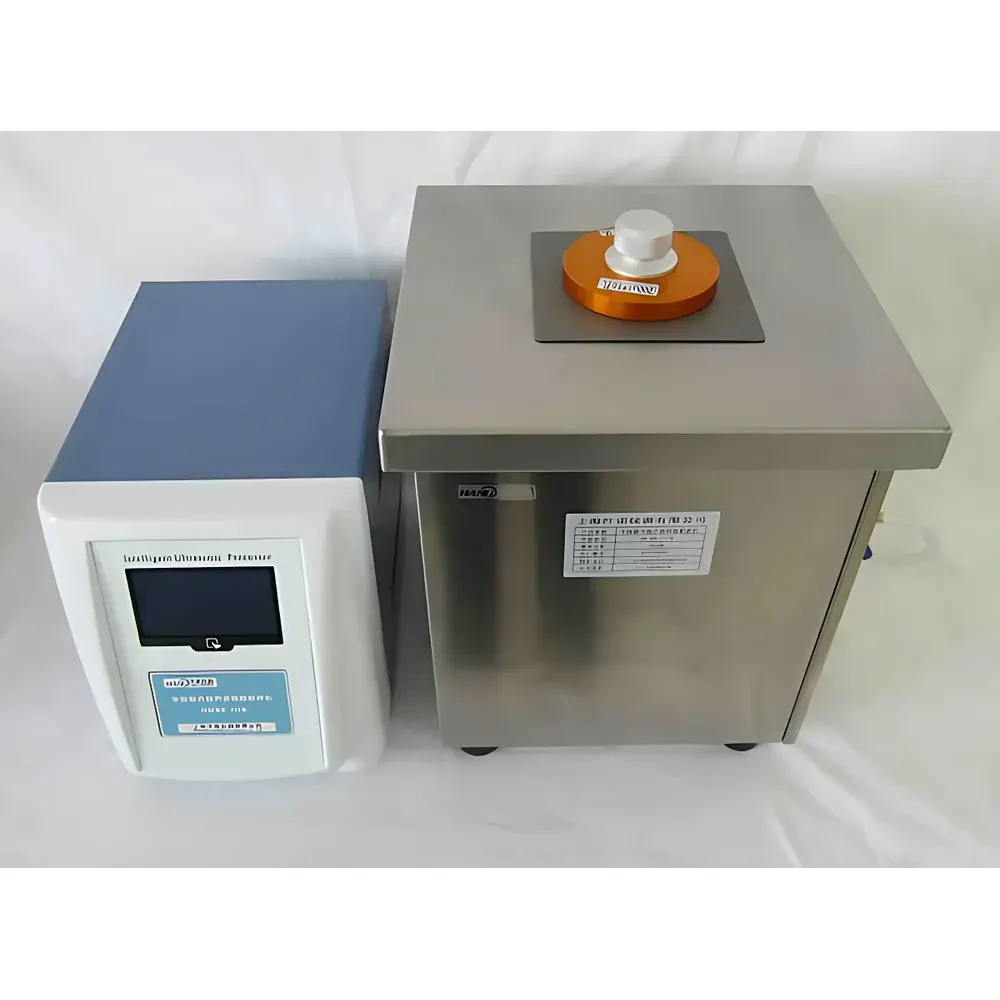
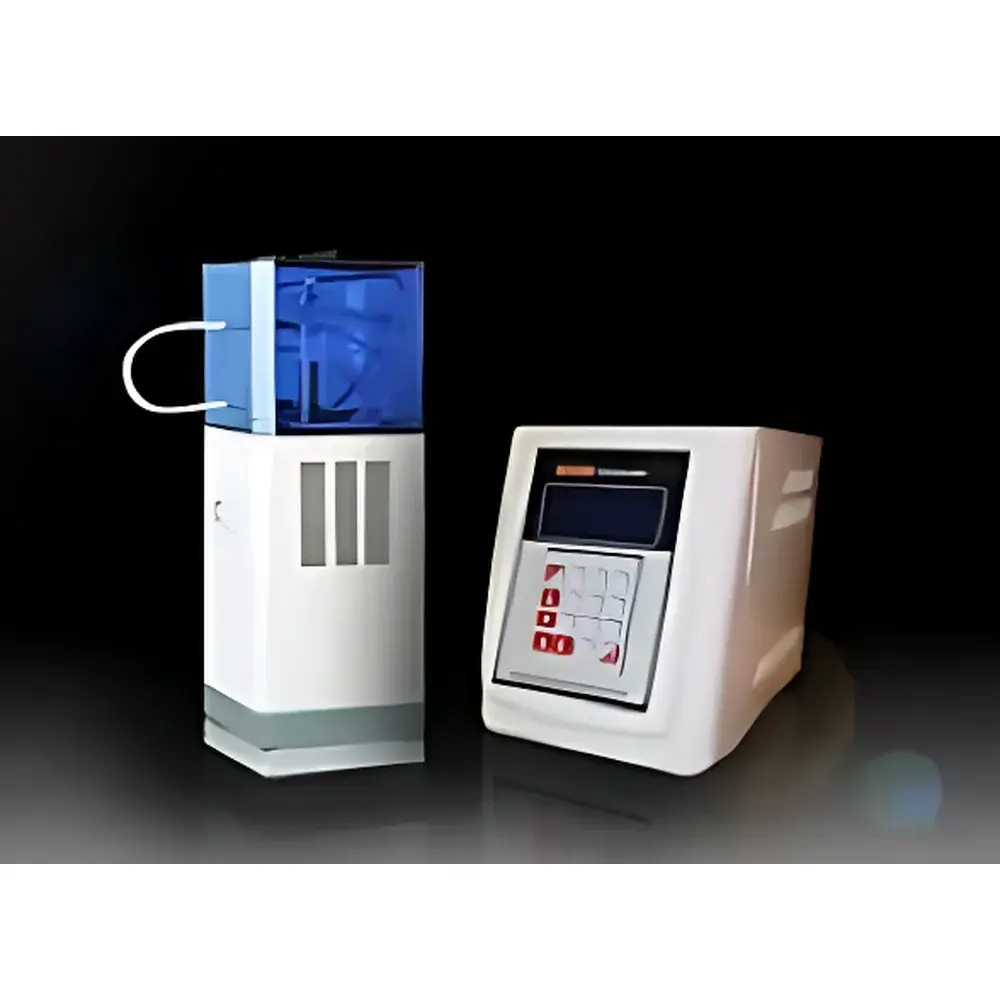
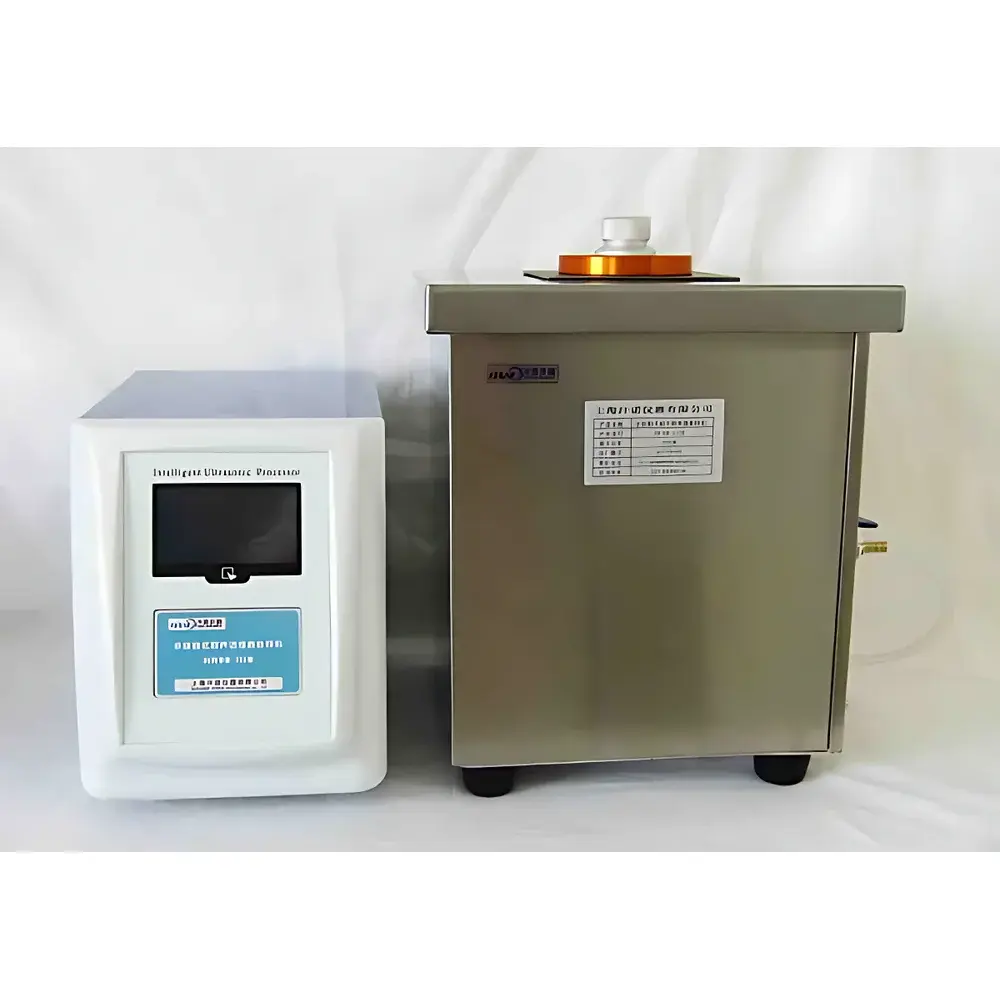
Hanuo HN98-IIB Cup-Horn Ultrasonic Cell Disruptor
| Brand | Hanuo |
|---|---|
| Origin | Shanghai, China |
| Model | HN98-IIB |
| Instrument Type | Cup-Horn Ultrasonic Cell Disruptor |
| Ultrasonic Power | 2500 W |
| Operating Frequency | 19 kHz |
| Sample Volume per Tube | 0.1–2 mL |
| Maximum Simultaneous Samples | 8 |
| Temperature Control | Ambient (with optional external chiller interface) |
| Duty Cycle Range | 1–99.9% |
| Input Voltage | 220 V / 50 Hz (standard) |
| Compliance | CE-marked design principles |
Overview
The Hanuo HN98-IIB Cup-Horn Ultrasonic Cell Disruptor is a fully enclosed, non-contact ultrasonic homogenization system engineered for high-efficiency, reproducible cell lysis and chromatin shearing in molecular biology and biopharmaceutical research. Unlike probe-based sonicators, this instrument employs a cup-horn transducer configuration: ultrasonic energy is transmitted through the walls of sealed microcentrifuge tubes immersed in a water-coupled stainless-steel cup, eliminating direct probe contact with samples. This architecture inherently prevents aerosol generation, cross-contamination, and thermal runaway—critical advantages for biosafety-sensitive applications such as adenovirus particle release, chromatin immunoprecipitation (ChIP), and nucleic acid-protein complex preparation. The system operates at a fixed resonant frequency of 19 kHz, delivering controlled cavitation within the liquid phase to induce mechanical shear forces sufficient to fragment chromosomal DNA, disrupt bacterial and mammalian cells, and solubilize inclusion bodies—without denaturing labile epitopes or co-factors.
Key Features
- Touchscreen interface with intuitive parameter programming: amplitude (0–100%), duty cycle (1–99.9%), total sonication time, and pulse interval—all configurable per protocol.
- Simultaneous processing of up to 8 samples (0.1–2 mL each) in individual, sealed 1.5–2.0 mL microcentrifuge tubes—enabling parallelized ChIP-seq, ATAC-seq, or viral vector prep workflows.
- Integrated acoustic damping enclosure with hinged access door and ergonomic side handles—reducing ambient noise to <65 dB(A) during operation and facilitating safe manual intervention.
- Dedicated cooling jacket port compatible with external recirculating chillers (e.g., –10 °C to +20 °C range), ensuring sample temperature stability during extended sonication cycles.
- Anti-foaming mode algorithm modulates power delivery to suppress bubble accumulation—particularly critical for viscous lysates or high-concentration viral suspensions.
- Robust stainless-steel cup-horn assembly with precision-machined titanium alloy horn surface—optimized for consistent energy transfer and long-term resonance stability.
Sample Compatibility & Compliance
The HN98-IIB accommodates standard polypropylene or low-binding microcentrifuge tubes (1.5–2.0 mL) without adapters. It supports diverse biological matrices: cultured mammalian cells (HEK293, HeLa), bacterial pellets (E. coli, B. subtilis), yeast spheroplasts, tissue homogenates, and soil suspensions. Its closed-tube design meets biosafety level 2 (BSL-2) containment requirements for handling replication-deficient adenoviral vectors and other moderate-risk agents. While not certified under ISO 13485 or FDA 21 CFR Part 11 out-of-the-box, the system’s protocol-driven operation, audit-ready parameter logging (via optional USB export), and traceable duty-cycle/amplitude settings support alignment with GLP and GMP documentation standards for preclinical assay development.
Software & Data Management
The embedded firmware stores up to 99 user-defined protocols with timestamped execution logs (date, time, operator ID placeholder, parameters). Data export is supported via USB flash drive in CSV format—containing cycle start/end timestamps, cumulative energy delivery estimates (W·s), and thermal status flags. No cloud connectivity or proprietary software installation is required. For laboratories operating under regulated environments, the system can be integrated into electronic lab notebook (ELN) platforms via manual log import, satisfying basic ALCOA+ data integrity criteria when paired with procedural SOPs.
Applications
- Chromatin fragmentation for ChIP-qPCR and ChIP-seq—producing DNA fragments in the 200–700 bp range with narrow size distribution.
- Adenovirus capsid disruption and genomic DNA release—enabling high-titer vector purification without protease contamination.
- Preparation of terminal protein-DNA complexes from adenoviral genomes for structural studies.
- Soil metagenomic extraction—efficient lysis of Gram-positive bacteria and spores while preserving DNA integrity.
- Cellular organelle isolation—gentle membrane disruption for mitochondria or nuclei enrichment.
- Pre-analytical sample prep for single-cell multi-omics workflows requiring low-input, high-reproducibility lysis.
FAQ
Is the HN98-IIB suitable for RNA extraction workflows?
Yes—its non-contact design minimizes RNase activation and thermal degradation; however, use of RNase-free tubes and chilled buffers is still required.
Can I process 16 samples simultaneously on this model?
No—the HN98-IIB supports up to 8 samples concurrently; the HN98-IIIB variant is required for 16-tube capacity.
Does the system include a built-in chiller?
No—it features a standardized cooling jacket inlet/outlet port for integration with third-party recirculating chillers (e.g., Huber, Julabo, or PolyScience units).
What maintenance is required for long-term reliability?
Annual inspection of horn coupling integrity and cup seal condition is recommended; ultrasonic transducer calibration is not user-serviceable and requires factory-certified recalibration every 24 months.
Is validation documentation available for regulatory submissions?
Instrument IQ/OQ documentation templates are provided upon request; PQ must be performed in situ using lab-specific acceptance criteria aligned with ISO/IEC 17025 or similar standards.




