
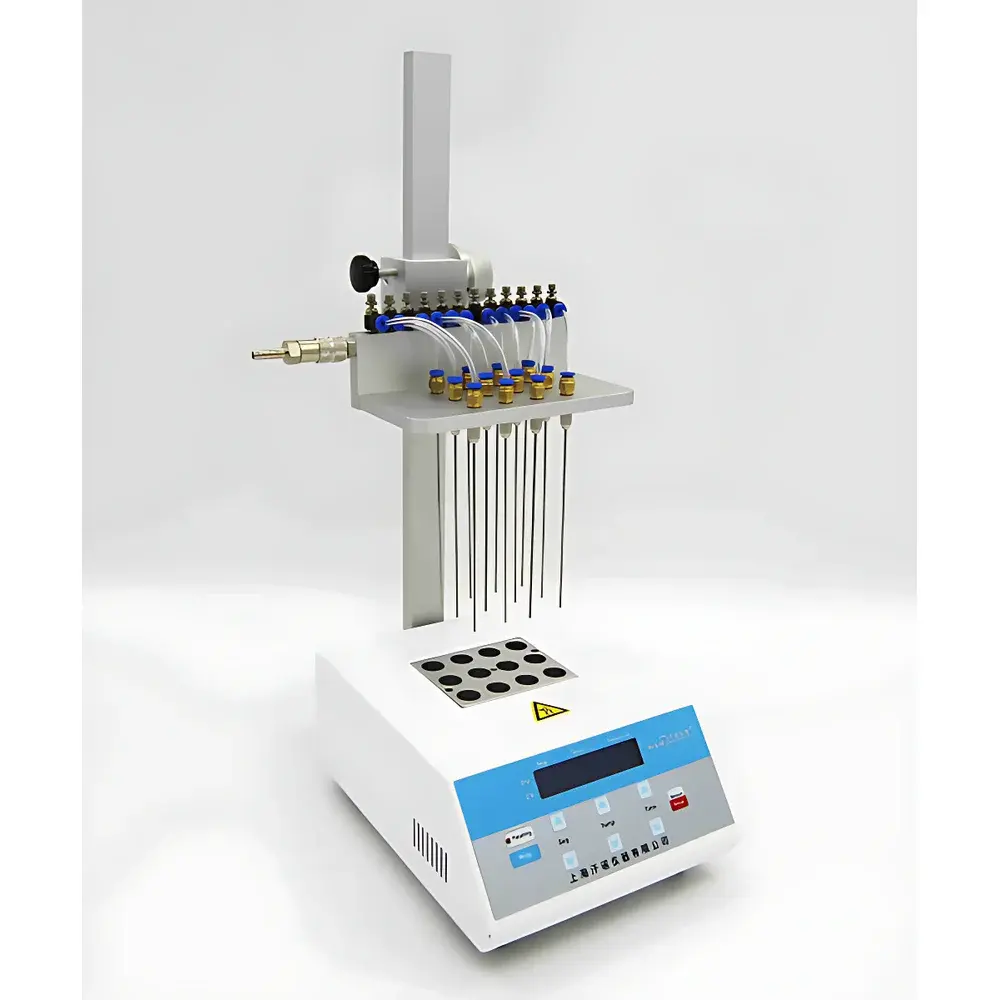
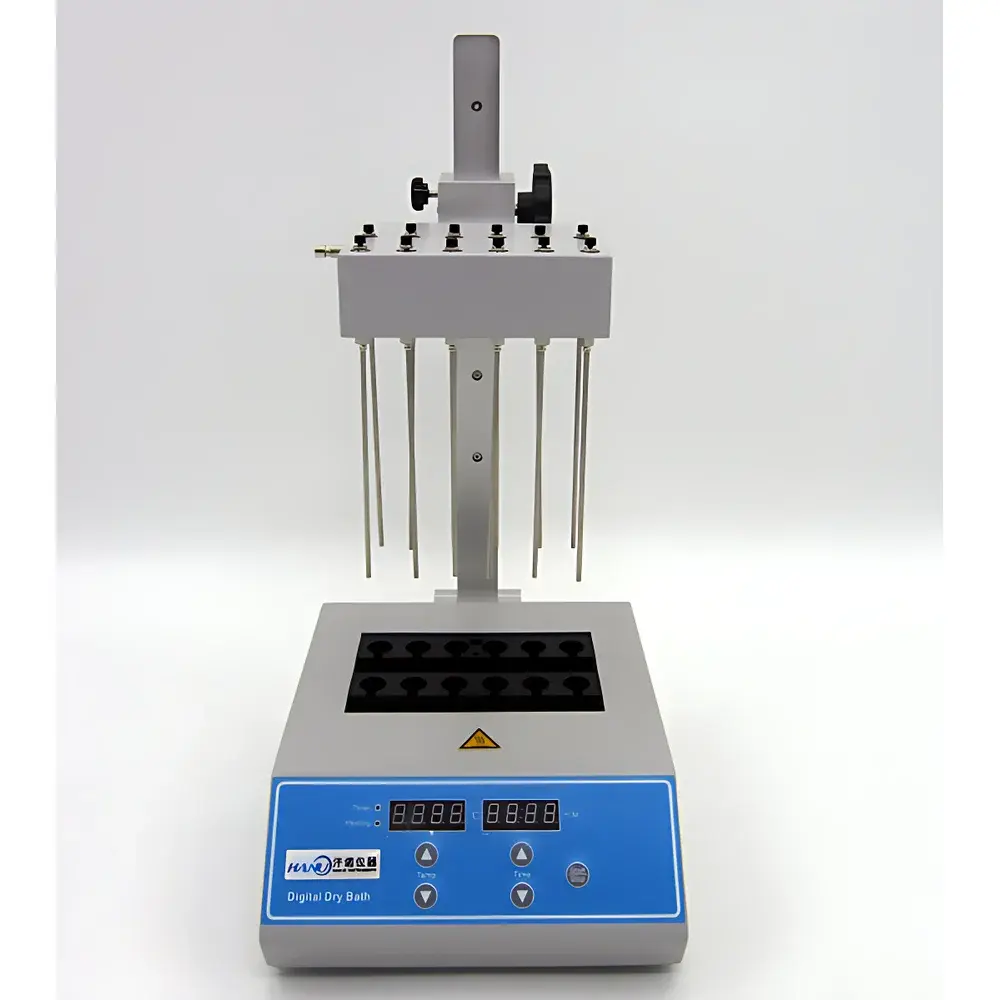
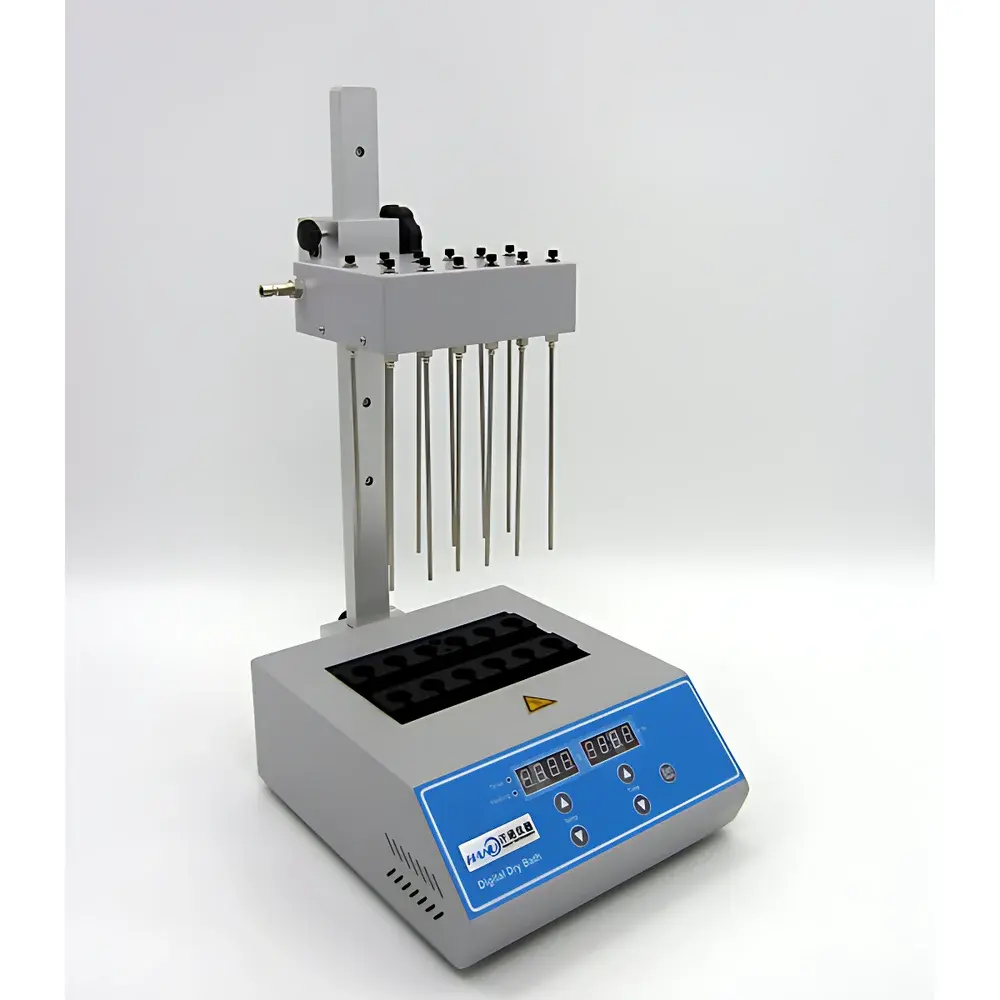
Hanuo HNDK200-2 Dry-Block Heated Nitrogen Evaporator
| Brand | Hanuo |
|---|---|
| Origin | Shanghai, China |
| Heating Method | Dry-block heating |
| Temperature Range | Ambient +5°C to 150°C |
| Temperature Stability | ±0.5°C at 100°C |
| Temperature Accuracy | ±0.5°C (40–100°C), ±1.0°C (100–150°C) |
| Sample Capacity | 24 positions |
| Tube Diameter Compatibility | 10–29 mm |
| Nitrogen Flow Rate | 0–10 L/min |
| Max Operating Pressure | ≤0.1 MPa |
| Heating Power | 150 W |
| Display Resolution | 0.1°C |
| Timer Range | 0–99 h 59 min |
| Safety Features | Over-temperature protection, real-time fault detection & audible alarm |
| Module Configuration | Dual interchangeable heating blocks (standard: two 12-position blocks) |
Overview
The Hanuo HNDK200-2 Dry-Block Heated Nitrogen Evaporator is an engineered solution for parallel solvent removal and sample concentration in analytical laboratories. It operates on the principle of controlled nitrogen gas sparging over heated liquid surfaces—accelerating evaporation while minimizing oxidation, thermal degradation, or cross-contamination. Unlike rotary evaporation, which processes samples sequentially, the HNDK200-2 enables simultaneous concentration of up to 24 samples under precisely regulated thermal and gaseous conditions. Its dry-block heating architecture eliminates oil bath maintenance and contamination risks, offering improved thermal uniformity, faster ramp times (≤30 min from 40°C to 150°C), and enhanced reproducibility across high-throughput workflows. Designed for compatibility with LC-MS, GC-MS, HPLC, immunoassay, and clinical toxicology sample preparation, the system supports method robustness in regulated environments where trace-level analyte integrity is critical.
Key Features
- Dual independent dry-block heating modules (12 positions each), enabling flexible configuration for heterogeneous tube sizes (10–29 mm OD) and staggered protocol execution
- Programmable temperature control from ambient +5°C to 150°C with ±0.5°C stability at 100°C and 0.1°C display resolution
- Individual gas channel shut-off valves (12 total) for precise nitrogen flow allocation—reducing gas consumption by up to 40% compared to fixed-flow systems
- Vertically adjustable gas manifold with 150 mm standard stainless-steel needles; height synchronizes dynamically with solvent level decline to maintain optimal gas–liquid interface distance
- Integrated safety architecture: real-time over-temperature cutoff, self-diagnostic error reporting, and audible alarm activation upon thermal or pressure anomaly
- LED-based user interface with dual-display capability—simultaneous viewing of setpoint temperature and countdown timer (0–99 h 59 min)
- Compact footprint and ventilation-compatible design: fully operable inside fume hoods when handling volatile, toxic, or low-boiling solvents (e.g., chloroform, hexane, acetonitrile)
Sample Compatibility & Compliance
The HNDK200-2 accommodates a broad range of sample containers—including culture tubes, centrifuge tubes, and GC vials—via interchangeable aluminum heating blocks (15 mm, 16 mm, and 19 mm configurations available). Its nitrogen delivery system meets ISO 8573-1 Class 2 purity requirements when paired with laboratory-grade nitrogen generators or cylinder supply (≤0.1 MPa inlet pressure). The instrument’s thermal performance aligns with ASTM E2014-22 (Standard Practice for Calibration of Thermal Analyzers) for block uniformity verification. While not inherently 21 CFR Part 11 compliant, its time-stamped temperature logging (when integrated with optional external data acquisition software) supports GLP/GMP-aligned recordkeeping for QC/QA applications in pharmaceutical and environmental testing labs.
Software & Data Management
The HNDK200-2 operates as a standalone benchtop unit with embedded firmware—no proprietary software required for basic operation. For audit-trail compliance, analog voltage outputs (0–5 V) are provided for external temperature monitoring and integration with LabArchives, Empower, or custom SCADA systems. Optional RS-232/USB interface modules enable remote parameter setting, real-time temperature streaming, and event-triggered data capture (e.g., alarm activation, timer completion). All logged values retain timestamp metadata, satisfying minimum ALCOA+ principles (Attributable, Legible, Contemporaneous, Original, Accurate) when exported to CSV or Excel formats.
Applications
- High-throughput sample prep for LC-MS/MS quantification of steroids, opioids, and therapeutic drugs in serum and urine matrices
- Residue analysis in food safety testing (e.g., pesticide extraction from fruits, vegetables, and dairy per AOAC 2007.01)
- Environmental monitoring: concentration of PAHs, PCBs, and organochlorine pesticides from water and soil extracts prior to GC-ECD or GC-MS analysis
- Forensic toxicology workflows requiring inert-atmosphere evaporation to preserve unstable metabolites
- Preparative chemistry: gentle removal of volatile solvents from reaction mixtures without bumping or foaming
FAQ
What is the maximum recommended nitrogen pressure for safe operation?
The inlet pressure must not exceed 0.1 MPa (1 bar); higher pressures may cause needle dislodgement or uneven gas distribution.
Can the HNDK200-2 be used with solvents boiling below 40°C?
Yes—provided the system is operated inside a certified fume hood and temperature setpoints are maintained ≥10°C above solvent boiling point to ensure controlled, non-turbulent evaporation.
Is calibration documentation included with shipment?
A factory calibration certificate (traceable to NIST standards) is supplied; users are advised to perform annual verification using calibrated PT100 probes per ISO/IEC 17025 guidelines.
Are replacement heating blocks available for non-standard tube formats?
Yes—custom-machined aluminum blocks (e.g., for 24-well plates or conical-bottom vials) can be ordered under Hanuo part numbers NDK-BLK-XX series.
Does the unit support programmable multi-step temperature ramps?
No—the HNDK200-2 features single-setpoint control only; multi-stage protocols require external sequencer integration via analog I/O or serial command scripting.



