
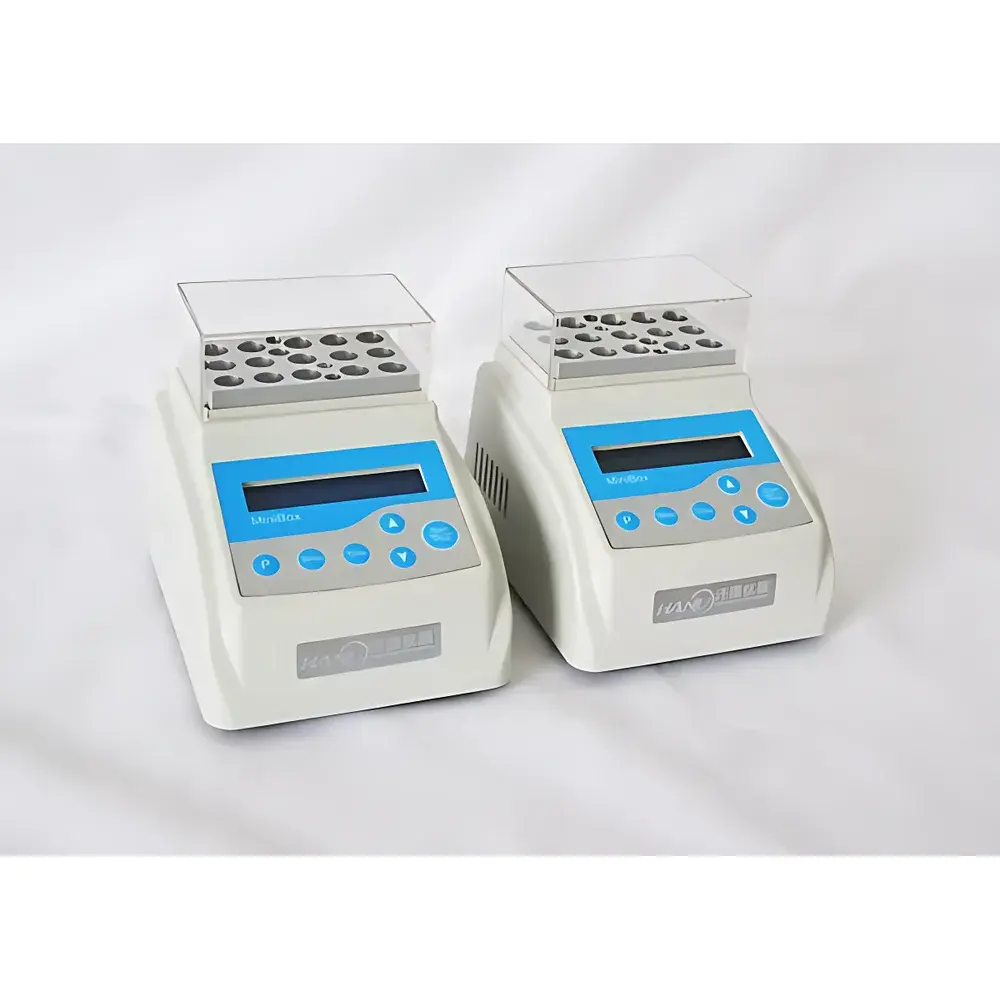
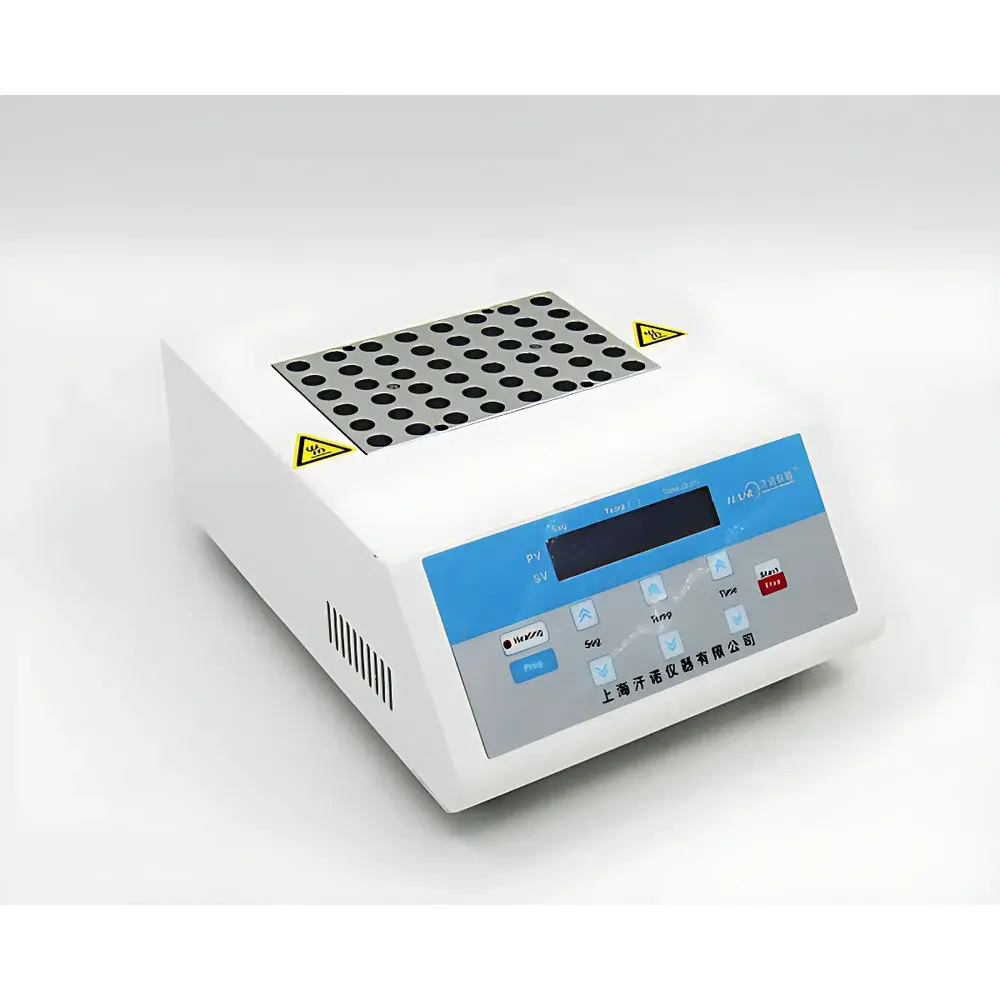
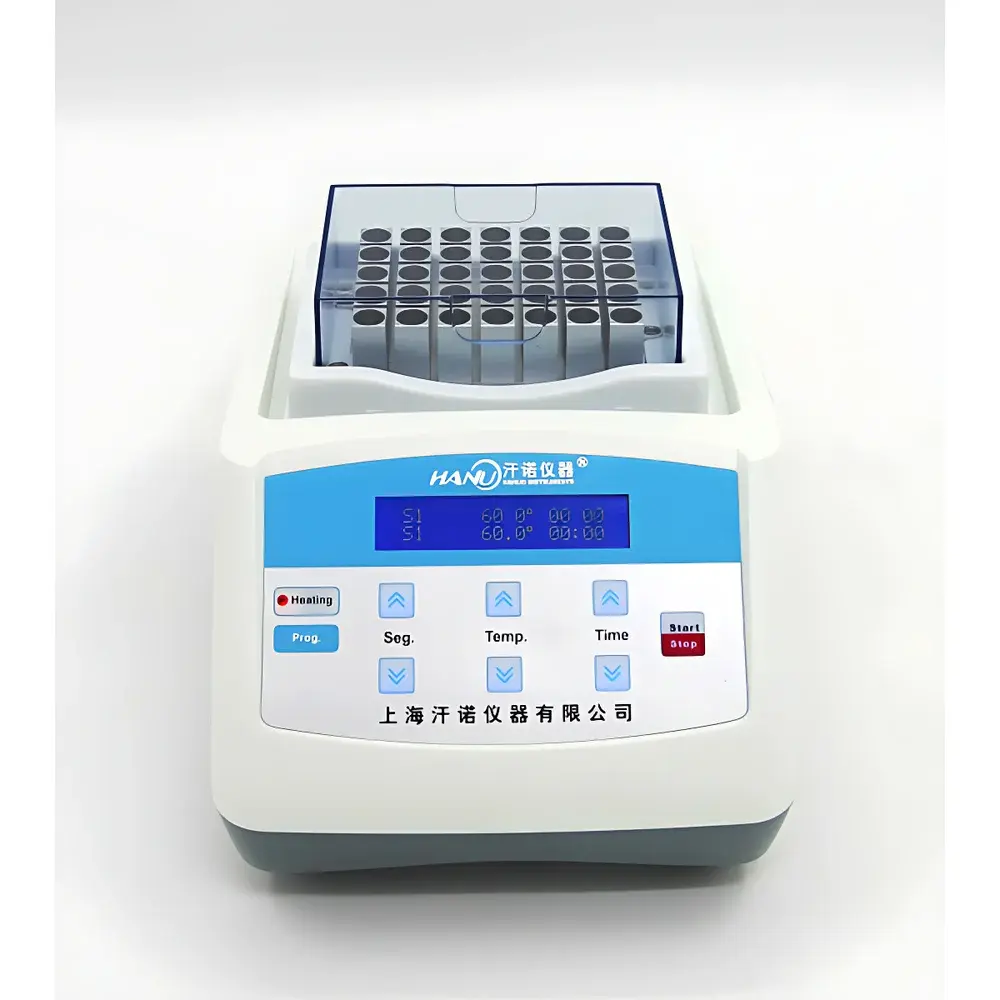
Hanuo HNES1000 Thermally Controlled Metal Block Bath with Heated Lid
| Brand | Hanuo |
|---|---|
| Model | HNES1000 |
| Temperature Range | −10 °C to 100 °C |
| Temperature Accuracy | ≤ ±0.5 °C (at setpoint) |
| Heating Time | ≤12 min (25 °C → 100 °C) |
| Cooling Capability | Yes (down to −10 °C) |
| Heated Lid Range | OFF to +10 °C |
| Heated Lid Accuracy | ≤ ±0.5 °C |
| Multi-Point Programming | Up to 5 temperature/time segments, up to 99 cycles |
| Timer Range | 1 s to 99 h 59 min or continuous operation |
| Display Resolution | 0.1 °C |
| Temperature Uniformity | ≤ ±0.3 °C at 37 °C |
| Input Power | 150 W |
| Voltage | AC 220 V, 50–60 Hz |
| Dimensions (W×D×H) | 300 × 200 × 210 mm |
| Net Weight | 4.0 kg |
| Compliance | CE-marked design principles |
Overview
The Hanuo HNES1000 Thermally Controlled Metal Block Bath with Heated Lid is an actively cooled and heated dry block incubator engineered for precise, stable thermal management of biological and chemical samples in research, clinical, and quality control laboratories. Unlike passive heating blocks or water baths, the HNES1000 employs solid-state Peltier elements for bidirectional thermal control—enabling both rapid heating and active cooling down to −10 °C—combined with high-gain PID feedback algorithms for dynamic load compensation. Its thermally isolated aluminum block architecture ensures minimal thermal gradient across sample positions, while the independently controllable heated lid eliminates condensation on tube caps during low-temperature protocols (e.g., enzyme reactions, RNA handling, or cold-start PCR setups). Designed for reproducible incubation, enzymatic activation, denaturation, hybridization, and post-reaction hold steps, the device operates within a validated ambient envelope of 0–35 °C and ≤70% RH, meeting foundational environmental requirements for ISO/IEC 17025-accredited labs.
Key Features
- Peltier-based dual-mode thermal control: Achieves both heating (up to 100 °C) and active cooling (to −10 °C) without refrigerants or external chillers—ideal for temperature-sensitive assays requiring thermal ramping or cold-soak phases.
- Independently regulated heated lid: Adjustable from OFF to +10 °C with ≤±0.5 °C accuracy; prevents moisture accumulation and maintains reaction integrity during extended low-temperature incubations.
- Multi-segment programmability: Supports up to five user-defined temperature/time steps per run, with configurable cycle repetition (1–99 cycles), enabling complex thermal profiles such as touchdown PCR, gradient-free enzyme kinetics, or multi-stage ligation protocols.
- Robust safety architecture: Dual redundant protection layers—including hardware-based thermal cutoff (250 V / 3 A fuse) and software-enforced upper/lower limits—comply with IEC 61010-1 safety standards for laboratory electrical equipment.
- GLP-ready operational functions: Includes auto-restart after power interruption, scheduled start-up, end-of-run 4 °C hold (on compatible modules), and real-time parameter logging—facilitating traceability under FDA 21 CFR Part 11 and EU Annex 11 guidelines when paired with validated data capture software.
- Modular interchangeability: Accepts 11 standardized aluminum blocks (e.g., ESC-04 for 96-well PCR plates, ESC-05 for microtiter formats, ESC-01 for 2.0 mL tubes), all calibrated individually to ensure ≤±0.3 °C uniformity at 37 °C across full block surface.
Sample Compatibility & Compliance
The HNES1000 accommodates standard lab consumables including 0.2 mL PCR strips, 0.5 mL and 1.5–2.0 mL microcentrifuge tubes, 96-well PCR plates, and flat-bottom ELISA plates. All modules are precision-machined from aerospace-grade anodized aluminum and undergo factory calibration against NIST-traceable reference thermometers. The system meets electromagnetic compatibility (EMC) requirements per EN 61326-1 and conforms to low-voltage directive 2014/35/EU. While not certified for IVD or medical device use out-of-box, its thermal stability, repeatability (<0.3 °C inter-run CV), and programmable audit trail support integration into GMP environments where instrument qualification (IQ/OQ/PQ) is performed per ASTM E2500 and USP .
Software & Data Management
The embedded firmware supports RS-232 serial communication (optional USB-to-serial adapter) for remote command execution and real-time data streaming (temperature, setpoint, elapsed time, segment status). Third-party SCADA and LIMS platforms can log timestamps and thermal events via ASCII protocol. For enhanced compliance, Hanuo offers optional PC-based software with electronic signature capability, automatic report generation (PDF/CSV), and 21 CFR Part 11–compliant audit trails—including user login history, parameter change logs, and deviation alerts. Calibration records for each module may be stored and exported separately, aligning with ISO/IEC 17025 clause 6.4.10 on measurement traceability.
Applications
- Enzyme activity assays requiring strict thermal staging (e.g., restriction digests, ligations, dephosphorylations)
- RNA/DNA storage and stabilization at sub-ambient temperatures (−10 °C to 4 °C hold)
- Controlled denaturation and renaturation studies without evaporation risk
- Cell culture reagent pre-warming and cold-chain maintenance during aliquoting
- Accelerated stability testing of pharmaceutical intermediates under defined thermal stress
- Calibration verification of thermocouples and digital thermometers using fixed-point reference blocks
FAQ
Does the HNES1000 support cooling below ambient temperature?
Yes—the Peltier-based cooling system achieves a minimum block temperature of −10 °C, verified under ISO 17025–aligned test conditions (25 °C ambient, 35-position 1.5 mL module).
Can multiple temperature programs be stored internally?
The device retains up to 10 user-defined protocols in non-volatile memory, each supporting 5-step sequencing and 99-cycle repetition.
Is calibration documentation provided with each unit?
Each HNES1000 ships with a factory calibration certificate referencing NIST-traceable standards; individual module certificates are available upon request.
What safety certifications does the instrument carry?
It complies with IEC 61010-1 (Safety Requirements for Electrical Equipment for Measurement, Control, and Laboratory Use) and EN 61326-1 (EMC for Laboratory Equipment); CE marking reflects conformity with applicable EU directives.
How is temperature uniformity validated across the block?
Uniformity is measured using nine calibrated PT100 probes positioned in a 3×3 grid per ASTM E1112; results consistently demonstrate ≤±0.3 °C deviation at 37 °C across all supported modules.



