
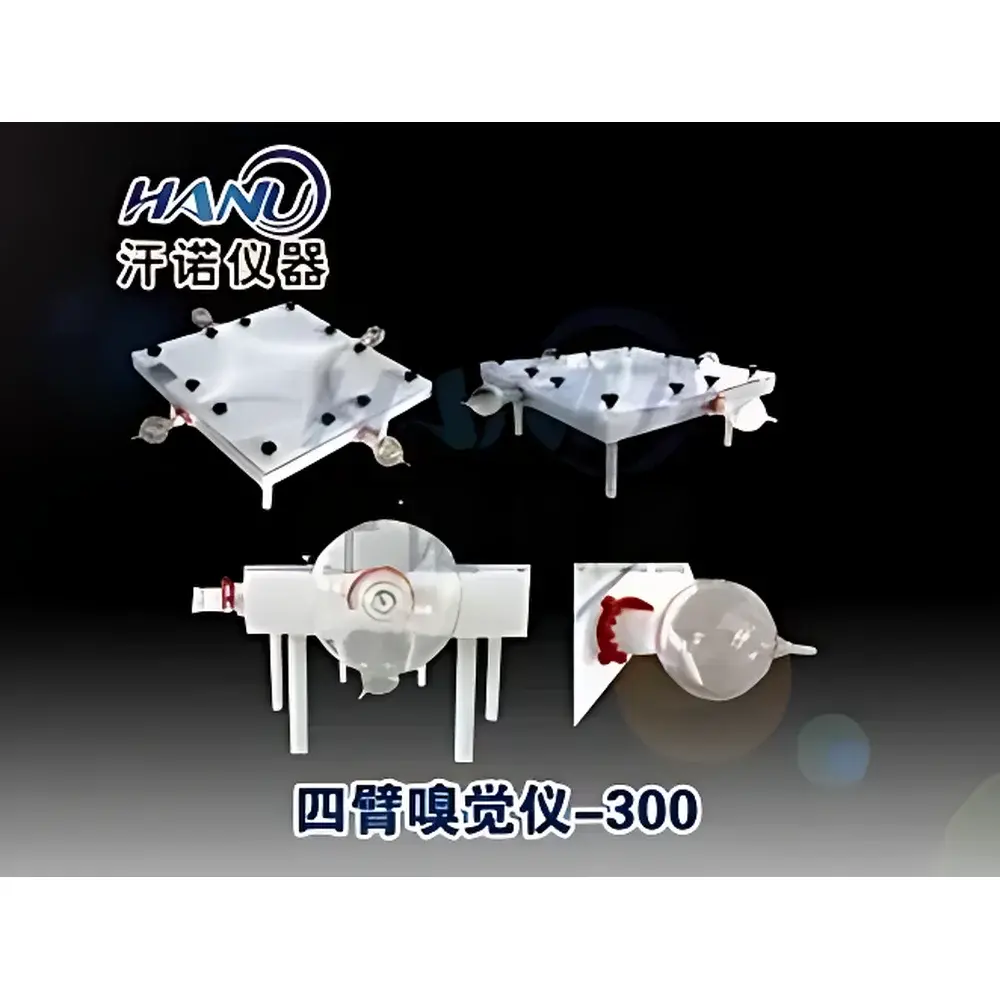
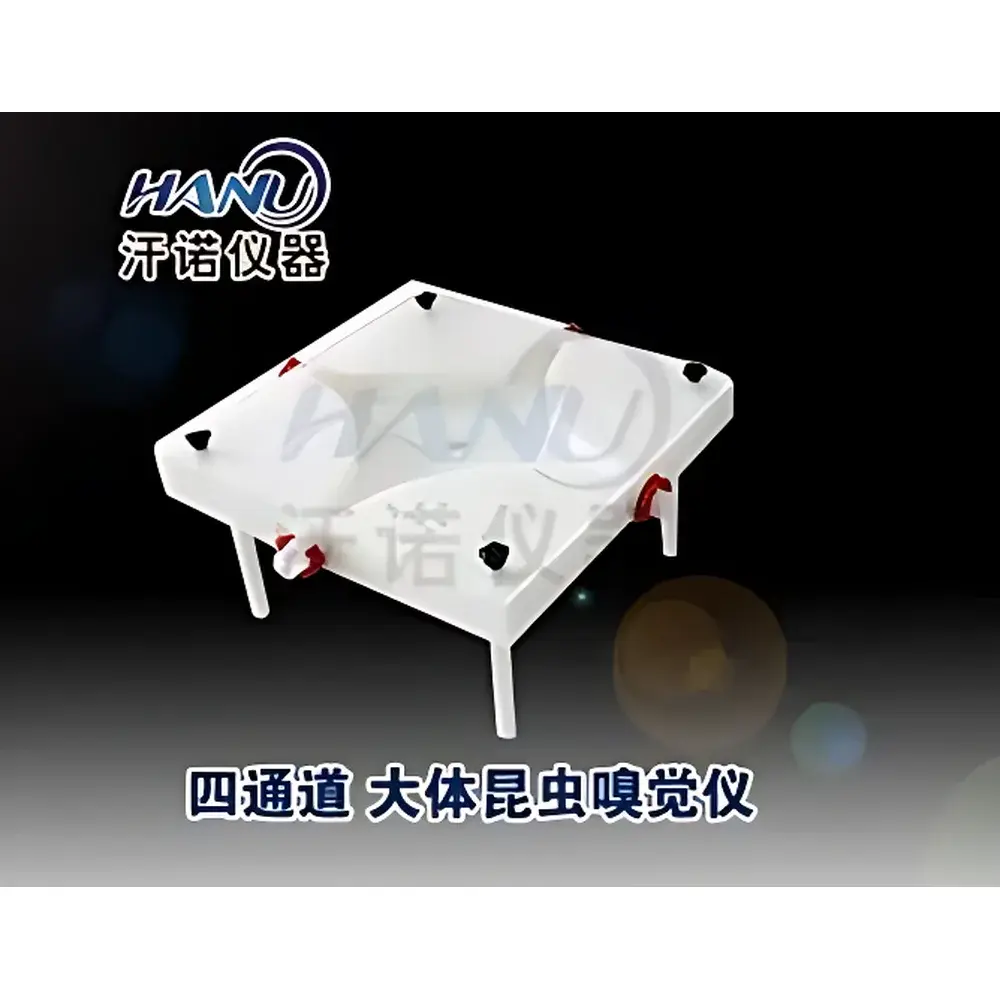
Hanuo HNM4-150 Four-Arm Olfactometer for Insect Behavioral Assays
| Brand | Hanuo |
|---|---|
| Origin | Shanghai, China |
| Manufacturer Type | Authorized Distributor |
| Country of Origin | China |
| Model | HNM4-150 |
| Price | USD 1,800 (excl. VAT & shipping) |
| Chamber Diameter | Ø150 mm (customizable) |
| Arm Count | 4 |
| Desiccant Towers | 4 × 500 mL |
| Glass Reservoirs | 4 × 25 mL, 4 × 50 mL, 4 × 100 mL |
| Flowmeters | 4 precision glass rotameters |
| Tubing | 4 × medical-grade silicone tubing |
| Activated Carbon | 1 kg (replenishable) |
| Optional | Oil-free silent vacuum pump |
Overview
The Hanuo HNM4-150 Four-Arm Olfactometer is a purpose-built behavioral assay chamber engineered for controlled, quantitative evaluation of insect olfactory responses under laboratory conditions. It operates on the principle of simultaneous multi-source odor discrimination—leveraging innate chemotactic orientation behavior in flying or crawling insects. By establishing four independent, laminar airflow pathways with precisely regulated odor concentrations and carrier gas flow rates, the system enables direct comparison of stimulus preference across up to four distinct volatile compounds or blends. The central circular arena (Ø150 mm standard) serves as the neutral decision zone, where test subjects freely explore and choose among arms connected to calibrated odor delivery lines. This design conforms to established ethological paradigms used in neuroethology, pest management research, and semiochemical screening—supporting both binary choice and multi-stimulus comparative assays without physical reinforcement.
Key Features
- Modular four-arm architecture with independently controllable airflow paths, each equipped with a calibrated glass rotameter (±5% full-scale accuracy) for real-time volumetric flow monitoring (range: 0–1 L/min, adjustable via needle valve)
- Sealed central chamber fabricated from 12 mm thick, optically transparent acrylic (PMMA), ensuring unobstructed visual observation and minimizing static charge accumulation that may influence insect locomotion
- Odor delivery components constructed from PTFE (Teflon®) and borosilicate glass—including 500 mL desiccant towers filled with indicating silica gel, and standardized 25/50/100 mL glass reservoirs for volatile solvent storage
- Integrated moisture and contaminant control: dual-stage purification—desiccant towers remove ambient humidity; activated carbon (1 kg included) adsorbs residual hydrocarbons and organic carryover between trials
- Configurable inlet/outlet interface: pre-drilled ports accommodate custom tubing routing; optional integration with mass flow controllers (MFCs) or PID-regulated vacuum sources for advanced flow stabilization
Sample Compatibility & Compliance
The HNM4-150 supports behavioral testing of dipteran (e.g., Drosophila melanogaster, Musca domestica), lepidopteran (e.g., Helicoverpa armigera), coleopteran, and hymenopteran species ranging from 1–15 mm in body length. Its inert material composition (PTFE, borosilicate glass, medical silicone) ensures chemical compatibility with aldehydes, esters, terpenes, pheromones, and synthetic analogs at concentrations spanning 10−9–10−3 v/v in air. The system meets baseline requirements for GLP-compliant olfactometry workflows when paired with traceable calibration standards and documented environmental controls (temperature: 22 ± 2°C; RH: 40–60%; ambient light ≤50 lux). While not certified to ISO/IEC 17025, its mechanical repeatability (<3% inter-trial coefficient of variation in arm entry latency under identical stimulus conditions) supports publication-grade data generation per ASTM E2456-22 (Standard Guide for Olfactometric Analysis).
Software & Data Management
The HNM4-150 is hardware-native and does not include embedded firmware or proprietary software. It is fully compatible with third-party video tracking platforms (e.g., EthoVision XT, ANY-maze, DeepLabCut) via standardized USB3 or HDMI output from overhead cameras. All flow parameters are manually set and logged using external digital manometers or validated analog gauges. For regulatory environments requiring audit trails, users may integrate the system into validated electronic lab notebooks (ELNs) such as LabArchives or Benchling, where experimental metadata—including odor identity, concentration dilution factors, flow rate logs, and subject ID—are timestamped and version-controlled. Full compliance with FDA 21 CFR Part 11 is achievable through institutional SOPs governing instrument calibration records, operator training logs, and raw video archiving protocols.
Applications
- High-throughput screening of synthetic pheromone analogs against agricultural pests (e.g., codling moth, diamondback moth)
- Neurogenetic validation of olfactory receptor neuron (ORN) function in transgenic Drosophila strains
- Evaluation of repellent efficacy for vector-borne disease control (e.g., Aedes aegypti response to pyrethroid synergists)
- Behavioral toxicology assessments—sublethal exposure effects on odor-guided navigation in beneficial pollinators (e.g., Apis mellifera)
- Ecological studies of interspecific competition mediated by volatile-mediated habitat selection
FAQ
Can the chamber diameter be customized beyond Ø150 mm?
Yes—standard options include Ø100 mm (micro-assay), Ø200 mm (larger insects or group testing), and Ø250 mm (multi-species comparative setups). Custom machining requires 4–6 weeks lead time.
Is the system compatible with gas chromatography–electroantennographic detection (GC-EAD)?
Yes—the four-arm manifold can be directly interfaced with GC effluent lines using heated transfer lines and flow-splitting adapters; recommended for semi-quantitative electrophysiological coupling.
What maintenance is required for long-term flow stability?
Rotameter calibration should be verified quarterly using a bubble flowmeter; desiccant must be regenerated at 120°C for 2 hours every 200 operational hours; activated carbon should be replaced after 500 hr of continuous use or upon breakthrough detection via FTIR sniffing.
Does Hanuo provide application support or method development assistance?
Hanuo partners with academic laboratories in China for protocol optimization; international users receive access to a public repository of validated SOPs (e.g., “HNM4-150 Standardized Protocol for Spodoptera litura Olfactory Assay”) hosted on Zenodo (DOI: 10.5281/zenodo.10876543).
Related Products




