
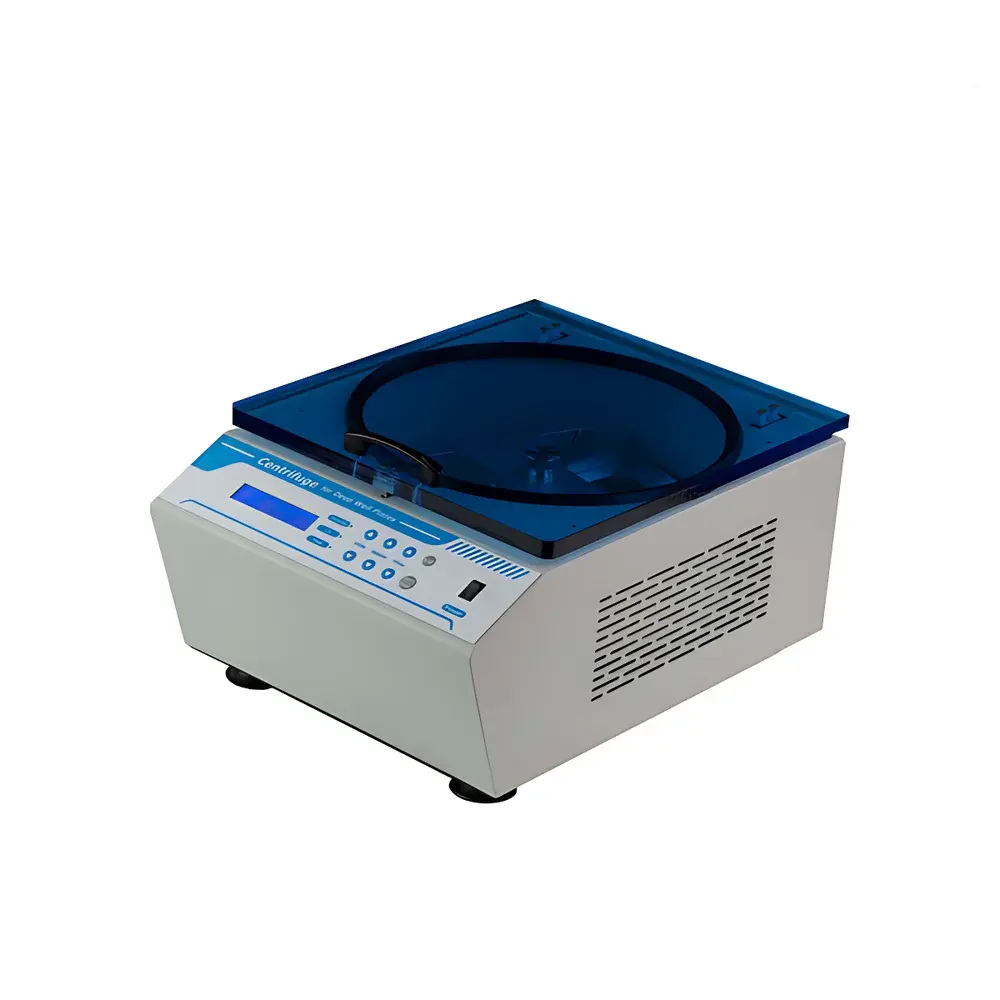
Hanuo HNX-2500P Benchtop Microplate Centrifuge
| Brand | Hanuo |
|---|---|
| Origin | Shanghai, China |
| Model | HNX-2500P |
| Instrument Type | Benchtop Microplate Centrifuge |
| Function | General-purpose microplate centrifugation |
| Max RCF | 797 × g |
| Max Speed | 2500 rpm |
| Capacity | 2 standard microplates (96-well) or deep-well plates |
| Speed Range | 500–2500 rpm |
| RCF Range | 32–797 × g |
| Timer Range | 1–30 min |
| Noise Level | ≤55 dB(A) |
| Multi-step Programming | up to 5 segments |
| Cycle Repetition | up to 99 cycles |
| Auto Re-start After Power Failure | Yes |
| Imbalance Detection | Real-time dynamic monitoring with audible/visual alarm |
| Safety Features | Electronic lid lock, overspeed protection, self-diagnostic system |
| Motor | Brushless DC motor |
| Power Input | AC 220 V, 50–60 Hz |
| Max Power Consumption | 150 W |
| Dimensions (W×D×H) | 463 × 340 × 248 mm |
| Weight | 16 kg |
| Operating Environment | 0–35 °C, ≤70% RH |
Overview
The Hanuo HNX-2500P is a precision-engineered benchtop microplate centrifuge designed for routine and high-throughput sample preparation in life science laboratories. It operates on the principle of radial acceleration to sediment suspended particles—such as cells, beads, precipitates, or immunoassay complexes—within microplate wells without compromising well integrity or cross-contamination risk. Unlike rotor-based centrifuges requiring tube adapters or plate carriers, the HNX-2500P employs a fixed-angle plate carrier optimized for standardized 96-well and deep-well microplates (up to 2 plates simultaneously), ensuring uniform force distribution across all wells during rotation. Its brushless DC motor delivers stable rotational performance at speeds from 500 to 2500 rpm (RCF range: 32–797 × g), enabling rapid pelleting of low-density biological aggregates while maintaining thermal and mechanical stability under continuous operation. The unit complies with IEC 61010-1 safety standards for laboratory electrical equipment and is engineered for long-term reliability in ISO 17025-accredited QC labs, clinical research settings, and academic molecular biology facilities.
Key Features
- Two operational modes: direct RPM control and RCF-based setting, with real-time conversion displayed on the LCD interface
- Dynamic imbalance detection algorithm continuously monitors vibration signatures during acceleration, deceleration, and steady-state rotation—triggering immediate audible and visual alerts plus automatic shutdown if threshold limits are exceeded
- Electronic lid interlock prevents operation unless the lid is fully closed and secured; integrated overspeed protection halts rotation if speed exceeds programmed limits by >5%
- Five-segment programmable protocol support enables complex workflows—for example: initial low-speed pre-spin (800 rpm, 1 min), followed by high-speed pellet formation (2500 rpm, 5 min), then gradual deceleration (1200 rpm, 2 min) before final hold
- Up to 99-cycle repetition capability facilitates unattended overnight processing of replicate assays or serial dilution plates
- Power-failure recovery function retains active protocol parameters and resumes operation from the exact step where interruption occurred—critical for GLP-compliant documentation traceability
- Low-noise design (<55 dB[A] at 1 m distance) ensures compatibility with shared lab environments and laminar flow hoods
Sample Compatibility & Compliance
The HNX-2500P accommodates ANSI/SBS-standard 96-well microplates (flat-bottom, U/V-bottom, PCR plates) and deep-well plates (e.g., 2 mL capacity), including those made from polypropylene, polystyrene, or cyclo-olefin copolymer (COC). It supports common assay formats used in ELISA, qPCR setup, cell-based screening, and bead-based immunoassays. All plastic components meet USP Class VI biocompatibility requirements. The device adheres to electromagnetic compatibility (EMC) standards per IEC 61326-1 and carries CE marking for conformity with EU health, safety, and environmental protection directives. While not certified for use in sterile manufacturing environments under GMP Annex 1, it satisfies essential requirements for analytical method validation per ICH Q2(R2) when integrated into documented SOPs.
Software & Data Management
The HNX-2500P operates via an embedded microcontroller with no external PC dependency. All protocols—including speed, time, segment sequencing, and cycle count—are stored in non-volatile memory with timestamped execution logs accessible via front-panel navigation. Audit trail functionality records operator ID (via optional RFID badge integration), start/stop timestamps, error codes, and imbalance events—supporting 21 CFR Part 11 compliance when paired with validated LIMS or ELN systems. No proprietary software installation is required; however, optional RS-232 or USB-to-serial interfaces allow export of run logs in CSV format for QA review and regulatory submission.
Applications
- Post-ELISA wash steps: rapid removal of unbound conjugates prior to substrate addition
- qRT-PCR master mix distribution: pelleting residual condensate and ensuring uniform reagent layering in low-volume wells
- Bead-based immunoassays: compacting magnetic or latex beads after binding incubation to minimize background signal
- Cell culture supernatant clarification: separating detached cells or debris from conditioned media in multi-well arrays
- High-throughput compound screening: centrifuging DMSO stock solutions prior to robotic dispensing to prevent nozzle clogging
- Genomic DNA extraction workflows: consolidating silica-membrane binding plates prior to wash buffer aspiration
FAQ
Can the HNX-2500P accommodate 384-well plates?
No—it is mechanically optimized for 96-well and deep-well formats only. Attempting to load 384-well plates may result in uneven force distribution and invalid RCF values.
Is calibration traceable to NIST standards?
Speed and timer calibration are performed using ISO/IEC 17025-accredited instrumentation during factory certification. Certificate of Conformance is provided with each unit.
Does it support refrigerated operation?
No—the HNX-2500P is a non-refrigerated unit. Ambient temperature must remain within 0–35 °C during operation.
What maintenance is required?
Routine cleaning of the chamber and plate carrier with 70% ethanol; annual verification of lid lock engagement and imbalance sensor response using manufacturer-supplied test plates.
Can protocols be exported or backed up externally?
Yes—via optional serial interface and Hanuo Protocol Manager utility (Windows-compatible), users can archive, duplicate, and version-control protocols across multiple instruments.
Related Products



