
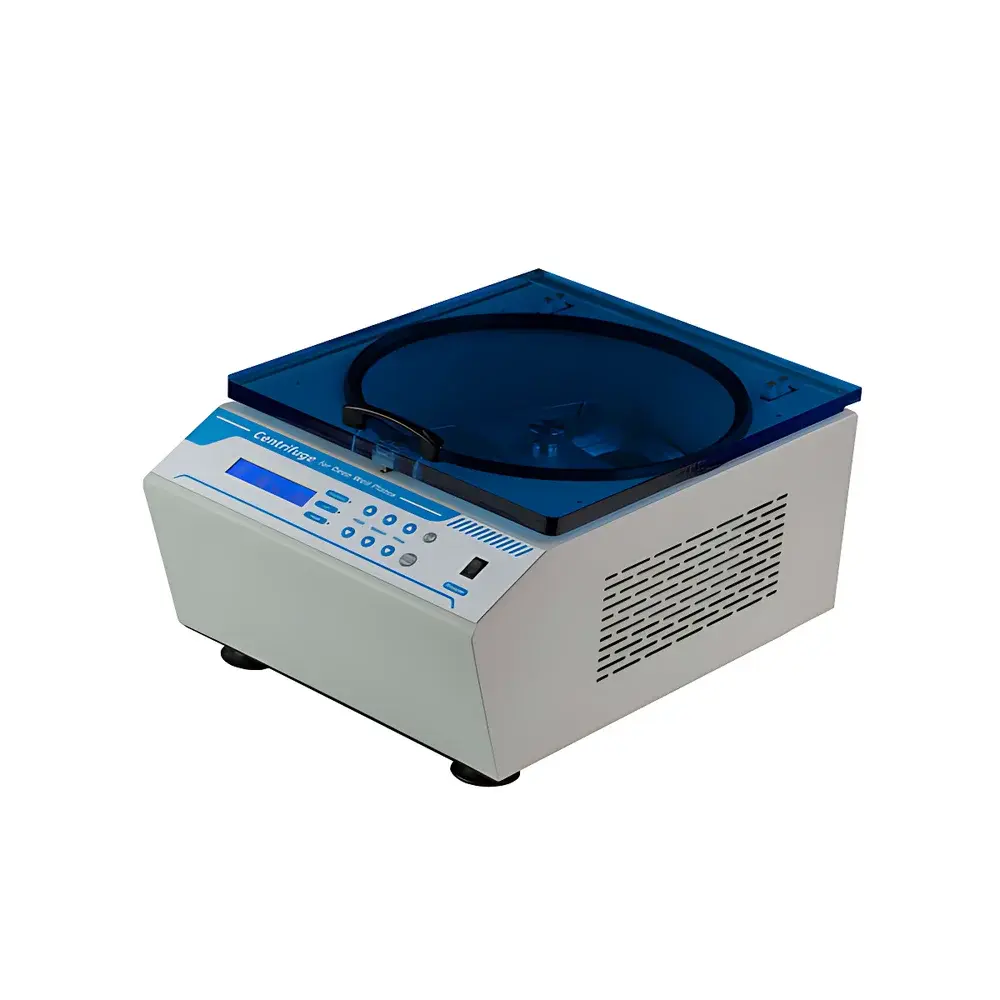
Hanuo HNX-2500P Benchtop Microplate Centrifuge
| Brand | Hanuo |
|---|---|
| Origin | Shanghai, China |
| Manufacturer Type | Direct Manufacturer |
| Product Category | Domestic |
| Model | HNX-2500P |
| Instrument Type | Benchtop Microplate Centrifuge |
| Function | Standard Microplate Centrifugation |
| Maximum RCF | 797 × g |
| Maximum Speed | 2500 rpm |
| Sample Capacity | 2 × 96-well PCR plates (or deep-well plates) |
| Operating Noise | ≤55 dB(A) |
| Speed Range | 500–2500 rpm |
| RCF Range | 32–797 × g |
| Timer Range | 1–30 min |
| Multi-step Programming | Up to 5 segments |
| Cycle Repetition | Up to 99 cycles |
| Auto Restart After Power Failure | Yes |
| Imbalance Detection | Real-time electronic monitoring with audible/visual alarm |
| Drive System | Brushless DC motor |
| Power Input | AC 220 V, 50–60 Hz |
| Max. Power Consumption | 150 W |
| Dimensions (W×D×H) | 463 × 340 × 248 mm |
| Weight | 16 kg |
| Ambient Operating Temperature | 0–35 °C |
| Relative Humidity | ≤70 % RH |
Overview
The Hanuo HNX-2500P Benchtop Microplate Centrifuge is an engineered solution for high-throughput microplate sample preparation in life science laboratories. Designed specifically for 96-well and deep-well microplates—including PCR plates, ELISA plates, and cell culture plates—it delivers precise, reproducible centrifugal force without compromising plate integrity or well-to-well consistency. The instrument operates on the principle of radial acceleration applied uniformly across the plate surface, ensuring rapid sedimentation of reagents, cells, or precipitates into the bottom of wells while minimizing cross-contamination risk and edge effects. Its brushless DC motor provides stable rotational dynamics over extended operation cycles, supporting applications requiring tight control of RCF (relative centrifugal force) rather than RPM alone—critical for standardizing protocols across instruments and labs.
Key Features
- Microprocessor-controlled operation with dual-mode display: simultaneous real-time readout of speed (rpm) and calculated RCF (× g), enabling direct method translation between instruments.
- Electronic imbalance detection system continuously monitors rotor load distribution; triggers immediate deceleration and visual/audible alert if asymmetry exceeds safe thresholds—preventing mechanical stress and preserving microplate geometry.
- Five-segment programmable protocol storage supports complex workflows (e.g., spin-pause-spin sequences), with up to 99 repeat cycles per segment for automated serial processing.
- Integrated safety architecture includes electromagnetic door lock, overspeed protection, automatic self-diagnostic at startup, and power-failure recovery that resumes the last active program from the exact point of interruption.
- Ultra-low acoustic profile (≤55 dB[A] at 1 m) achieved via precision-balanced rotor assembly, vibration-damping chassis, and optimized airflow design—suitable for shared lab environments and laminar flow hoods.
- Compact footprint (463 × 340 × 248 mm) and lightweight construction (16 kg) facilitate placement on benchtops, inside biosafety cabinets, or within cold rooms (operational down to 0 °C).
Sample Compatibility & Compliance
The HNX-2500P accommodates two standard SBS-format microplates simultaneously—compatible with ANSI/SLAS-compliant 96-well PCR plates (including skirted, semi-skirted, and unskirted variants), 96-well ELISA plates, and 96-well deep-well plates (up to 2.2 mL well volume). Plate retention is secured via spring-loaded clamping mechanism with tactile feedback, eliminating need for adhesive tape or external fixtures. All internal surfaces are constructed from corrosion-resistant stainless steel and medical-grade polymers compliant with ISO 10993-5 (cytotoxicity) and RoHS Directive 2011/65/EU. While not certified as IVD or GMP-grade equipment, its consistent performance and audit-ready operational logs support GLP-aligned workflows and internal SOP documentation per ISO/IEC 17025 requirements.
Software & Data Management
The HNX-2500P operates autonomously via embedded firmware with no external PC dependency. All user-defined parameters—including speed, time, ramp profiles, and multi-step sequences—are stored in non-volatile memory with timestamped execution history (last 50 runs). Though lacking network connectivity or FDA 21 CFR Part 11-compliant electronic signatures, its deterministic behavior, repeatable calibration traceability, and built-in self-test routines enable straightforward validation for routine QC/QA use. For regulated environments, integration with laboratory information management systems (LIMS) is achievable via optional RS-232 or USB-to-serial adapters (sold separately), allowing export of run logs in CSV format for archival and audit review.
Applications
- Pre-PCR cleanup: pelleting enzymatic reaction components prior to thermal cycling.
- ELISA workflow acceleration: rapid immobilization of capture antibodies and antigen-antibody complexes during wash steps.
- Cell-based assays: gentle pelleting of adherent or suspension cells in microplate wells for downstream lysis or staining.
- High-throughput drug screening: uniform sedimentation of compound libraries dissolved in DMSO or aqueous buffers across assay plates.
- Nucleic acid purification: consolidating binding buffer–bead suspensions in silica-membrane or magnetic bead-based kits.
- Quality control of plate seal integrity: verifying absence of leakage under centrifugal stress before incubation or storage.
FAQ
What microplate formats are supported by the HNX-2500P?
It accepts all ANSI/SLAS-standard 96-well plates, including PCR, ELISA, and deep-well configurations—with or without skirts—and supports concurrent processing of two plates.
Does the centrifuge offer RCF-based programming?
Yes. Users may input either rpm or RCF directly; the unit calculates and maintains the corresponding value in real time using calibrated rotor geometry and radius data.
Is the instrument suitable for use inside a cold room?
Yes—rated for continuous operation between 0 °C and 35 °C ambient temperature, with condensation-resistant electronics and non-brittle polymer housing.
Can the device be validated for GLP compliance?
While not pre-certified, its deterministic firmware, non-volatile parameter logging, and mechanical stability allow full IQ/OQ/PQ validation per laboratory-specific protocols aligned with ISO/IEC 17025.
What safety certifications does the HNX-2500P carry?
It complies with IEC 61010-1:2010 (Safety Requirements for Electrical Equipment for Measurement, Control, and Laboratory Use) and meets EMC standards EN 61326-1:2013.






