
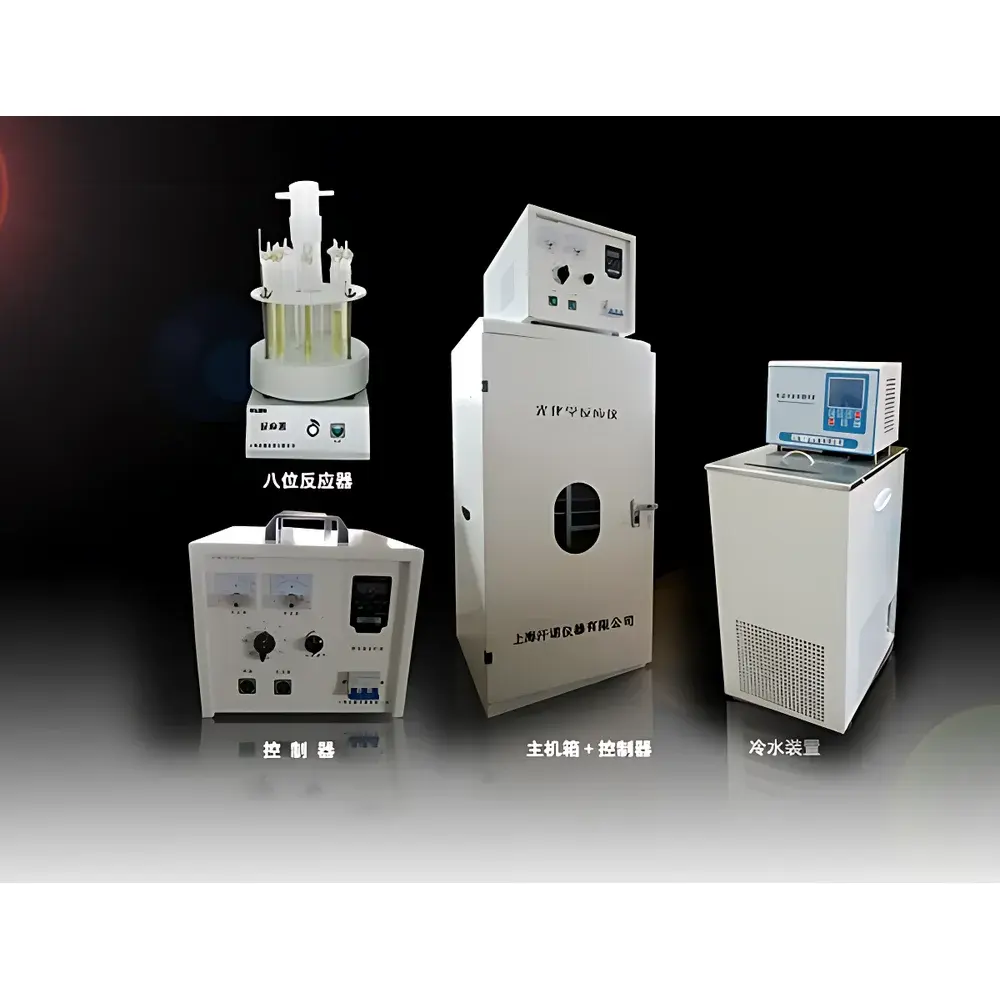
HANUO-V Integrated Photochemical Reactor System
| Brand | HANUO |
|---|---|
| Model | HANUO-V |
| Light Source Type | Xenon Lamp (also compatible with Mercury & Metal Halide Lamps) |
| Max. Power Output | 1000 W (Xenon/Mercury), 450 W (Metal Halide) |
| Adjustable Power Range | 100–1000 W (Xenon/Mercury), 100–450 W (Metal Halide) |
| Sample Capacity | 8 parallel reaction vessels |
| Vessel Volume Options | 30 mL, 50 mL (customizable) |
| Stirring | 8-channel synchronized magnetic stirring |
| Cooling System | Recirculating chiller with >1000 W cooling capacity, casters & bottom drain valve |
| Origin | Shanghai, China |
| Compliance | Designed for laboratory-scale photochemical research under ISO/IEC 17025-aligned experimental conditions |
Overview
The HANUO-V Integrated Photochemical Reactor System is an engineered platform for controlled, reproducible photochemical experimentation in both liquid-phase and gas-phase environments. It operates on the principle of controlled photon delivery to initiate and sustain photoinduced reactions—leveraging high-intensity, spectrally stable arc-lamp sources (xenon, mercury, or metal halide) to simulate solar UV–visible irradiation or deliver narrowband excitation. The system supports heterogeneous photocatalytic studies—including TiO2-mediated oxidation—and homogeneous photolysis under precisely regulated thermal and mixing conditions. Its modular architecture enables systematic variation of irradiance intensity, reaction time, catalyst loading, and mass transfer dynamics—critical parameters in quantum yield determination, kinetic modeling (e.g., pseudo-first-order rate constants), and mechanistic radical trapping experiments.
Key Features
- Multi-lamp compatibility: Integrated lamp controller supports xenon (100–1000 W), mercury (100–1000 W), and metal halide (100–450 W) lamps with continuous, stepless power adjustment—ensuring spectral fidelity and irradiance stability across operational ranges.
- Parallel reaction capability: Eight independently positioned quartz reaction tubes (standard 30 mL or 50 mL; custom volumes available) mounted on a precision-machined aluminum reaction block with uniform optical path alignment.
- Synchronized agitation: Eight-channel magnetic stirrer with individual speed control (0–1200 rpm typical range) ensures consistent mass transfer and minimizes concentration gradients across all reactors.
- Thermal management: Integrated recirculating chiller unit delivers >1000 W cooling capacity at 20 °C ambient; equipped with industrial-grade casters and bottom-mounted drain valve for safe coolant servicing and long-duration thermal equilibration.
- Optical integrity: All irradiation paths utilize high-purity synthetic quartz (transmission >90% from 190 nm to 2500 nm), minimizing UV absorption and thermal distortion during extended operation.
- Modular safety interface: Interlocked lamp housing with overtemperature cutoff, emergency stop circuitry, and CE-compliant electrical isolation—designed for routine use in ISO 14644-1 Class 7 cleanrooms or general chemistry laboratories.
Sample Compatibility & Compliance
The HANUO-V accommodates diverse sample matrices: aqueous suspensions, organic solvent solutions, gaseous mixtures (via sealed septum-capped tubes), and immobilized photocatalyst films on quartz substrates. Reaction vessels are chemically inert to strong oxidants (e.g., •OH, O3, H2O2) and compatible with acidic/basic media (pH 1–13). System design aligns with ASTM E2535-21 (Standard Guide for Photocatalytic Activity Testing) and supports experimental protocols compliant with ISO 10678:2010 (Photocatalysis — Determination of photocatalytic activity). While not FDA-registered, its construction materials (316 stainless steel chassis, borosilicate glass optics, PTFE-sealed joints) meet GLP documentation requirements for traceable reaction parameter logging.
Software & Data Management
The HANUO-V operates as a hardware-controlled benchtop instrument without embedded firmware or proprietary software. All operational parameters—including lamp power setting, stirring speed, and chiller setpoint—are manually configured via front-panel digital interfaces with ±1% full-scale analog feedback. For audit-trail compliance, users integrate external data loggers (e.g., Omega OM-DAQPRO-5300) connected to analog outputs (0–10 V DC) for real-time recording of lamp current, coolant temperature, and stirrer RPM. This architecture satisfies 21 CFR Part 11 requirements when paired with validated electronic lab notebook (ELN) systems such as LabArchives or IDBS E-WorkBook—enabling timestamped, role-based access to raw parameter logs and analytical chromatography/mass spectrometry output files.
Applications
- Environmental photocatalysis: Degradation kinetics of micropollutants (pharmaceuticals, pesticides, dyes) in wastewater effluents using TiO2/UV systems.
- Photochemical synthesis: C–C bond formation via [2+2] cycloadditions, Norrish-type cleavages, and metal-free aryl aminations under visible-light activation.
- Quantum yield quantification: Actinometric calibration using potassium ferrioxalate or Aberchrome 540 under identical irradiance profiles.
- ROS generation profiling: Time-resolved detection of superoxide (O2•−), hydroxyl radical (•OH), and singlet oxygen (1O2) via spin-trapping ESR or fluorescent probe assays.
- Photostability testing: ICH Q1B-compliant forced degradation of APIs under controlled UV–vis exposure.
FAQ
What lamp types are supported, and how is spectral output verified?
The system accepts standard 100–1000 W xenon and mercury short-arc lamps, plus 100–450 W metal halide lamps. Spectral validation requires external calibration using a NIST-traceable spectroradiometer (e.g., Bentham DMc150); no built-in spectrometer is included.
Can reaction vessels be pressurized or used under inert atmosphere?
Yes—quartz tubes accept standard PTFE-lined screw caps with septa; optional gas inlet/outlet manifolds enable continuous N2/Ar purging or O2 dosing during irradiation.
Is the chiller unit integrated or external?
The chiller is a self-contained module mounted beneath the reactor base, connected via quick-release fluid couplings; no external chiller purchase is required.
What maintenance intervals are recommended for lamp replacement and quartz cleaning?
Xenon lamps require replacement after ~1000 hours of cumulative operation; quartz tubes should be cleaned with piranha solution (only by trained personnel) or oxygen plasma between experiments to prevent photocatalyst residue buildup.
Does the system comply with explosion-proof requirements for volatile solvent use?
No—while designed for standard organic solvents (acetone, acetonitrile, methanol), it lacks ATEX/IECEx certification; use in fume hoods with vapor monitoring is mandatory for low-flashpoint media.



