
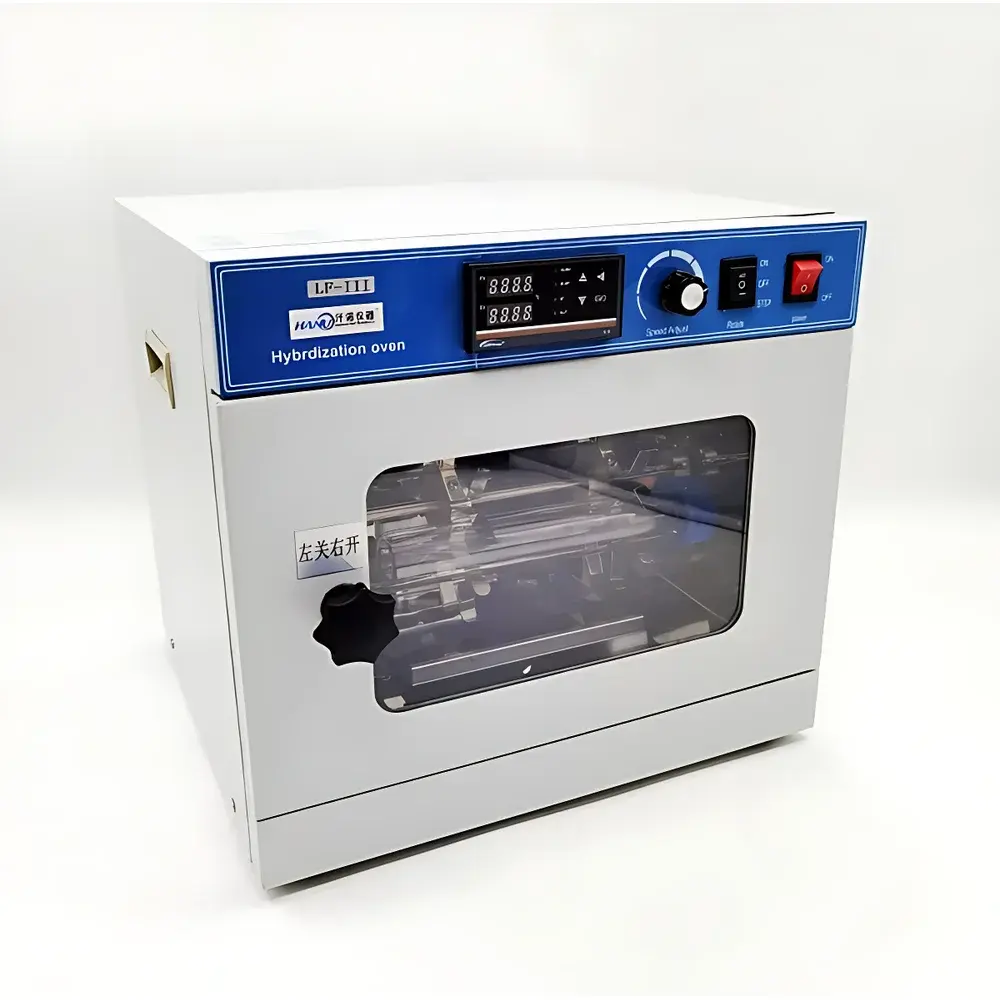
Hanuo LF-I Constant-Temperature Molecular Hybridization Instrument
| Brand | Hanuo |
|---|---|
| Origin | Shanghai, China |
| Manufacturer Type | Direct Manufacturer |
| Instrument Type | Nucleic Acid Molecular Hybridization Instrument |
| Model | LF-I |
| Temperature Range | Ambient +5°C to 100°C |
| Temperature Uniformity | ±0.03°C |
| Rotation Speed | 6.5 ± 0.5 rpm |
| Capacity | 6 hybridization tubes (Ø35 × 220 mm) or slides/plates |
| Buffer Volume per Chamber | 100 mL |
| Display Resolution | 0.1°C |
| Temperature Equilibration Time | <20 min |
| Continuous Operation | Up to 24 h |
| Power Supply | 220 VAC, 50 Hz |
| Rated Power | 600 W |
| External Dimensions (W×D×H) | 420 × 380 × 380 mm |
Overview
The Hanuo LF-I Constant-Temperature Molecular Hybridization Instrument is a precision-engineered benchtop system designed for controlled nucleic acid hybridization under rigorously maintained thermal and mechanical conditions. It operates on the fundamental principle of nucleic acid hybridization—where complementary single-stranded DNA or RNA sequences anneal via hydrogen bonding under defined temperature, ionic strength, and agitation parameters. The instrument integrates a high-stability Peltier-based heating/cooling module with a microprocessor-controlled digital thermostat, enabling accurate setpoint regulation across a broad operational range (ambient +5°C to 100°C). Its rotating platform ensures uniform buffer convection and consistent probe-target contact across all samples—critical for reproducible hybridization kinetics, especially in low-abundance target detection. Unlike static incubators, the LF-I’s regulated rotational motion minimizes boundary layer effects and sedimentation artifacts, making it suitable not only for traditional Southern/Northern blotting but also for enzyme-linked immunoassays (ELISA), antibody-antigen binding studies, and post-PCR hybridization steps in quantitative or semi-quantitative diagnostic workflows.
Key Features
- Precision temperature control with ±0.03°C uniformity across all six sample positions—validated per ISO/IEC 17025 calibration protocols for laboratory-grade consistency.
- Low-speed orbital rotation at 6.5 ± 0.5 rpm, optimized to enhance hybridization efficiency without shearing fragile nucleic acid complexes or disrupting membrane-bound targets.
- Dedicated capacity for six standard hybridization tubes (Ø35 × 220 mm), accommodates alternative formats including glass slides and microtiter plates via optional adapters.
- Intuitive digital interface with 0.1°C display resolution, real-time temperature logging, and programmable ramp-hold profiles supporting multi-step hybridization protocols.
- Robust aluminum alloy chassis with insulated chamber walls and overheat protection circuitry—compliant with IEC 61010-1 safety standards for Class II laboratory equipment.
- 24-hour continuous operation capability with thermal stability maintained throughout extended incubations—essential for overnight hybridization protocols common in virology and bacteriology diagnostics.
Sample Compatibility & Compliance
The LF-I supports a wide range of solid-phase substrates, including nitrocellulose and nylon membranes, coated glass slides, and 96-well ELISA plates. Its 100 mL buffer volume per chamber ensures sufficient liquid-phase volume for optimal stringency control during wash and hybridization steps. The instrument is routinely employed in clinical molecular laboratories performing gene detection assays for pathogens such as HBV, HCV, HPV, and Mycobacterium tuberculosis—protocols aligned with CLSI MM17-A and ISO 13485–certified quality management systems. While the device itself does not carry CE or FDA 510(k) designation, its operational parameters meet technical prerequisites for use in GLP-compliant environments when integrated into validated assay workflows per ISO/IEC 17025 requirements.
Software & Data Management
The LF-I operates via embedded firmware without external PC dependency; however, optional RS-232 or USB-to-serial interfaces enable integration with laboratory information management systems (LIMS) for audit-trail generation. Temperature setpoints, dwell times, and rotation status are logged internally with timestamping. When connected to compliant software platforms, the instrument supports electronic record retention in accordance with FDA 21 CFR Part 11 requirements—including user authentication, data integrity checks, and immutable event logs. Firmware updates are delivered via secure manufacturer-signed packages, ensuring traceability and version control.
Applications
- High-fidelity DNA/DNA and DNA/RNA hybridization in Southern and Northern blotting procedures.
- Post-PCR probe hybridization for allele-specific detection and pathogen genotyping.
- Antibody-antigen incubation in ELISA and immunoblotting workflows requiring precise thermal control.
- Controlled denaturation and renaturation studies of nucleic acid secondary structures.
- Standardized incubation for microarray hybridization and in situ hybridization (ISH) slide processing.
- Supporting ISO 15189-accredited clinical microbiology labs in developing in-house molecular diagnostic assays.
FAQ
What is the maximum number of hybridization tubes the LF-I can process simultaneously?
The instrument accommodates up to six standard Ø35 × 220 mm hybridization tubes in a single run.
Does the LF-I support programmable temperature gradients or multi-step protocols?
Yes—it allows user-defined ramp-and-hold sequences with up to three independent segments, each configurable for temperature, duration, and rotation state.
Is the rotation speed adjustable?
No—the LF-I maintains a fixed, optimized rotation speed of 6.5 ± 0.5 rpm to ensure reproducibility and minimize mechanical stress on immobilized nucleic acids.
Can the LF-I be used for RNA hybridization without degradation risk?
When operated within recommended RNase-free conditions and paired with appropriate buffers (e.g., containing DEPC-treated water and RNase inhibitors), the LF-I provides stable, low-shear incubation suitable for RNA probe hybridization.
What regulatory documentation is available for validation purposes?
Hanuo provides factory calibration certificates, electrical safety test reports (IEC 61010-1), and a detailed technical specification sheet—all supplied with each unit for IQ/OQ documentation support.



