
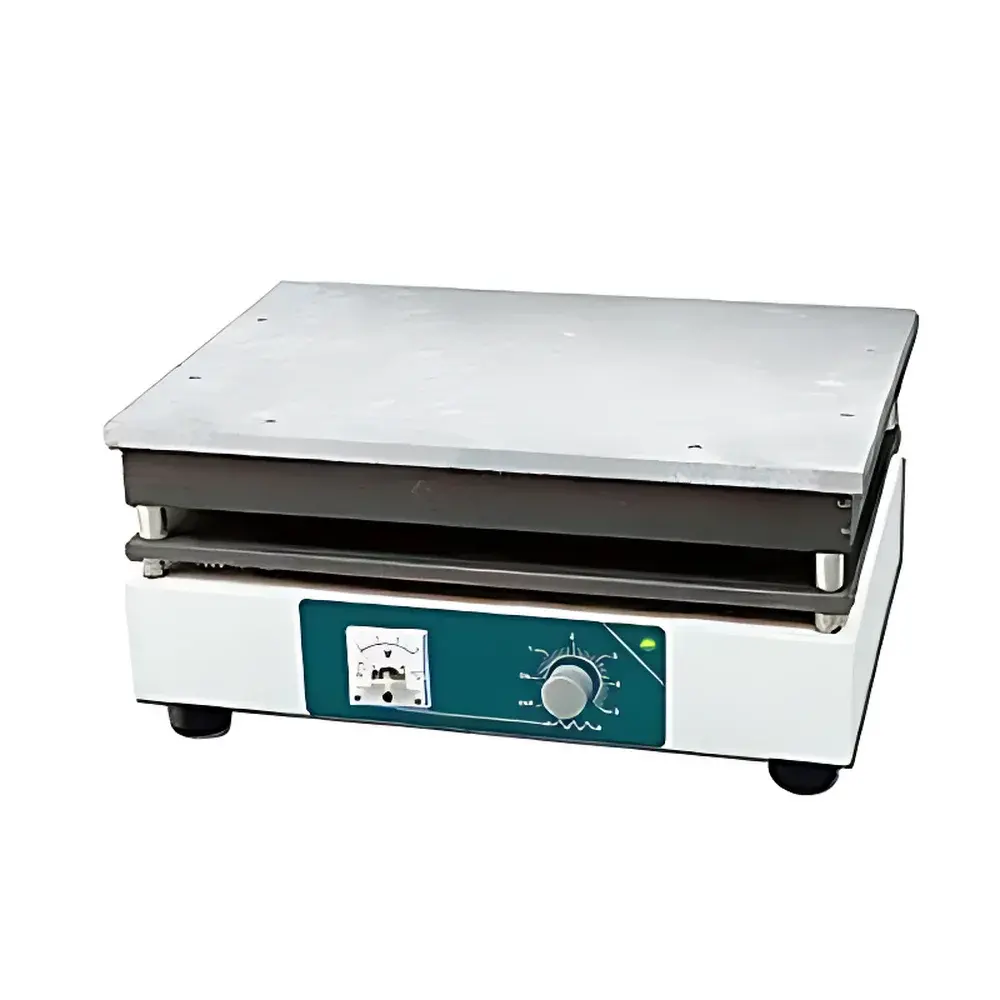
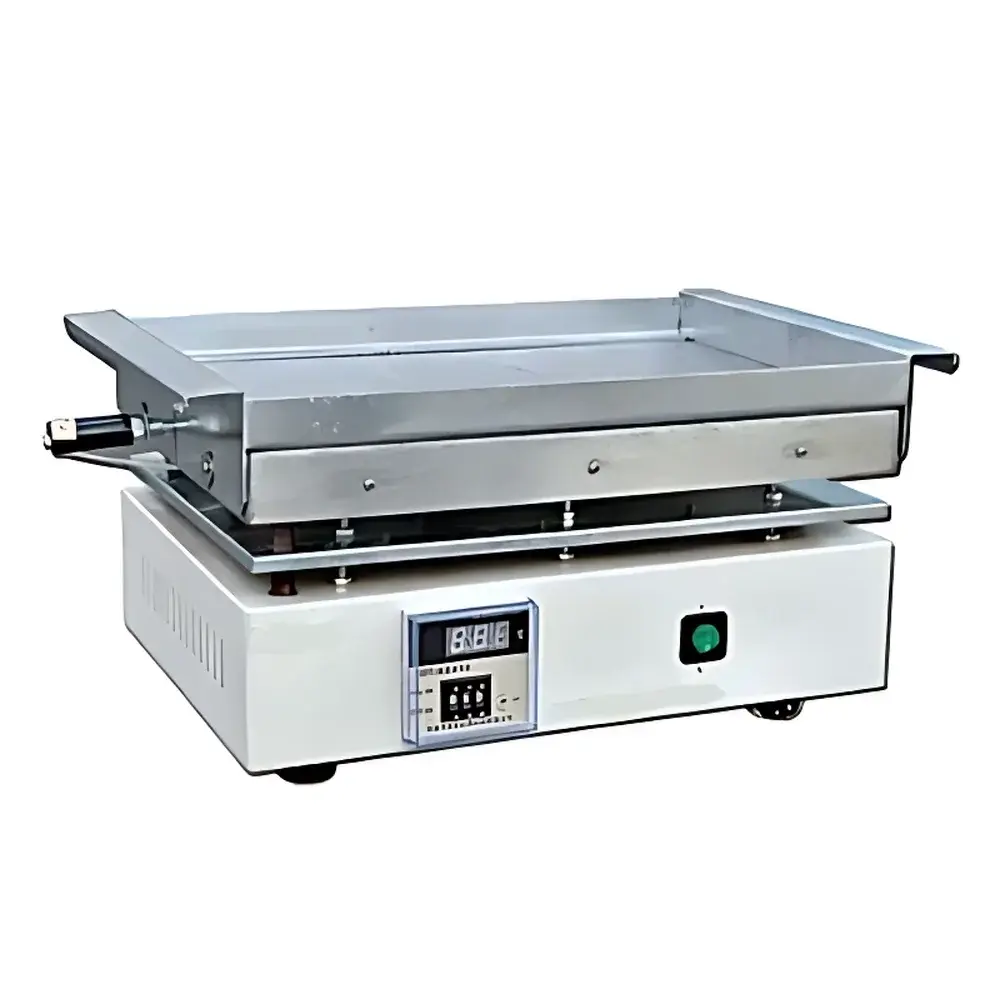
Hanuo ML-1.5-4 Electric Heating Plate
| Brand | Hanuo |
|---|---|
| Model | ML-1.5-4 |
| Origin | Shanghai, China |
| Heating Power | 1500 W |
| Max. Operating Temperature | 300 °C |
| Temperature Uniformity | ±5 °C (across surface, at 250 °C steady state) |
| Heating Surface Dimensions | 40 cm × 30 cm |
| Overall Dimensions | 40 cm × 33 cm × 17 cm |
| Control Method | Silicon Controlled Rectifier (SCR) phase-angle power regulation |
| Surface Material | 304 Stainless Steel |
| Enclosure Finish | Electrostatically Applied Epoxy-Polyester Coating |
| Safety Certification | Compliant with GB/T 2894–2008 (Safety Signs), IEC 61000-6-3 (EMC), and IEC 61000-6-2 (Immunity) |
Overview
The Hanuo ML-1.5-4 Electric Heating Plate is a robust, benchtop thermal platform engineered for precise, flameless conductive heating in analytical, preparatory, and routine laboratory workflows. Designed around resistive heating elements embedded beneath a monolithic 304 stainless steel top plate, it operates on the principle of direct conduction—transferring thermal energy uniformly from the heated surface to reaction vessels, digestion tubes, evaporating dishes, or sample trays placed in direct contact. Unlike open-coil hotplates or ceramic variants, the ML-1.5-4 employs a fully enclosed heating architecture that eliminates exposed resistive wires and prevents ingress of liquids or particulates, significantly enhancing operational safety and long-term reliability in humid or corrosive environments. Its fixed maximum temperature limit of 300 °C aligns with standard requirements for acid digestion (e.g., HNO₃/HCl/HF mixtures), solvent evaporation, gravimetric drying, and controlled thermal conditioning of biological matrices—making it suitable for ISO/IEC 17025-accredited labs performing method-defined thermal steps under documented conditions.
Key Features
- 1500 W high-power heating system delivering rapid thermal response and stable plateau maintenance at setpoints up to 300 °C
- 40 cm × 30 cm continuous heating zone fabricated from electropolished 304 stainless steel—resistant to pitting, oxidation, and chemical attack from common mineral acids and organic solvents
- Silicon Controlled Rectifier (SCR)-based phase-angle power control enabling smooth, stepless adjustment of thermal output without mechanical switches or discrete settings
- Electrostatically applied hybrid epoxy-polyester coating on the housing provides abrasion resistance, dielectric integrity, and consistent thermal insulation across ambient temperatures from 5 °C to 40 °C
- No open flame, no radiant coil exposure—fully compliant with OSHA 1910.1030 (bloodborne pathogens) and CLSI GP26-A4 (laboratory safety standards) for use in BSL-2 and teaching laboratories
- Integrated overtemperature cut-off circuit (independent of main controller) activates at 320 °C to prevent thermal runaway during unattended operation
Sample Compatibility & Compliance
The ML-1.5-4 accommodates standard laboratory glassware—including 100–1000 mL beakers, digestion vessels (e.g., Teflon® PFA, quartz, or borosilicate), Petri dishes, aluminum weighing pans, and stainless steel trays—without requiring clamping or auxiliary fixtures. Its flat, rigid surface ensures full-bottom contact critical for reproducible heat transfer during EPA Method 3050B (acid digestion of sediments), ASTM D5685 (moisture content by oven drying), or USP (residue on ignition). The unit meets electromagnetic compatibility (EMC) requirements per IEC 61000-6-3 (radiated emissions) and immunity per IEC 61000-6-2, and its construction adheres to national safety standard GB/T 2894–2008 for hazard signage and labeling. While not inherently 21 CFR Part 11–compliant (as it lacks digital audit trail functionality), it may be integrated into GLP/GMP workflows when paired with external calibrated thermocouple loggers and documented SOPs.
Software & Data Management
The ML-1.5-4 is an analog-controlled instrument with no embedded microprocessor, touchscreen interface, or data logging capability. Temperature regulation is achieved solely via manual rotary potentiometer input to the SCR driver stage; no firmware, USB port, or Bluetooth module is present. Consequently, all operational parameters—including duration, setpoint, and observed surface temperature—must be recorded manually in lab notebooks or LIMS-integrated electronic records. For traceable calibration, users are advised to verify surface uniformity annually using a NIST-traceable infrared thermometer (e.g., Fluke 62 Max+) and document deviations per ISO/IEC 17025 clause 6.4.2. No proprietary software, drivers, or cloud services are associated with this model.
Applications
- Open-vessel acid digestion of environmental samples (soils, sludges, plant tissues) prior to ICP-OES or AAS analysis
- Controlled evaporation of aqueous extracts and organic solvent fractions in natural product isolation
- Drying of filter papers, crucibles, or desiccated precipitates in gravimetric analysis (e.g., sulfate, chloride, ash content)
- Pre-heating of reagents and buffers in molecular biology workflows where water bath limitations apply
- Thermal conditioning of calibration standards and reference materials in metrology labs
- Classroom demonstrations of thermal kinetics, phase transitions, and mass loss behavior under defined heating profiles
FAQ
Does the ML-1.5-4 support programmable ramp-hold temperature profiles?
No. It features only manual SCR-based power adjustment with no time-based or multi-step programming capability.
Is the heating surface compatible with hydrofluoric acid (HF) digestion vessels?
Yes—when used with certified PFA or quartz digestion tubes placed directly on the stainless steel surface; however, HF must never contact the plate itself due to potential etching of passive oxide layer.
What is the recommended recalibration interval for surface temperature accuracy?
Annually, or after any physical impact to the plate surface, using a NIST-traceable contact thermometer or IR pyrometer with emissivity correction for stainless steel (ε ≈ 0.55–0.65).
Can the ML-1.5-4 be operated inside a fume hood?
Yes—its sealed construction and absence of volatile off-gassing coatings make it suitable for continuous operation under negative pressure hoods during acid digestion procedures.
Does it include a built-in temperature sensor for feedback control?
No. It operates in open-loop mode; surface temperature is inferred from power input and stabilized empirically—not actively measured or regulated.



