
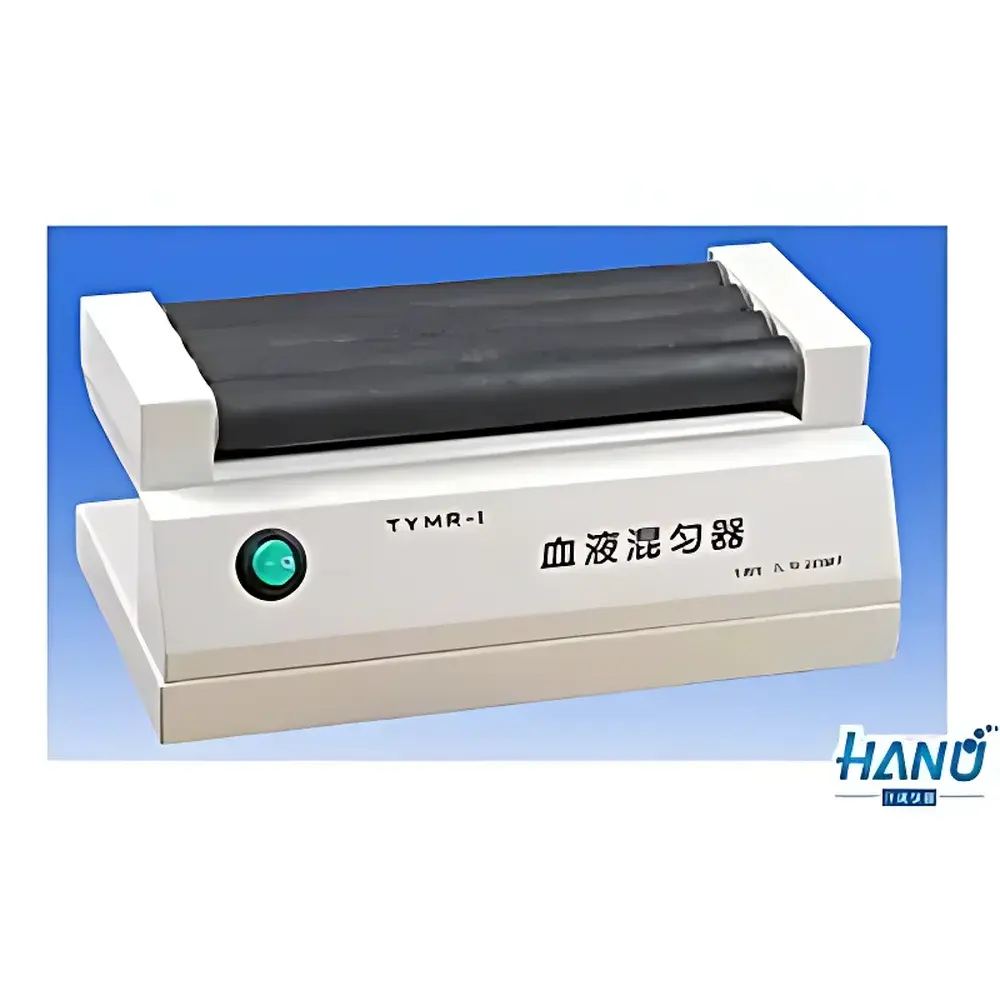
Hanuo TYMR-III Four-Roller Blood Mixer
| Brand | Hanuo |
|---|---|
| Model | TYMR-III |
| Type | Four-Roller Blood Mixer |
| Roller Count | 4 |
| Oscillation Mode | Rocking & Rolling |
| Speed Range | 10–80 cycles/min (rocking) / 10–80 rpm (rolling) |
| Stroke Amplitude | 22 mm ±1 mm |
| Power Consumption | 12 W |
| Input Voltage | 220 V ±10%, 50 Hz |
| Net Weight | 3.6 kg |
| Dimensions (L×W×H) | 394 × 266 × 98 mm |
| Compliance | CE-marked design for in vitro diagnostic (IVD) support environments |
| Application Domain | Clinical laboratory pre-analytical sample handling |
Overview
The Hanuo TYMR-III Four-Roller Blood Mixer is a precision-engineered, benchtop mechanical mixer designed specifically for consistent, low-shear homogenization of anticoagulated blood specimens, lyophilized reagents, whole-blood controls, and other viscous or sediment-prone biological samples. Unlike generic orbital shakers or vortex mixers, this device employs a dual-mode motion architecture—combining controlled rocking and synchronized rolling—to ensure uniform mixing without hemolysis, foaming, or particle aggregation. Its operation adheres to the physical principle of gentle axial displacement and rotational inertia transfer, enabling reproducible sample resuspension across variable viscosities and container geometries (e.g., EDTA/K2EDTA tubes, serum separator tubes, and small-volume vials). The TYMR-III is not intended for incubation or temperature control; it operates at ambient laboratory conditions and is optimized for pre-analytical standardization in clinical pathology, transfusion medicine, and reference laboratory workflows.
Key Features
- Dual-motion actuation system: Independent adjustment of rocking frequency (10–80 cycles/min) and rolling speed (10–80 rpm), allowing protocol-specific optimization for different sample types and tube fill volumes.
- Four-roller configuration with precision-machined stainless-steel rollers and low-friction polymer bushings, engineered for long-term mechanical stability and minimal maintenance.
- Fixed stroke amplitude of 22 mm ±1 mm ensures repeatable mechanical input energy delivery—critical for inter-laboratory comparability and GLP-aligned SOP execution.
- Compact footprint (394 × 266 × 98 mm) and lightweight design (3.6 kg) enable seamless integration into laminar flow hoods, biosafety cabinets, or crowded clinical benchtops.
- Low-power 12 W motor with thermal protection circuitry ensures continuous operation without overheating, supporting extended batch processing during high-throughput specimen preparation.
- CE-conformant electrical design compliant with IEC 61010-1 safety standards for laboratory equipment used in in vitro diagnostic support applications.
Sample Compatibility & Compliance
The TYMR-III accommodates standard clinical specimen containers including 13 × 75 mm, 13 × 100 mm, and 16 × 100 mm vacuum blood collection tubes (e.g., BD Vacutainer®, Greiner Bio-One), as well as 2–10 mL glass or polypropylene vials. It is validated for use with EDTA, citrate, and heparin-anticoagulated whole blood, lyophilized calibration standards, and suspended quality control materials. While not an IVD device per se, its mechanical performance supports compliance with ISO 15189:2022 clause 5.4.2 (pre-examination procedures) and CLSI GP45-A4 recommendations for specimen mixing prior to analysis. The absence of heating/cooling elements excludes it from requirements under ISO 17025 temperature-controlled validation but reinforces its role as a dedicated mechanical homogenizer within auditable pre-analytical workflows.
Software & Data Management
The TYMR-III is a stand-alone electromechanical instrument with no embedded microprocessor, touchscreen interface, or digital connectivity (e.g., USB, RS-232, Ethernet). All operational parameters are set via front-panel mechanical dials with tactile feedback and calibrated analog indicators. This architecture eliminates software validation burdens associated with FDA 21 CFR Part 11 or EU Annex 11 compliance—making it suitable for laboratories requiring minimal computerized system validation (CSV) overhead. Usage logs, maintenance records, and calibration checks (e.g., speed verification using optical tachometry) are maintained manually per institutional GLP/GMP documentation protocols.
Applications
- Standardized mixing of anticoagulated blood prior to hematocrit measurement, coagulation assays (PT/aPTT), or flow cytometry sample preparation.
- Reconstitution of lyophilized internal controls and external proficiency testing materials without manual agitation-induced variability.
- Homogenization of whole-blood quality control suspensions to maintain particle dispersion integrity across analytical runs.
- Pre-analytical conditioning of samples for automated analyzers (e.g., Sysmex XN-series, Beckman Coulter DxH series) where inconsistent mixing contributes to flagging or outlier results.
- Research applications involving exosome isolation buffers, plasma-derived matrices, or cell suspension stabilization prior to centrifugation or filtration steps.
FAQ
Is the TYMR-III compatible with pediatric microtainers (e.g., 0.5 mL EDTA tubes)?
Yes—its roller spacing and cradle geometry accommodate tubes as small as 0.5 mL when loaded in matched pairs to maintain dynamic balance.
Does the device include speed calibration certification?
No factory-issued calibration certificate is supplied; users should perform initial and periodic speed verification using a traceable handheld tachometer per internal QA procedures.
Can the TYMR-III be operated inside a cold room (4 °C)?
Yes—the motor and electronics are rated for operation between 5 °C and 40 °C; however, prolonged exposure below 10 °C may affect bearing lubrication longevity.
What maintenance is required?
Biannual inspection of roller alignment and cleaning of dust accumulation from ventilation slots; no scheduled lubrication is specified by the manufacturer.
Is there a version with timer functionality?
No—the TYMR-III lacks built-in timing circuits; external plug-in timers or laboratory workflow management systems must be used for duration control.



