
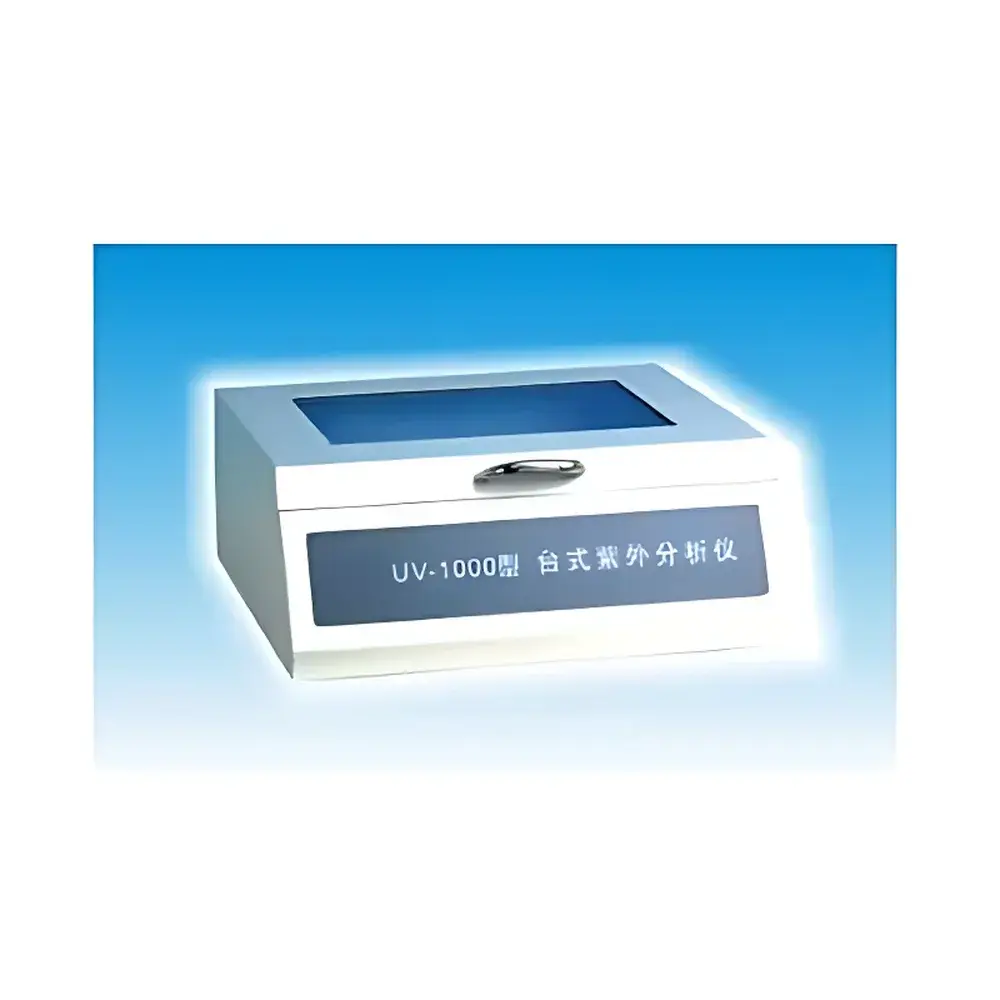
Hanuo UV-1000 Desktop UV Transilluminator
| Brand | Hanuo |
|---|---|
| Model | UV-1000 |
| Type | Desktop Transilluminator |
| Wavelength Options | 254 nm, 302 nm, or 365 nm (single-wavelength selection) |
| UV Filter Size | 200 × 200 mm |
| UV Lamp Configuration | Eight 15 W low-pressure mercury lamps |
| Power Input | 120 V / 230 V, 50/60 Hz |
| Safety | Integrated UV-blocking acrylic shield with safety interlock |
| Compliance | CE-marked, RoHS-compliant |
| Dimensions (W × D × H) | 280 × 240 × 120 mm |
| Weight | 4.2 kg |
Overview
The Hanuo UV-1000 Desktop UV Transilluminator is an engineered solution for routine nucleic acid and protein visualization in molecular biology laboratories. It operates on the principle of ultraviolet-induced fluorescence—where ethidium bromide (EtBr), SYBR Safe, GelRed, or other DNA-binding fluorophores absorb UV light at specific wavelengths and re-emit visible light, enabling detection of nucleic acid bands in agarose or polyacrylamide gels. Designed for benchtop use, the UV-1000 delivers uniform illumination across its 200 × 200 mm active transillumination area, supporting standard mini-gel formats (e.g., 7 × 10 cm and 10 × 10 cm). Its modular single-wavelength architecture allows users to select between 254 nm (optimal for maximum DNA excitation and UV crosslinking), 302 nm (balanced sensitivity and reduced DNA damage), or 365 nm (lower photodamage, ideal for SYBR-based dyes and preparative gel excision). The system integrates a rigid, UV-opaque housing and a hinged, high-transmission acrylic shield with automatic circuit cutoff upon opening—ensuring consistent operator protection per IEC 62471 (Photobiological Safety of Lamps) guidelines.
Key Features
- Eight 15 W low-pressure mercury vapor lamps providing stable, homogeneous UV output with minimal hot-spot formation across the entire 200 × 200 mm viewing surface.
- Interchangeable wavelength configuration: factory-set single-band operation at 254 nm, 302 nm, or 365 nm—no optical filters required; wavelength selection is hardware-defined during manufacturing.
- Integrated safety shield constructed from >99.9% UV-absorbing acrylic (cut-off 99.99% of incident UVC and UVB radiation; mechanical interlock disables lamp power when shield is raised.
- Compact desktop footprint (280 × 240 × 120 mm) with reinforced ABS chassis and non-slip rubber feet—optimized for shared core facilities and teaching labs where space and stability are constrained.
- No external cooling fans or forced-air systems; thermal management relies on passive convection and lamp ballast design, ensuring silent operation and eliminating aerosol dispersion risks near open gels.
Sample Compatibility & Compliance
The UV-1000 supports standard electrophoretic matrices including agarose (0.7–2.0%), native and denaturing polyacrylamide (8–20%), and gradient gels. It is compatible with common fluorescent nucleic acid stains (EtBr, GelGreen, SYBR Gold, SYBR Safe) and protein stains such as Deep Purple and Krypton. All lamp assemblies comply with IEC 61000-6-3 (EMC emission standards) and IEC 61000-6-2 (immunity). The unit bears CE marking under the EU Low Voltage Directive (2014/35/EU) and RoHS 2011/65/EU, confirming absence of lead, cadmium, mercury, hexavalent chromium, PBBs, and PBDEs. While not classified as medical equipment, its design aligns with GLP-relevant practices for documentation of gel imaging conditions (wavelength, exposure time, stain type) in regulated environments.
Software & Data Management
The UV-1000 is a standalone hardware platform without embedded microprocessor control or digital interface. It does not include software, USB ports, or image capture capability—intentionally designed to serve as a dedicated, interference-free excitation source for integration with third-party gel documentation systems (e.g., Bio-Rad ChemiDoc, Azure Biosystems cSeries, or UVP VisionWorks LS). Users record exposure parameters manually (wavelength, visual assessment duration) for audit trail consistency. For laboratories operating under FDA 21 CFR Part 11 requirements, procedural SOPs should define lamp warm-up time (recommended ≥2 min), visual inspection intervals, and periodic intensity verification using NIST-traceable UV radiometers—practices documented in ISO/IEC 17025-accredited quality systems.
Applications
- Routine post-electrophoresis DNA/RNA band visualization and size estimation in undergraduate and graduate teaching labs.
- Preparative gel excision under long-wave (365 nm) illumination to minimize thymine dimer formation and preserve template integrity for downstream cloning or sequencing.
- Verification of restriction digest completeness, PCR product identity, and plasmid linearization prior to transformation or ligation.
- Qualitative assessment of protein migration in SDS-PAGE stained with UV-compatible dyes (e.g., Coomassie Fluoro Orange).
- Supporting rapid diagnostic workflows in field-deployable molecular units where robustness, low power draw, and absence of moving parts are prioritized over quantitative densitometry.
FAQ
Is the UV-1000 compatible with ethidium bromide and SYBR Safe staining?
Yes—the 302 nm configuration provides optimal excitation efficiency for both EtBr and SYBR Safe, while the 365 nm option reduces photodegradation during extended visualization or cutting.
Can multiple wavelengths be used simultaneously on this instrument?
No—the UV-1000 is configured for single-wavelength operation only. Multi-band functionality requires separate instruments or filter-wheel-equipped transilluminators.
Does the unit include a camera or imaging software?
No—it is a pure excitation source. Image capture must be performed using an external CCD or CMOS camera system positioned above the transilluminator.
What maintenance is required for the UV lamps?
Lamps should be replaced every 1,000–1,500 hours of cumulative use. Output intensity declines gradually; periodic radiometric verification is recommended for critical applications.
Is the UV-1000 suitable for GMP-regulated QC testing?
It may be deployed within GMP environments as a support tool, provided operational parameters are defined in controlled SOPs, lamp performance is monitored, and usage logs are maintained—but it is not validated as a regulated analytical instrument per ICH Q2(R2).




