
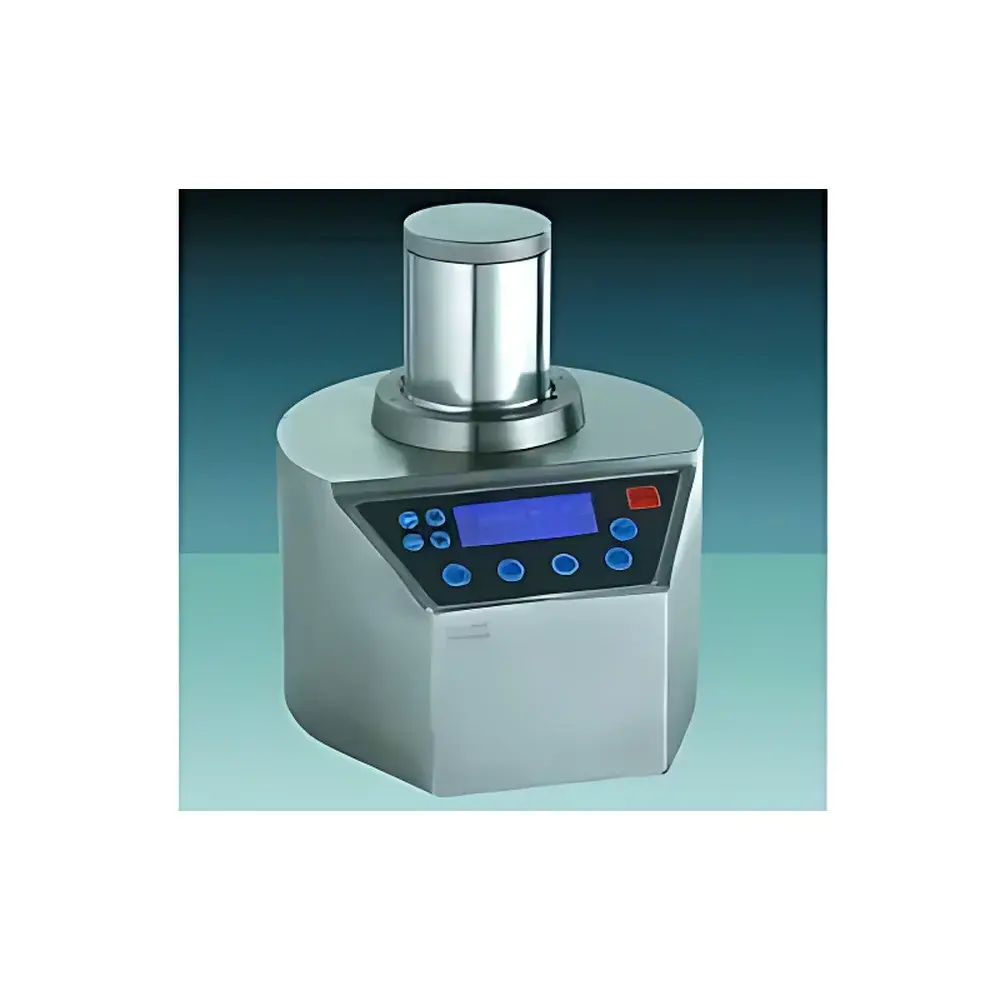
Hanuo ZW-800G Fully Enclosed Intelligent Homogenizer
| Brand | Hanuo |
|---|---|
| Origin | Zhejiang, China |
| Model | ZW-800G |
| Power | 300 W |
| Voltage/Frequency | 220 V / 50 Hz |
| Speed Range | 10,000–20,000 rpm |
| Timer Range | 0–300 s |
| Weight | 10 kg |
| Dimensions (W×D×H) | 26 × 24 × 16 cm |
| Housing Material | AISI 304 Stainless Steel |
| Cup Material | Stainless Steel (Autoclavable) |
| Sealing | Integrated Blade-Cup Assembly with Wear-Resistant Shaft Seal |
Overview
The Hanuo ZW-800G Fully Enclosed Intelligent Homogenizer is a precision-engineered laboratory homogenization system designed for rapid, reproducible, and contamination-controlled sample preparation in regulated life science and quality control environments. It operates on the principle of high-shear mechanical homogenization: a micro-sized, high-torque motor drives a fixed-axis stainless steel blade assembly within a sealed cup, generating intense turbulent flow, cavitation, and impact forces to achieve efficient particle size reduction, dispersion, and emulsification of solid, liquid, or semi-solid matrices. Unlike open-beaker blending methods, its fully enclosed architecture eliminates aerosol generation and cross-sample contamination—critical for microbiological testing, sterility assurance, and GLP-compliant workflows. The unit is engineered for routine use in pharmaceutical QC labs performing USP & EP microbial limit tests, food safety laboratories conducting pathogen enrichment, and cosmetic R&D facilities preparing stable emulsions for stability studies.
Key Features
- Fully enclosed, one-piece stainless steel homogenization cup with integrated blade mount—eliminates disassembly points and ensures leak-proof operation during high-speed processing.
- AISI 304 stainless steel housing with electropolished finish for corrosion resistance, ease of decontamination, and compatibility with ethanol, hydrogen peroxide vapor, and saturated steam sterilization (121 °C, 15–20 min, validated cycle).
- High-efficiency brushless motor delivering consistent torque across the full speed range (10,000–20,000 rpm), enabling scalable homogenization from coarse tissue disruption to sub-micron emulsion formation.
- Digital timer with 1-second resolution (0–300 s) and automatic cut-off—supports standardized SOP execution and repeatable process validation.
- Cross-shaped, hardened stainless steel blade geometry optimized for balanced shear distribution and minimal heat accumulation during extended operation.
- Sealed shaft bearing assembly incorporating dual-lip elastomeric seals rated for continuous operation at >18,000 rpm and resistant to organic solvents and aqueous cleaning agents.
Sample Compatibility & Compliance
The ZW-800G accommodates a broad spectrum of sample types—including tablets, capsules, ointments, creams, suspensions, viscous oils, soft tissues, and powdered excipients—without requiring pre-dilution or solvent addition. Its sealed cup design meets ISO 13485 and ICH Q5C requirements for equipment used in biopharmaceutical raw material testing. For microbiological applications, the unit supports ASTM D7217 (standard practice for homogenization of environmental samples) and aligns with FDA Bacteriological Analytical Manual (BAM) Chapter 3 protocols for food and pharmaceutical sample preparation. All wetted parts are autoclavable and compliant with USP Sterility Assurance guidelines. No lubricants or plastics contact the sample zone—ensuring extractables-free operation suitable for extractable/leachable (E&L) screening prep.
Software & Data Management
While the ZW-800G operates via an embedded digital interface (no external PC required), its timer and speed settings are fully programmable and retain last-used parameters after power cycling. For audit-trail compliance in GMP environments, users may integrate the device into lab-wide electronic batch record (EBR) systems via optional RS-232 output (available upon request). All operational logs—including run duration, speed setpoint, and start/stop timestamps—can be exported for 21 CFR Part 11–compliant review when paired with validated LIMS or ELN platforms. Calibration certificates traceable to NIST standards are provided with each unit shipment.
Applications
- Pharmaceutical QC: Homogenization of solid dosage forms (tablets, capsules, granules) prior to membrane filtration or pour-plate microbiological enumeration per USP and .
- Food & Beverage Safety: Rapid dispersion of low-moisture foods (spices, powders, dried herbs) for Salmonella and Enterobacteriaceae enrichment per ISO 6579-1 and FDA BAM.
- Cosmetic Stability Testing: Emulsification of oil-in-water formulations for centrifugal stability assessment and viscosity profiling.
- Biomedical Research: Tissue homogenization for nucleic acid or protein extraction without enzymatic degradation—compatible with downstream qPCR and ELISA workflows.
- Chemical QA: Dispersion of pigment masterbatches, polymer fillers, and catalyst slurries for rheological and particle size distribution analysis.
FAQ
Is the ZW-800G suitable for sterile processing environments?
Yes—the entire cup assembly is autoclavable at 121 °C for 20 minutes and features zero O-rings or gaskets in the sample path, minimizing bioburden retention.
Can it process viscous samples such as ointments or pastes?
Yes, the high-torque motor and cross-blade geometry maintain stable rotational dynamics up to 10,000 cP; pre-warming samples to ≤40 °C is recommended for optimal dispersion.
What maintenance is required for long-term reliability?
Routine cleaning with 70% ethanol followed by air drying; annual inspection of shaft seal integrity and blade edge wear is advised per ISO/IEC 17025 preventive maintenance schedules.
Does the unit support IQ/OQ protocol documentation?
Yes—Hanuo provides a vendor-validated IQ/OQ template aligned with ASTM E2500 and EU Annex 15, including performance verification test scripts for speed accuracy, timer repeatability, and temperature rise under load.
Is third-party calibration available?
Yes—accredited metrology laboratories can perform traceable speed and timer calibration using ISO/IEC 17025–certified tachometers and time-interval analyzers; calibration intervals are typically 12 months.



