
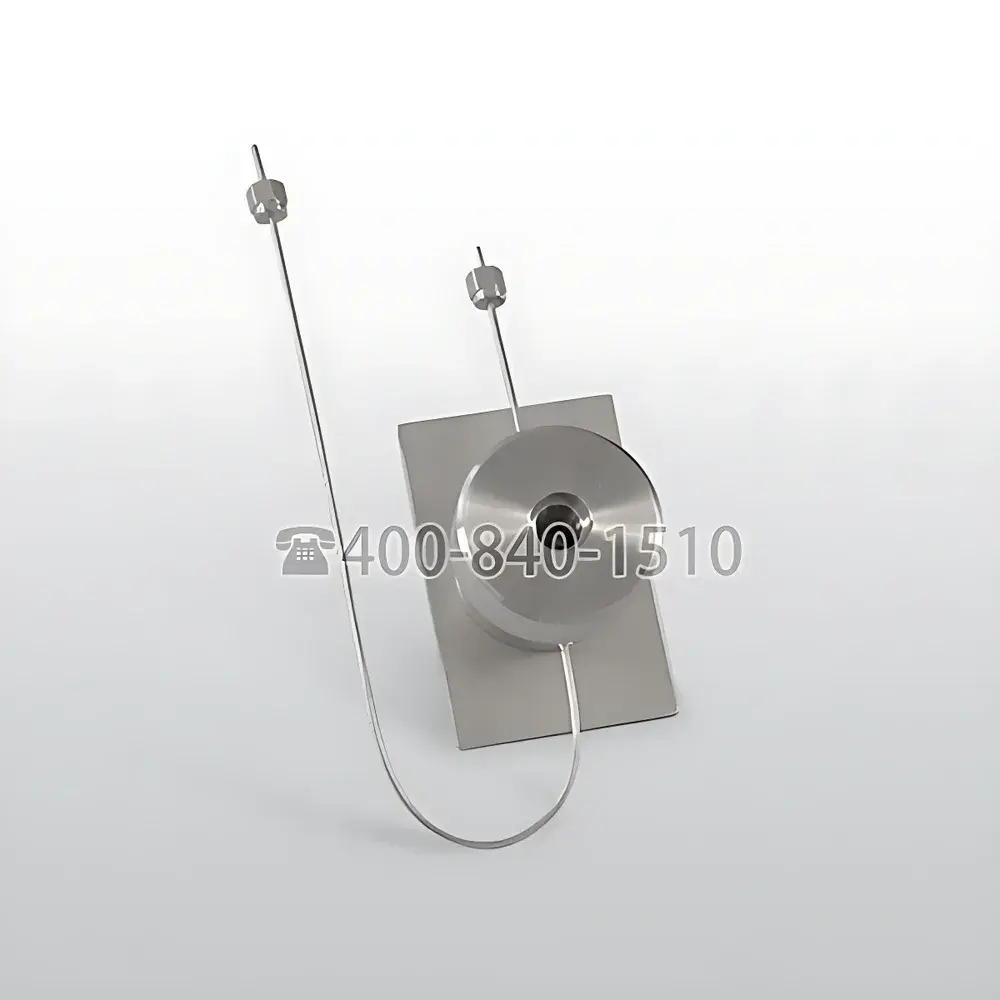
Harrick HPL-C-13 High-Pressure Removable Liquid Cell
| Brand | Harrick |
|---|---|
| Origin | USA |
| Model | HPL-C-13 |
| Construction Material | 316 Stainless Steel |
| Maximum Operating Pressure | 34.5 MPa (5000 psi) |
| Temperature Range | Up to 240 °C (with Kalrez O-rings) or 200 °C (with Viton O-rings) |
| Optical Path Length Range | 6 µm – 5 mm (via interchangeable PTFE spacers) |
| Window Aperture | 8 mm clear diameter |
| Port Configuration | Two 1/16″ Swagelok™ fittings |
| Thermal Management | Integrated cartridge heater, K-type thermocouple, and coolant channels |
| Mounting | FTIR-compatible slide-in sample stage |
| Compliance | Designed for ASTM E1421-compliant IR transmission measurements under process-relevant conditions |
Overview
The Harrick HPL-C-13 High-Pressure Removable Liquid Cell is an engineered optical transmission accessory designed for in situ Fourier Transform Infrared (FTIR) spectroscopy of liquids, slurries, pastes, and thin films under rigorously controlled thermal and pressure conditions. Based on the principle of infrared absorption spectroscopy, the HPL-C-13 enables quantitative and qualitative molecular analysis—such as functional group identification, reaction monitoring, and phase behavior studies—within sealed, chemically inert environments. Its modular architecture supports both static and flow-through configurations, making it suitable for fundamental research in catalysis, petrochemical processing, polymerization kinetics, and high-pressure solvation studies. The cell operates at pressures up to 34.5 MPa (5000 psi) and temperatures up to 240 °C, with full compatibility across commercial benchtop and microscope-coupled FTIR platforms.
Key Features
- Removable, tool-free cell body design facilitates rapid disassembly, thorough cleaning, and window replacement—critical for minimizing cross-contamination between aggressive or viscous samples.
- Interchangeable path length spacers manufactured from chemically inert polytetrafluoroethylene (PTFE), offering precise optical path lengths from 6 µm to 5 mm in discrete increments (6, 12, 25, 65, 100, 150, 250, 390, 500, 630, 750, and 950 µm).
- 316 stainless steel housing provides exceptional resistance to corrosion, stress cracking, and mechanical deformation under sustained high-pressure operation.
- Dual 1/16″ Swagelok™ ports enable flexible integration into closed-loop recirculation systems or static pressurization setups using standard high-pressure gas or liquid manifolds.
- Integrated thermal management system includes a precision-wound cartridge heater, embedded K-type thermocouple for real-time temperature feedback, and dedicated coolant channels for active temperature stabilization during exothermic processes.
- Optimized 8 mm clear aperture ensures maximum beam throughput while maintaining mechanical rigidity and sealing integrity across the full operational envelope.
Sample Compatibility & Compliance
The HPL-C-13 accommodates a broad range of sample types—including aqueous and organic solvents, ionic liquids, suspensions, catalyst slurries, and semi-solid formulations—without degradation of spectral fidelity or structural integrity. Its construction adheres to ASME B31.3 process piping guidelines for pressure boundary components and meets material compatibility requirements outlined in ASTM E1421 for IR cell validation. When operated with Kalrez® perfluoroelastomer O-rings, the cell satisfies USP <661> extractables testing conditions and supports GLP-compliant data acquisition workflows. Optional traceable calibration certificates are available for temperature and pressure transducers upon request.
Software & Data Management
While the HPL-C-13 is a hardware-only accessory, its thermal and pressure interfaces are fully compatible with Harrick’s TC-2000 Temperature Controller and third-party PID systems supporting 0–10 V analog input/output and Modbus RTU protocols. Real-time temperature logging can be synchronized with FTIR acquisition software (e.g., Thermo OMNIC, Bruker OPUS, or Agilent Resolutions Pro) via TTL triggers or external clock signals. All thermal control parameters—including ramp rates, hold times, and safety cutoff thresholds—are configurable and auditable, satisfying FDA 21 CFR Part 11 requirements when deployed within validated laboratory information management systems (LIMS).
Applications
- In situ monitoring of homogeneous and heterogeneous catalytic reactions under industrially relevant pressure–temperature regimes.
- High-pressure phase transition analysis of CO₂-expanded solvents and supercritical fluid systems.
- Thermal stability assessment of battery electrolytes and next-generation lubricants.
- Reaction kinetics modeling for hydrothermal synthesis and Fischer–Tropsch chemistry.
- Quality assurance of pharmaceutical suspensions and topical formulations under accelerated aging conditions.
- Development and validation of process analytical technology (PAT) strategies compliant with ICH Q8(R3) and Q9 frameworks.
FAQ
Are optical windows included with the HPL-C-13?
No. Windows must be selected and ordered separately based on spectral range (e.g., CaF₂ for UV-Vis-IR, BaF₂ for mid-IR, ZnSe for broad-band IR), mechanical strength, and chemical compatibility.
What is the maximum recommended pressure at 200 °C?
Maximum allowable pressure decreases with increasing temperature; at 200 °C, the safe operating limit is 20.7 MPa (3000 psi) when using Kalrez O-rings and sapphire windows.
Can the HPL-C-13 be used in ATR mode?
No. The HPL-C-13 is configured exclusively for transmission-mode measurements; Harrick offers separate high-pressure ATR accessories (e.g., HPA-20 series) for attenuated total reflectance applications.
Is the slide-in mounting mechanism compatible with all FTIR spectrometers?
Yes—the standardized 25.4 mm × 76.2 mm (1″ × 3″) footprint conforms to ISO 17025-aligned sample stage specifications used by Thermo, Bruker, PerkinElmer, and Nicolet platforms.
Do PTFE spacers require recalibration after each replacement?
No. Each spacer thickness is laser-measured and certified to ±0.5 µm tolerance; path length accuracy remains traceable without user recalibration.




