
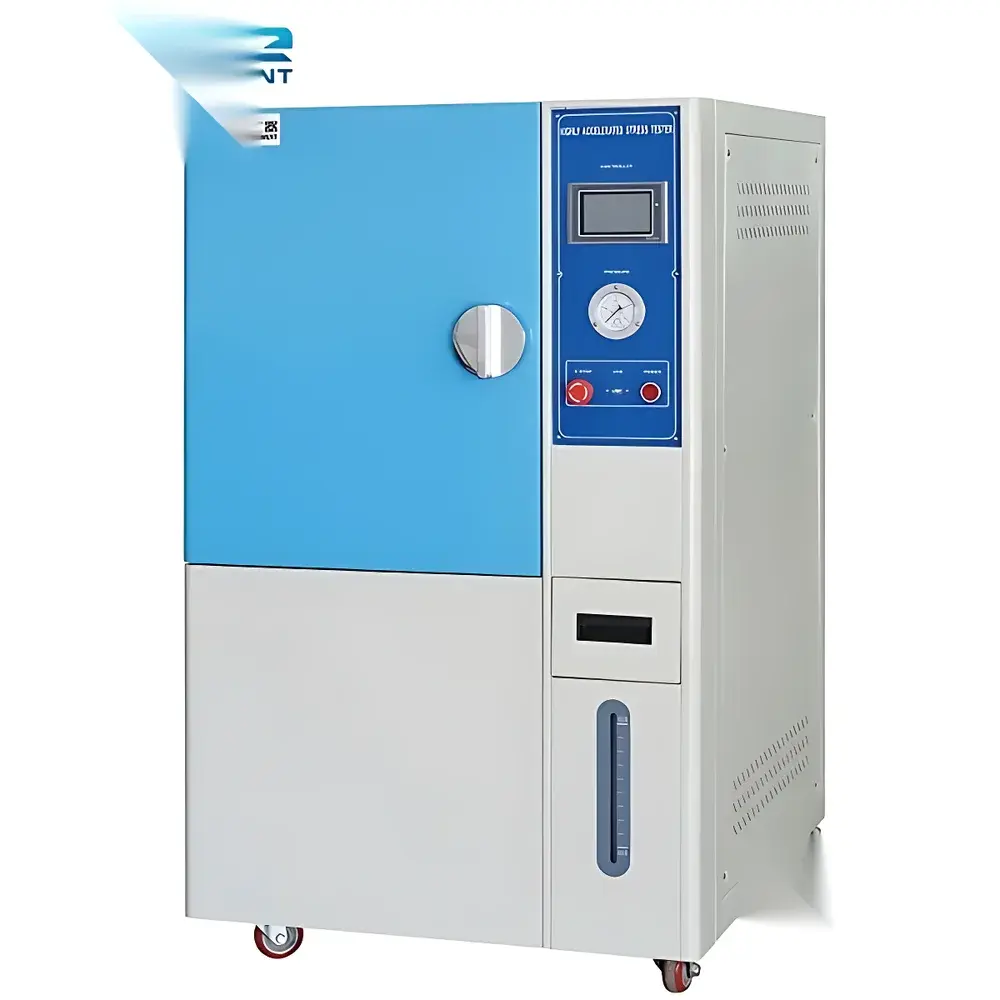
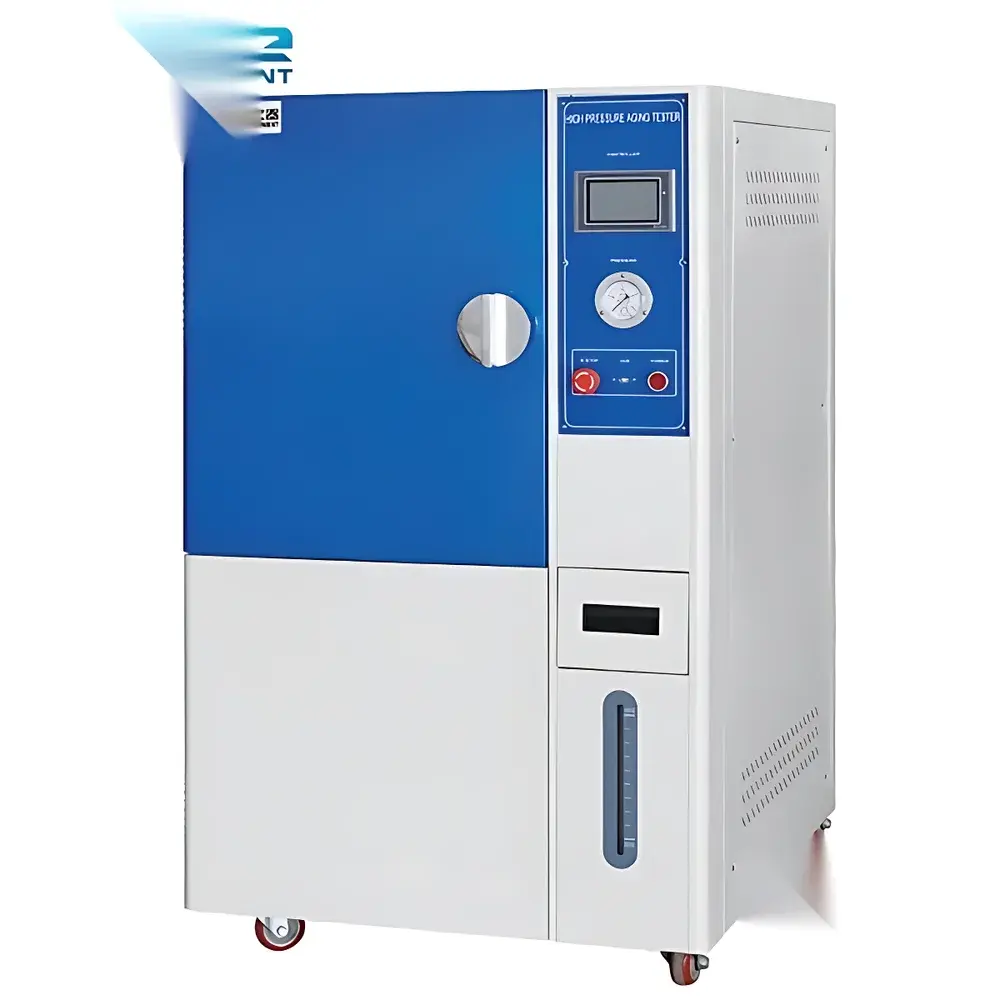
OK-HAST Series High-Pressure Accelerated Life Aging Test Chamber
| Brand | OK |
|---|---|
| Origin | Imported |
| Manufacturer Type | Authorized Distributor |
| Price | USD 13,500 (FOB) |
| Internal Dimensions (Ø×H) | Φ250×300 mm to Φ650×600 mm |
| External Dimensions (W×H×D) | 500×500×700 mm to 950×900×1100 mm |
| Operating Temperature Range | 105–135 °C (143 °C optional) |
| Relative Humidity Range | 70–100 % RH |
| Steam Pressure Range | 0.0–2.0 kg/cm² (gauge) above ambient atmospheric pressure (3.0 kg/cm² optional) |
| Circulation Method | Forced steam convection |
| Power Supply | AC 220 V / 380 V, 50/60 Hz |
| Safety Features | Dual overheat protection, mechanical door interlock, pressure relief valve, low-water cutoff, automatic steam purging, ABS insulated door handle, seamless silicone door gasket |
| Accessories | Two stainless-steel adjustable shelves |
Overview
The OK-HAST Series High-Pressure Accelerated Life Aging Test Chamber is an engineered environmental stress screening system designed for reliability validation of semiconductor devices, LED modules, photovoltaic cells, magnetic components, printed circuit boards (PCBs), and other microelectronic assemblies. It operates on the principle of Highly Accelerated Stress Testing (HAST), combining elevated temperature, controlled high relative humidity, and super-atmospheric steam pressure to accelerate moisture diffusion and electrochemical degradation mechanisms—such as corrosion, delamination, and conductive anodic filament (CAF) formation—without requiring liquid immersion. Unlike traditional 85/85 testing, HAST significantly reduces test duration (typically 96–168 hours vs. 1000+ hours) while maintaining correlation to real-world field failure modes under humid conditions. The chamber conforms to industry-standard test methodologies including JEDEC JESD22-A110 (HAST), JESD22-A118 (uHAST), and IEC 60068-2-66, enabling qualification-grade data generation for AEC-Q200, MIL-STD-883, and automotive electronics applications.
Key Features
- Automated water replenishment system with level-sensing electrodes ensures uninterrupted operation during extended test cycles; activates only when reservoir falls below operational threshold.
- Digital LED temperature controller with ±0.5 °C accuracy and programmable ramp/soak profiles supports precise thermal setpoint management across the full 105–135 °C range.
- Steam-synchronized digital timer initiates countdown only after chamber reaches target temperature and stabilizes—eliminating premature accumulation of elapsed time.
- Integrated pressure-temperature display provides real-time monitoring of saturated steam conditions, referenced to ASME B31.1 steam tables for traceable thermodynamic validation.
- Active steam purification via continuous purge of non-saturated vapor improves steam quality and minimizes condensate carryover onto test specimens.
- Electropolished stainless-steel interior chamber with mirror-finish surface resists oxidation, facilitates cleaning, and prevents particulate shedding during thermal cycling.
- Mechanically interlocked door system prevents power-up unless door is fully sealed; dual redundant safety cutoffs deactivate heating elements if latch engagement is incomplete.
- ASME-certified spring-loaded safety relief valve rated for 3.0 kg/cm² maximum allowable working pressure (MAWP) provides fail-safe overpressure protection.
- Two-stage thermal protection: primary bimetallic thermostat and secondary solid-state limit switch—both independently wired to cut heater power and trigger audible alarm upon exceedance.
- ABS-insulated door handle and ergonomic lever mechanism reduce surface temperature exposure, meeting ISO 13732-1 ergonomics guidelines for operator safety.
Sample Compatibility & Compliance
The OK-HAST chamber accommodates standard JEDEC trays (JEDEC STD-20), 300-mm wafer carriers, and custom fixtures up to Ø650 mm diameter. Internal geometry allows unobstructed steam flow around stacked PCBs or multi-layer packages. All models are CE-marked per Machinery Directive 2006/42/EC and Pressure Equipment Directive 2014/68/EU. Calibration documentation includes NIST-traceable temperature and pressure verification reports. Optional IQ/OQ protocols support GMP-compliant installation and operational qualification in regulated environments (e.g., ISO 13485 medical device manufacturing or IATF 16949 automotive supply chain).
Software & Data Management
While the base configuration features standalone analog/digital controls, optional RS-485 Modbus RTU interface enables integration with SCADA systems or centralized lab management platforms (e.g., LabWare LIMS). Real-time logging of temperature, pressure, and runtime is supported via external data loggers compliant with FDA 21 CFR Part 11 requirements—including electronic signatures, audit trails, and user-access-level permissions. Raw sensor outputs meet IEEE 1451.2 transducer standards for interoperability with third-party analytics tools.
Applications
This system is routinely deployed for: qualification of lead-free solder joints under moisture-laden thermal stress; evaluation of conformal coating integrity on automotive ECUs; screening of die-attach adhesion in high-brightness LED packages; validation of encapsulant hydrolytic stability in PV module backsheet materials; and accelerated life modeling of MEMS sensor packaging under cyclic HAST exposure. Its reproducible steam environment supports failure analysis root-cause correlation using SEM/EDS, acoustic microscopy, and TDR-based interconnect integrity assessment.
FAQ
What is the difference between saturated and unsaturated HAST?
Saturated HAST maintains 100 % RH at elevated pressure (e.g., 110 °C / 1.5 kg/cm²), while unsaturated HAST (uHAST) operates at lower RH (e.g., 85 % RH) to simulate less aggressive field conditions—both defined in JEDEC JESD22-A110 and A118.
Can the chamber be validated per ISO/IEC 17025?
Yes—when equipped with calibrated Class A PT100 sensors and pressure transducers, and operated under documented SOPs, the system meets metrological requirements for accredited calibration laboratories.
Is steam purity monitored during operation?
The automatic purge function removes sub-saturated vapor before it contacts samples; optional conductivity-based steam purity sensor (model SP-200) can be added for continuous TDS monitoring.
How is traceability maintained for long-term reliability studies?
Each test cycle generates a timestamped log file containing setpoints, actuals, alarms, and operator ID—exportable as CSV or PDF for archival per GLP Annex 11 requirements.
Are custom internal configurations available?
Yes—custom shelf layouts, fixture mounting rails, and inert gas purge ports (N₂ or dry air) can be integrated during factory build based on customer mechanical drawings and application specifications.



