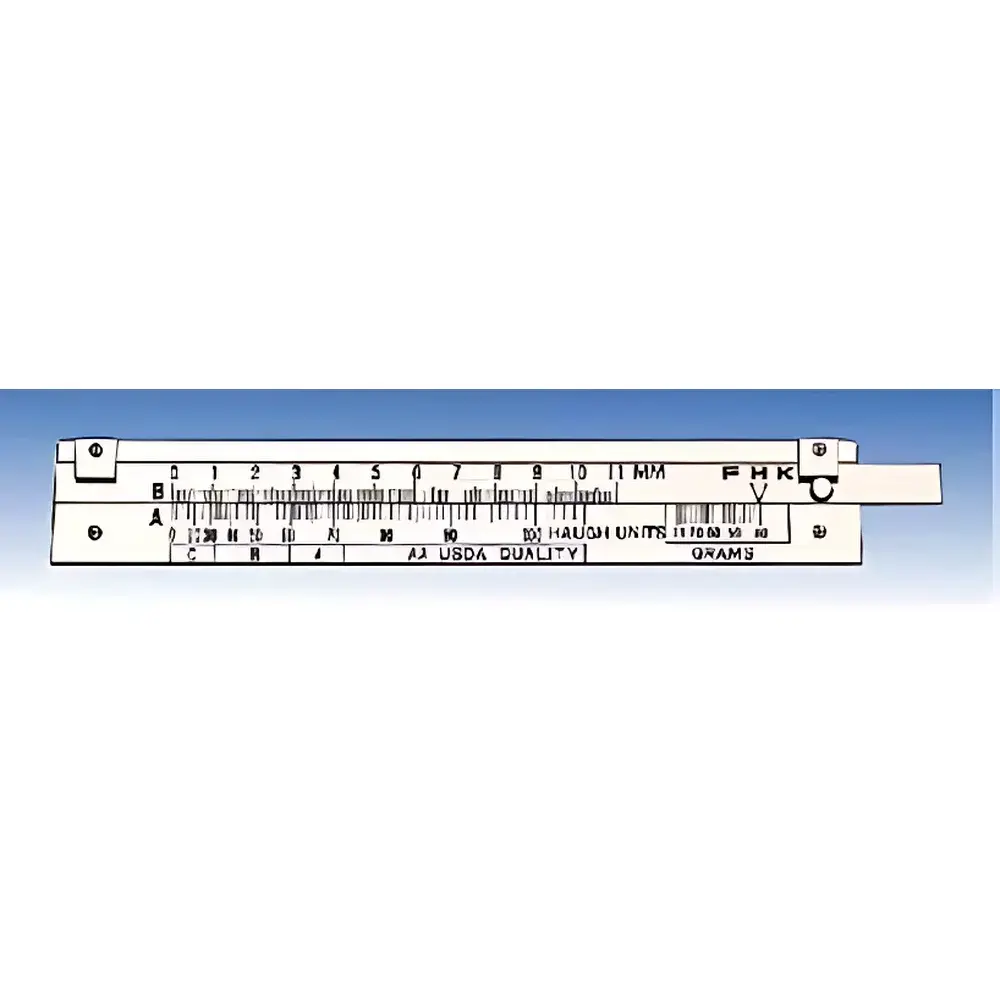
Haugh Unit Calculation Slide Rule Model 383
| Origin | Japan |
|---|---|
| Manufacturer Type | Authorized Distributor |
| Origin Category | Imported |
| Model | 383 |
| Price | USD 560 (FOB) |
Overview
The Haugh Unit Calculation Slide Rule Model 383 is a precision analog computing instrument engineered for rapid, field-deployable determination of the Haugh Unit (HU)—a standardized metric quantifying egg albumen quality based on albumen height and egg mass. Developed in accordance with USDA Agricultural Marketing Service (AMS) standards and aligned with ISO 6560:2017 (Eggs — Determination of Haugh unit), this slide rule implements the empirical Haugh equation: HU = 100 × log10(H − 1.7 × W0.37 + 7.6), where H is thick albumen height (mm) and W is egg weight (g). Unlike digital calculators or software-based solutions, the Model 383 delivers deterministic, battery-free computation with zero calibration drift—critical for routine quality control in hatcheries, grading stations, and regulatory inspection labs operating under GLP-compliant workflows.
Key Features
- Single-step mechanical computation: Input measured albumen height (mm) and egg weight (g) directly onto calibrated logarithmic scales to obtain Haugh Unit value without intermediate calculation or device dependency.
- Dual-scale visual grading reference: Integrated USDA AMS egg quality classification band (AA: ≥72 HU, A: 60–71 HU, B: 31–59 HU, C: ≤30 HU) printed adjacent to the HU scale for immediate interpretive assessment.
- High-contrast engraved acrylic construction: 180 mm × 40 mm ruled surface with UV-stable, abrasion-resistant markings; designed for repeated use under ambient laboratory or farm conditions.
- No power, no software, no validation overhead: Fully compliant with FDA 21 CFR Part 11 Annex A guidance for manual records, eliminating electronic audit trail requirements while maintaining traceability via handwritten entry logs.
- Pre-calibrated at point-of-manufacture in Japan: Each unit bears a factory verification mark confirming conformance to JIS Z 8001-2:2019 (Accuracy of slide rules) and traceable to NMIJ/AIST reference standards.
Sample Compatibility & Compliance
The Model 383 is validated for use with hen eggs (Gallus gallus domesticus) across standard commercial weight ranges (45–75 g) and albumen height measurements obtained via calibrated vernier calipers or dedicated albumen height gauges (e.g., Egg Multi-Tester EM-2000). It is not intended for use with duck, quail, or ostrich eggs due to species-specific density and albumen rheology deviations from the Haugh model assumptions. The device supports compliance with USDA AMS Grade Standards for Shell Eggs (7 CFR Part 56), EU Commission Regulation (EC) No 589/2008, and China GB/T 2749–2015. Its passive design ensures unrestricted deployment in environments where electromagnetic interference or data security policies restrict electronic instrumentation.
Software & Data Management
As a non-electronic analog tool, the Model 383 does not incorporate firmware, connectivity, or data storage. All measurements and resulting Haugh Unit values are recorded manually in paper-based QC logs or LIMS-integrated worksheets. This architecture inherently satisfies ALCOA+ principles (Attributable, Legible, Contemporaneous, Original, Accurate) when used in conjunction with controlled document practices (e.g., pre-numbered logbooks, ink-only entries, reviewer sign-offs). For laboratories requiring digital integration, raw inputs (H and W) may be transcribed into validated spreadsheets or ELN systems—where the Model 383 serves as the primary source of truth for HU derivation.
Applications
- Routine egg grading in USDA-licensed packing houses and EU-approved grading centers.
- Quality surveillance during cold chain logistics audits (e.g., temperature-abuse impact on albumen thinning).
- Research applications in avian nutrition studies assessing dietary impacts on albumen viscosity.
- Regulatory inspections by national food safety authorities (e.g., CFDA, EFSA, FSIS) requiring rapid, equipment-independent verification.
- Training modules for QA technicians where conceptual understanding of the Haugh relationship must precede digital tool adoption.
FAQ
Does the Model 383 require recalibration during its service life?
No. As a passive analog device with no moving parts or electronic components, it maintains metrological integrity indefinitely unless physically damaged. Periodic visual verification against a certified reference slide rule (e.g., NIST SRM 2892) is recommended annually.
Can it be used with eggs outside the 45–75 g range?
The scale’s logarithmic interpolation assumes the original Haugh dataset parameters. Use outside this range introduces systematic bias exceeding ±3 HU; alternative methods (e.g., regression-based calculators) are advised for jumbo or bantam eggs.
Is the Model 383 accepted in official USDA or EU certification reports?
Yes—provided measurement procedures follow AMS Handbook 100 or EU Annex VII of Regulation (EC) No 589/2008, and results are documented with instrument identification, operator ID, and environmental conditions (temperature/humidity).
What documentation accompanies shipment?
Each unit ships with a Certificate of Conformance (CoC) referencing JIS Z 8001-2:2019, a laminated usage guide in English, and a traceable serial number registered in the global distributor’s quality management system (ISO 9001:2015 certified).
Related Products