
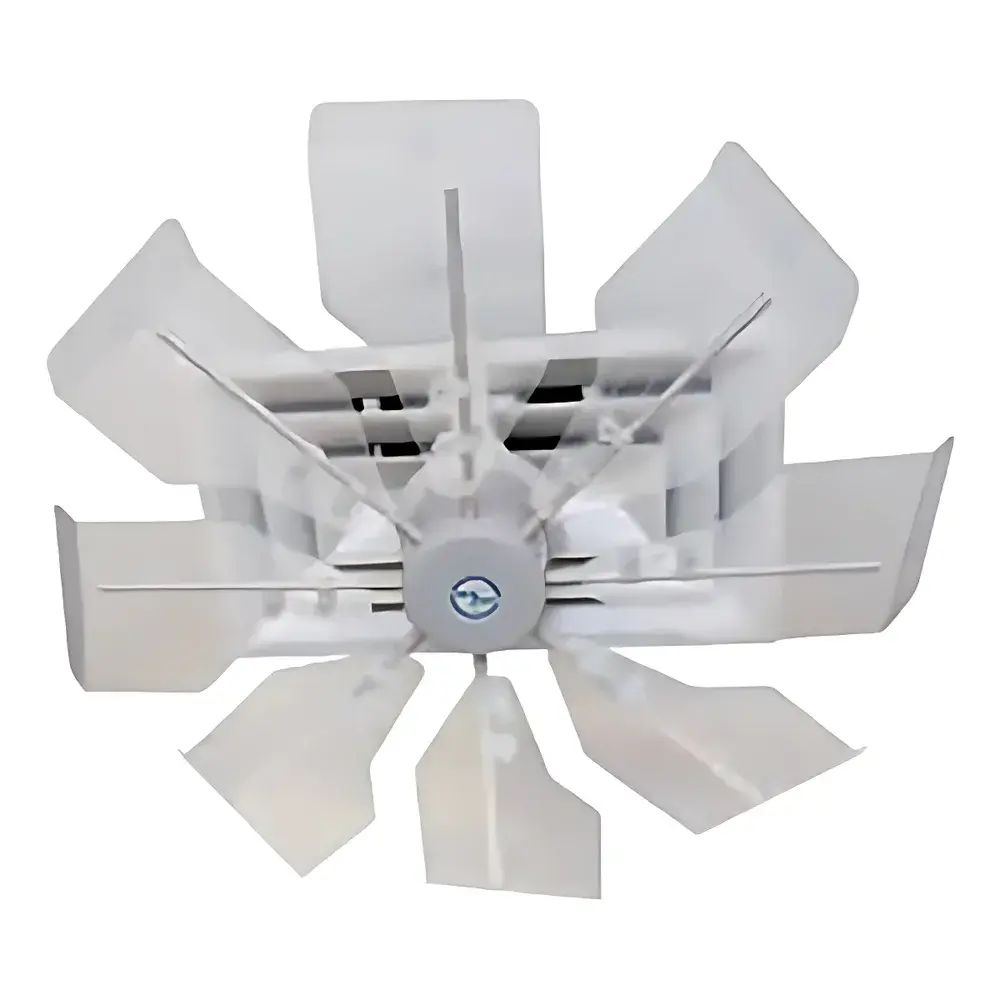
AS ONE HBF-TJRCW Ceiling-Mounted Passive Air Circulation Fan (Semi-Transparent Design)
| Brand | AS ONE |
|---|---|
| Origin | Japan |
| Manufacturer Type | Direct Manufacturer |
| Origin Category | Imported |
| Model | 2-9652-01 |
| Blade Material | Semi-Transparent Plastic |
| Hub & Spoke Material | Aluminum |
| Adjustable Diameter Range | 500–700 mm |
| Weight | Approx. 530 g |
| Power Source | None (Airflow-Driven) |
| Installation Tool Required | Single Phillips Screwdriver |
Overview
The AS ONE HBF-TJRCW is a ceiling-mounted, mechanically passive air circulation fan engineered for integration with standard ducted or cassette-type air conditioning systems in commercial, institutional, and laboratory environments. Unlike electrically powered ceiling fans, this device operates solely on the kinetic energy of conditioned airflow exiting the HVAC unit — eliminating electrical consumption, wiring requirements, and associated safety certifications. Its core function is to enhance vertical and horizontal air mixing within conditioned spaces, thereby reducing thermal stratification and improving thermal uniformity across occupied zones. By promoting more effective distribution of cooled or heated air, the HBF-TJRCW enables HVAC systems to maintain setpoint temperatures with reduced compressor runtime and lower static pressure demand — contributing directly to measurable reductions in energy consumption and CO₂ emissions per ISO 50001-aligned facility management practices.
Key Features
- Airflow-driven operation: No electrical connection, no motor, no maintenance-intensive components — designed for zero-energy auxiliary circulation.
- Semi-transparent polymeric blades: Optimized aerodynamic profile with light-diffusing properties; minimizes visual obstruction while maintaining structural rigidity under sustained airflow loads.
- Adjustable diameter mechanism: Tool-free telescoping hub allows precise adaptation from 500 mm to 700 mm to match duct outlet dimensions or ceiling cavity constraints.
- Aluminum spoke-and-hub architecture: Provides high strength-to-weight ratio and long-term dimensional stability under cyclic thermal and mechanical stress.
- Single-screwdriver installation: Compatible with standard T-bar suspended ceilings and HVAC register mounting flanges; typical field deployment time ≤ 90 seconds per unit.
- Corrosion-resistant finish: Anodized aluminum components and UV-stabilized plastic blades ensure durability in controlled indoor environments with relative humidity up to 80% RH.
Sample Compatibility & Compliance
The HBF-TJRCW is intended for use exclusively with low-velocity, medium-static-pressure HVAC discharge outlets (typically 0.8–2.5 m/s exit velocity, <150 Pa static pressure). It is not rated for use in cleanrooms requiring ISO 14644-1 Class 5 or higher, nor for environments subject to explosive atmospheres (ATEX/IECEx). Units comply with JIS B 8615-2018 (General Requirements for Air Terminal Devices) and meet RoHS Directive 2011/65/EU material restrictions. While not certified to UL 705 or EN 60335-2-80, its passive design inherently satisfies fundamental electrical safety requirements under IEC 61000-6-3 (emissions) and IEC 61000-6-1 (immunity) by virtue of having no active electronics.
Software & Data Management
This is a purely mechanical device with no embedded electronics, firmware, or connectivity interfaces. Consequently, it requires no software, drivers, calibration files, or data logging infrastructure. Performance validation is conducted via physical airflow measurement using calibrated hot-wire anemometry (e.g., ISO 16813-compliant instrumentation) and thermal mapping (ASTM E1423-22). Facility energy managers may document operational impact using utility meter interval data correlated with HVAC runtime logs — supporting internal energy performance reporting aligned with ISO 50002 and GHG Protocol Scope 1 & 2 accounting frameworks.
Applications
- Energy optimization in office buildings, university laboratories, and pharmaceutical QC labs where HVAC runtime reduction supports sustainability KPIs.
- Thermal uniformity enhancement in high-ceiling spaces (≥3.5 m), such as lecture halls, atriums, and warehouse-style instrument rooms.
- Supplemental air distribution in LEED-certified facilities seeking Innovation in Design credits for passive energy conservation measures.
- Post-construction retrofit where electrical upgrades are cost-prohibitive or prohibited due to fire-rated ceiling assemblies.
- Temporary climate control support during HVAC commissioning or seasonal load balancing without permanent infrastructure modification.
FAQ
Does the HBF-TJRCW require any electrical power source?
No — it operates exclusively on the kinetic energy of conditioned air exiting the HVAC duct. Zero wattage draw.
Can it be installed on non-AS ONE HVAC units?
Yes — compatible with any ceiling-mounted air terminal device featuring a standard 500–700 mm outlet diameter and sufficient discharge velocity (>0.7 m/s).
Is routine maintenance required?
None beyond periodic visual inspection for dust accumulation or mechanical deformation; no lubrication, cleaning cycles, or part replacement specified.
What is the expected service life under continuous operation?
Rated for ≥15 years in typical office/lab environments based on accelerated fatigue testing per JIS Z 8703-2016 methodology.
Does it affect HVAC filter efficiency or static pressure drop?
Independent testing shows negligible impact (<0.8 Pa additional static pressure loss at 1.8 m/s flow), well within ASHRAE 62.1-2022 allowable limits for terminal devices.



