
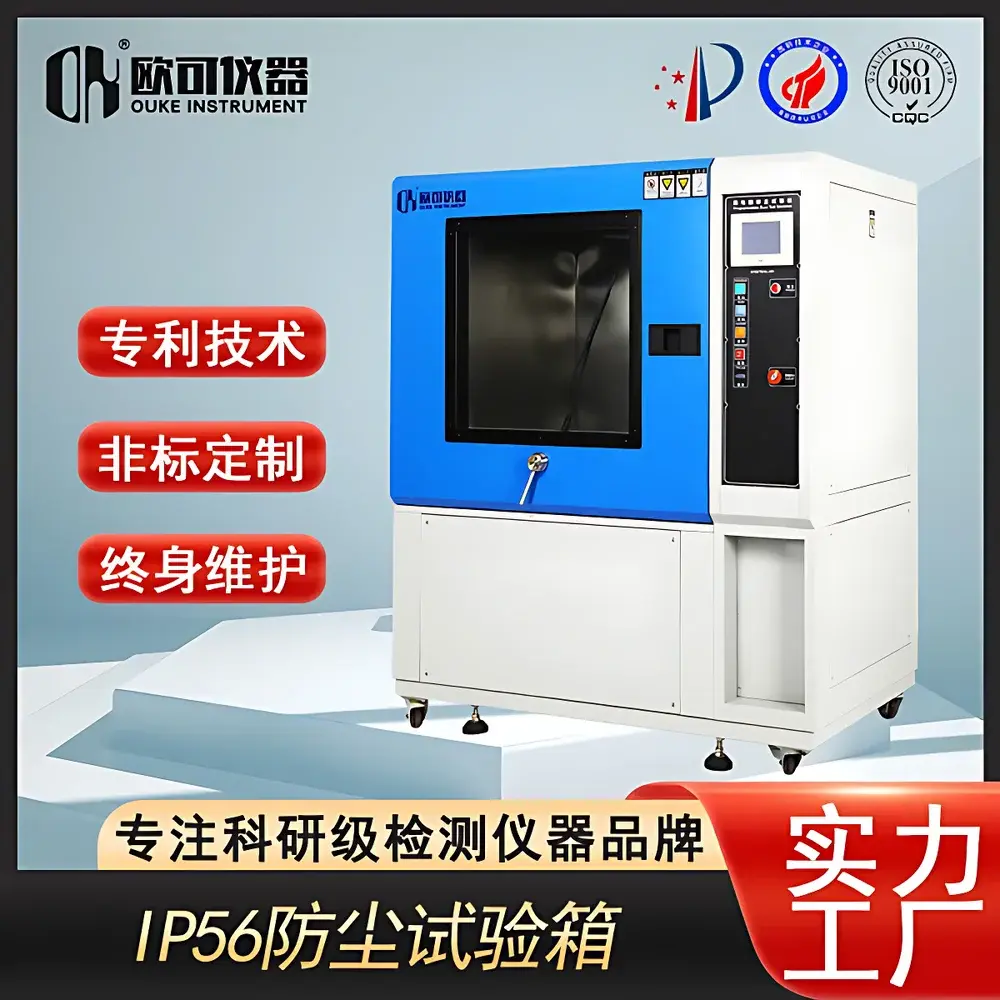
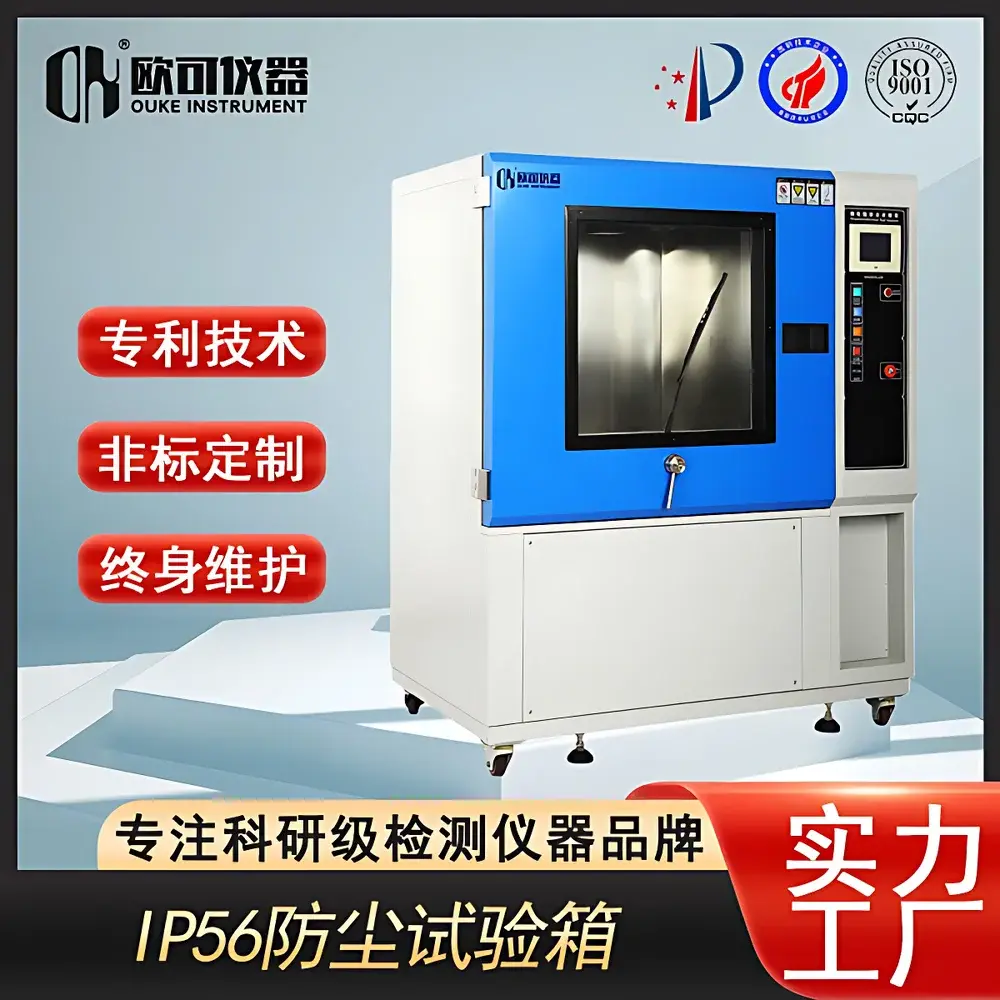
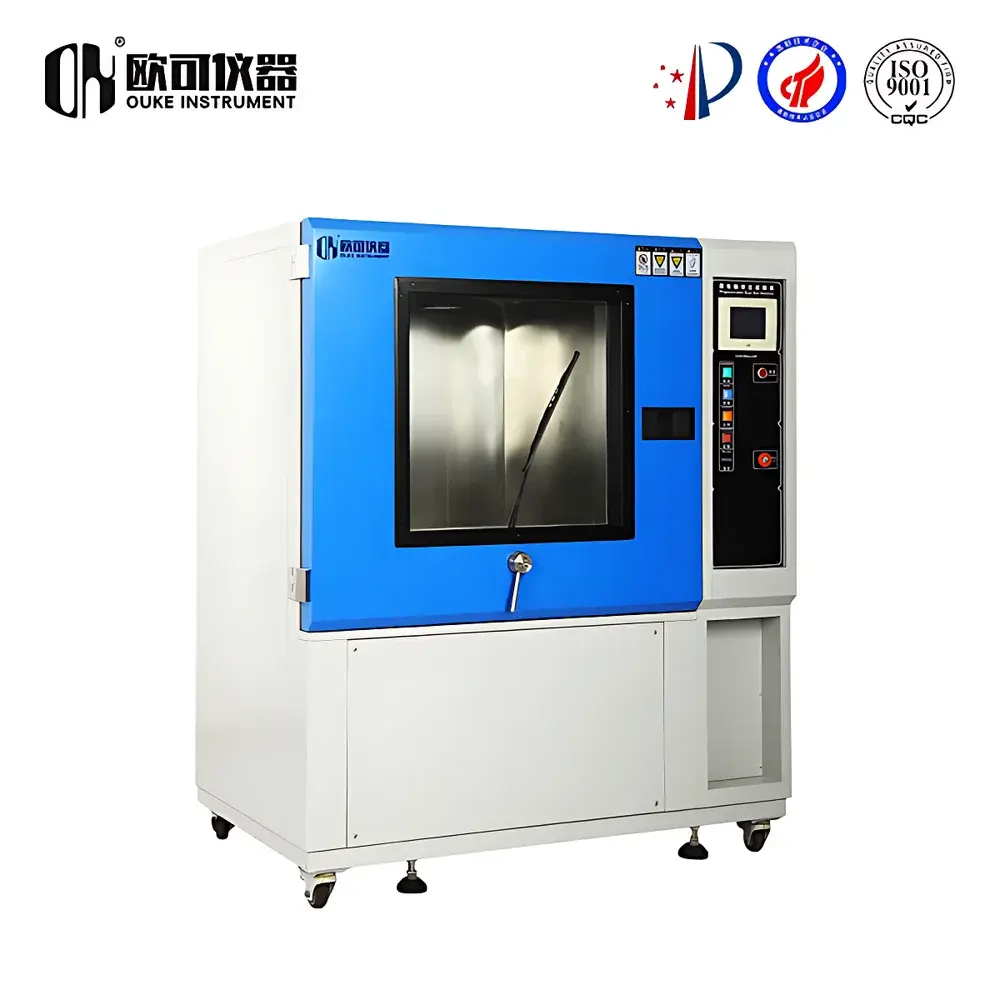
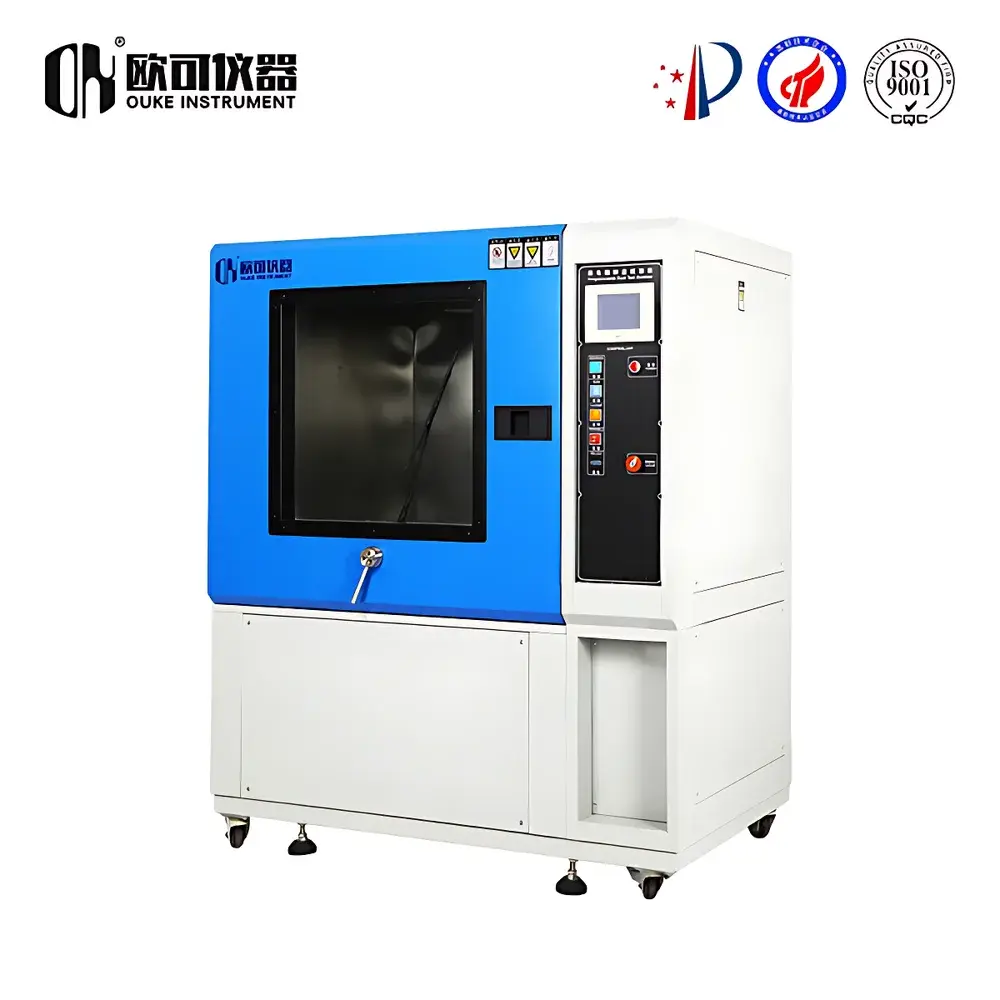
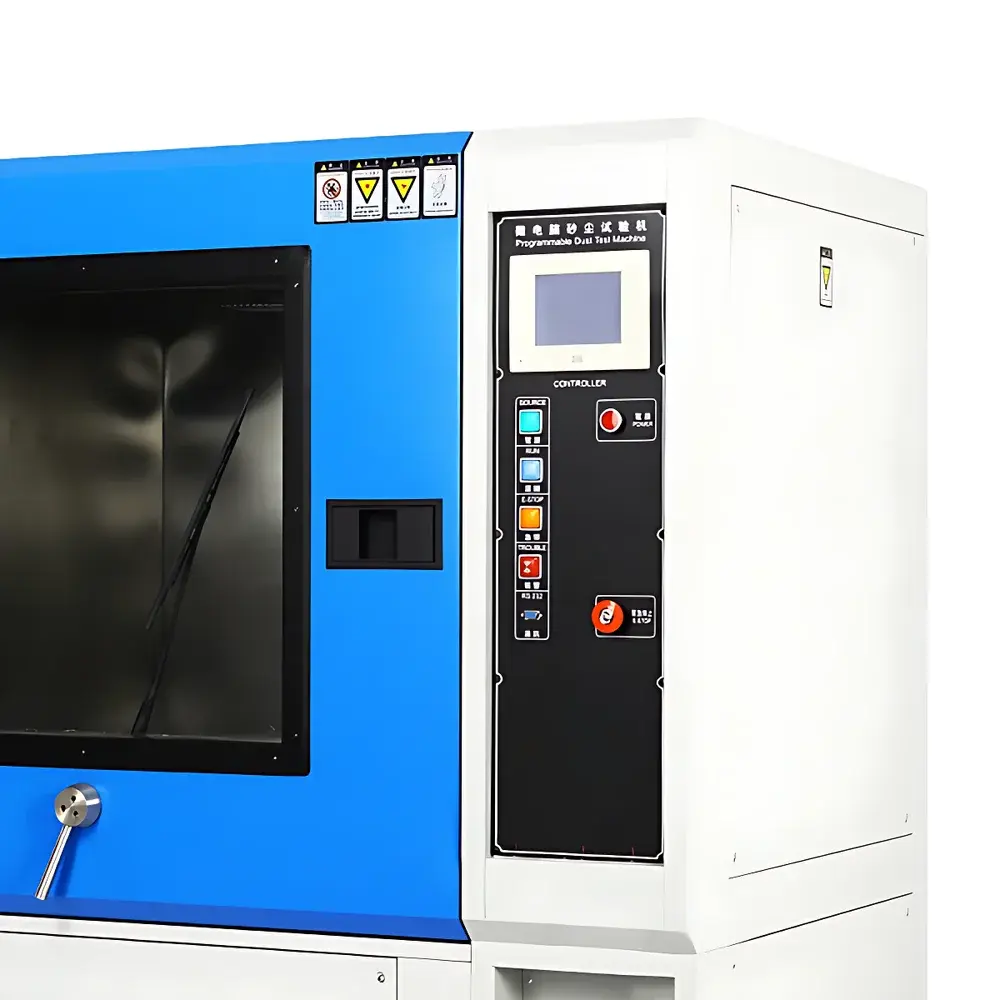
OK-HC-1000.02 IP567 Sand and Dust Test Chamber
| Brand | OK Instruments |
|---|---|
| Origin | Guangdong, China |
| Manufacturer Type | Direct Manufacturer |
| Model | OK-HC-1000.02 |
| Silica Content | 97–99% SiO₂ |
| Dust Concentration (IP5X) | 0.1–10.6 ±7 g/m³ |
| Dust Velocity | 8.9 ±1.2 m/s |
| Sand Concentration (IP6X) | 1.1 ±0.25 to 2.2 ±0.5 g/m³ |
| Sand Velocity | 0–29 m/s |
| Chamber Construction | SUS 304 Stainless Steel Interior |
| Compliance | IEC 60529, GB/T 4208, ISO 20653, MIL-STD-810G/H Method 510.5, GJB 150.12A |
Overview
The OK-HC-1000.02 IP567 Sand and Dust Test Chamber is an engineered environmental simulation system designed to replicate controlled airborne particulate conditions in accordance with international ingress protection (IP) rating standards—specifically IP5X (dust-protected) and IP6X (dust-tight), as defined in IEC 60529 and GB/T 4208. It operates on the principle of forced-air suspension and directed particle impingement, utilizing calibrated airflow dynamics to deliver repeatable, traceable dust and sand exposure profiles. Unlike generic climate chambers, this unit integrates precision aerodynamic design—including Venturi nozzles, conical sedimentation ducts, and laminar flow conditioning—to ensure spatial uniformity of particle concentration and velocity across the test volume. Its primary engineering purpose is functional validation of enclosure integrity, surface abrasion resistance (e.g., optical coatings, polymer housings, gasket interfaces), and long-term operational reliability under simulated arid or desert-field conditions. The chamber supports both static dust deposition (IP5X) and high-velocity sand impact (IP6X), making it suitable for qualification testing in automotive lighting systems, EV battery enclosures, outdoor telecom cabinets, UAV sensors, and military-grade electronic assemblies.
Key Features
- Robust chamber construction with full SUS 304 stainless steel interior walls, floor, and ceiling—resistant to abrasive wear and corrosion from repeated silica exposure.
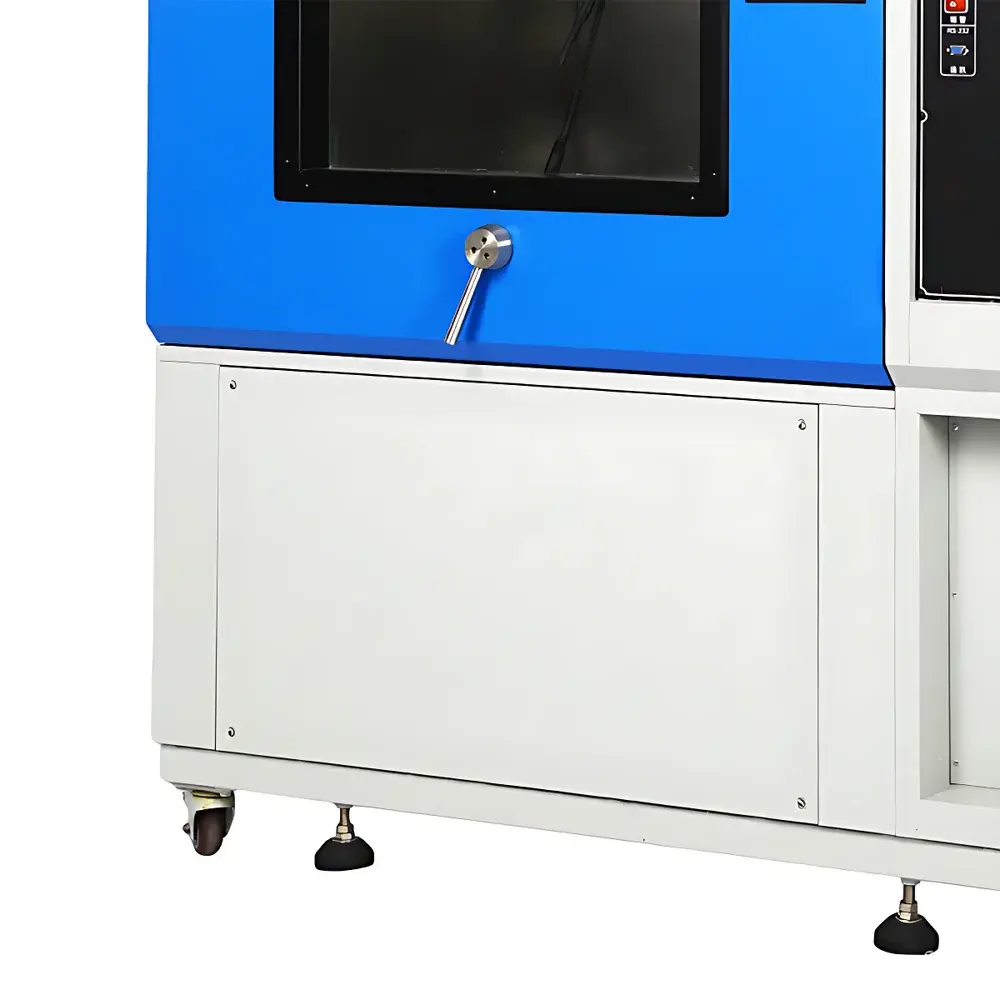
- Dual-seal silicon gasket door with anti-scratch tempered observation window, certified for zero particulate leakage during operation and post-test containment.
- Programmable rotating sample turntable (0–10 rpm, load capacity up to 50 kg), essential for uniform angular exposure during IP6X sand impact tests.
- High-efficiency recirculation system featuring a variable-frequency high-pressure centrifugal blower (0–29 m/s range), enabling precise wind speed control per test method requirements.
- Automated quantitative dust/sand dosing via vibratory feed mechanism and adjustable sieve mesh—ensuring stable concentration delivery within ±7 g/m³ (dust) or ±0.5 g/m³ (sand).
- Integrated HEPA + activated carbon filtration cascade, activated automatically upon shutdown to prevent operator exposure and lab contamination during chamber access.
- PLC-based control architecture with 10.1″ industrial touchscreen HMI, supporting multi-step programmable sequences, real-time parameter logging, and CSV export for audit-ready data archives.
Sample Compatibility & Compliance
The OK-HC-1000.02 accommodates samples up to 800 × 800 × 800 mm (W × D × H) and is routinely deployed for component-level validation per ISO 20653 (road vehicles), MIL-STD-810G/H Method 510.5 (military equipment), and GJB 150.12A (Chinese defense standards). It meets full compliance requirements for IP5X (limited dust ingress not harmful to operation) and IP6X (complete dust exclusion) verification. All internal surfaces are non-shedding and electrostatically neutralized to avoid particle agglomeration artifacts. Calibration protocols align with ISO/IEC 17025-accredited practices where third-party verification is required. The system supports powered-in testing with optional feedthrough terminals (IP68-rated, up to 24 VDC / 5 A), enabling real-time functional monitoring during exposure.
Software & Data Management
The embedded controller firmware implements deterministic real-time scheduling for all actuator and sensor loops, with timestamped data acquisition at 1 Hz resolution. Test programs are structured using hierarchical step logic (duration, setpoint ramp rate, hold conditions), with built-in validation checks to prevent out-of-spec execution. Logged parameters include actual vs. target dust/sand concentration (via laser scattering sensor), air velocity (hot-wire anemometer), chamber temperature (PT100), and motor current feedback. Data files conform to ASTM E2911-21 metadata conventions and support direct import into LIMS platforms. Optional 21 CFR Part 11-compliant software add-on provides electronic signatures, audit trails, and role-based user access control—suitable for GLP/GMP-regulated quality laboratories.
Applications
- Automotive: Headlamp housing sealing verification, ADAS sensor lens erosion assessment, EV charging port dust ingress resistance.
- Aerospace & Defense: Avionics enclosure qualification per MIL-STD-810, UAV gimbal bearing wear analysis, ruggedized display panel durability.
- Renewable Energy: Solar inverter cabinet IP rating validation, wind turbine control box long-term storage survivability.
- Consumer Electronics: Smart home gateway dust accumulation modeling, rugged tablet screen coating abrasion benchmarking.
- Industrial IoT: Outdoor gateway enclosure certification for smart grid deployments in desert regions.
FAQ
What standards does the OK-HC-1000.02 fully support for IP5X and IP6X testing?
It is validated for IEC 60529, GB/T 4208, ISO 20653, MIL-STD-810G/H Method 510.5, and GJB 150.12A—with documented uniformity performance across the working volume.
Can the chamber operate with powered devices under test (DUTs)?
Yes—optional IP68-rated electrical feedthroughs support DC power, signal lines, and thermocouple inputs without compromising seal integrity.
Is silica sand supplied with the system?
No—OK Instruments supplies technical specifications and sourcing guidance for ASTM E1533-compliant quartz sand (97–99% SiO₂, D₅₀ ≈ 200 µm); users procure consumables locally per their QA protocol.
How is dust concentration measured and maintained during extended tests?
Concentration is monitored continuously via a Class 1 laser scattering photometer (ISO 21501-4 compliant), with closed-loop feedback to the vibratory dosing system to maintain setpoint stability within tolerance bands.
What maintenance intervals are recommended for critical subsystems?
HEPA filters require replacement every 200 operational hours; blower bearings are greased every 1,000 hours; calibration of velocity and concentration sensors is recommended annually or per ISO/IEC 17025 internal schedule.



