
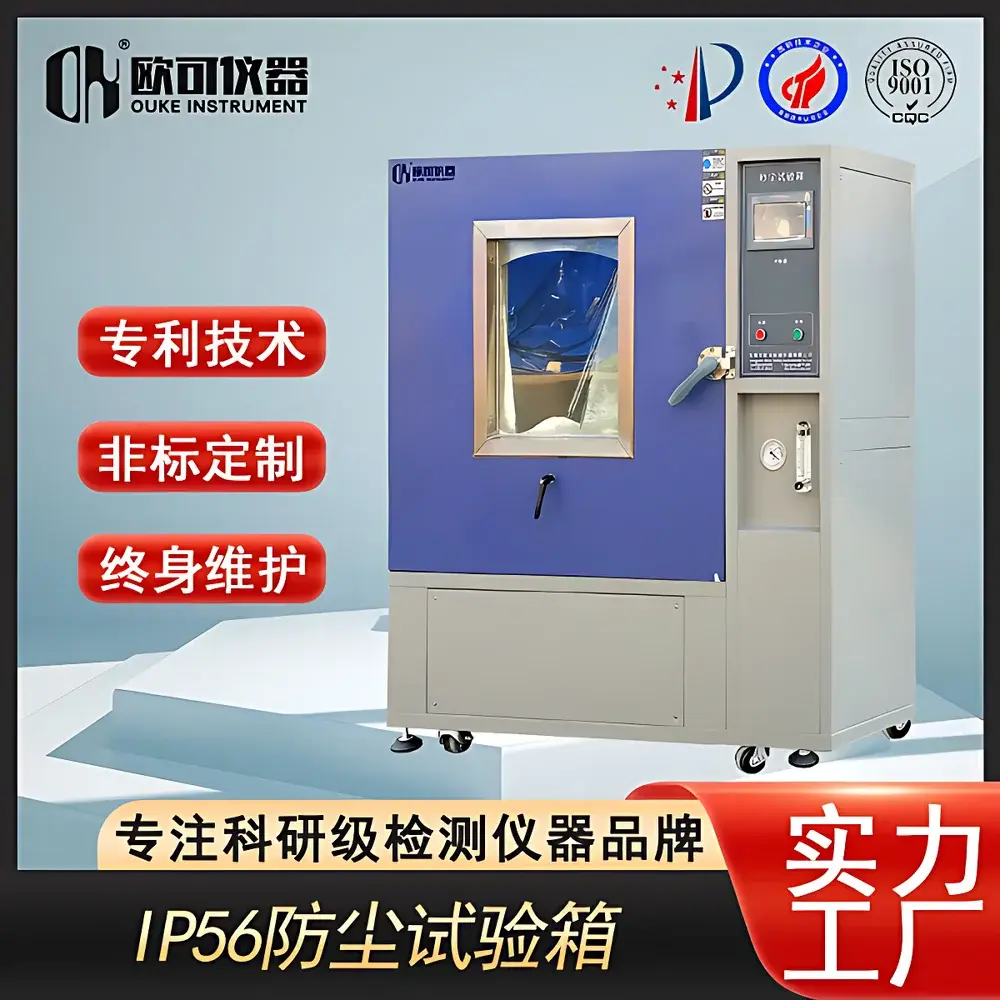
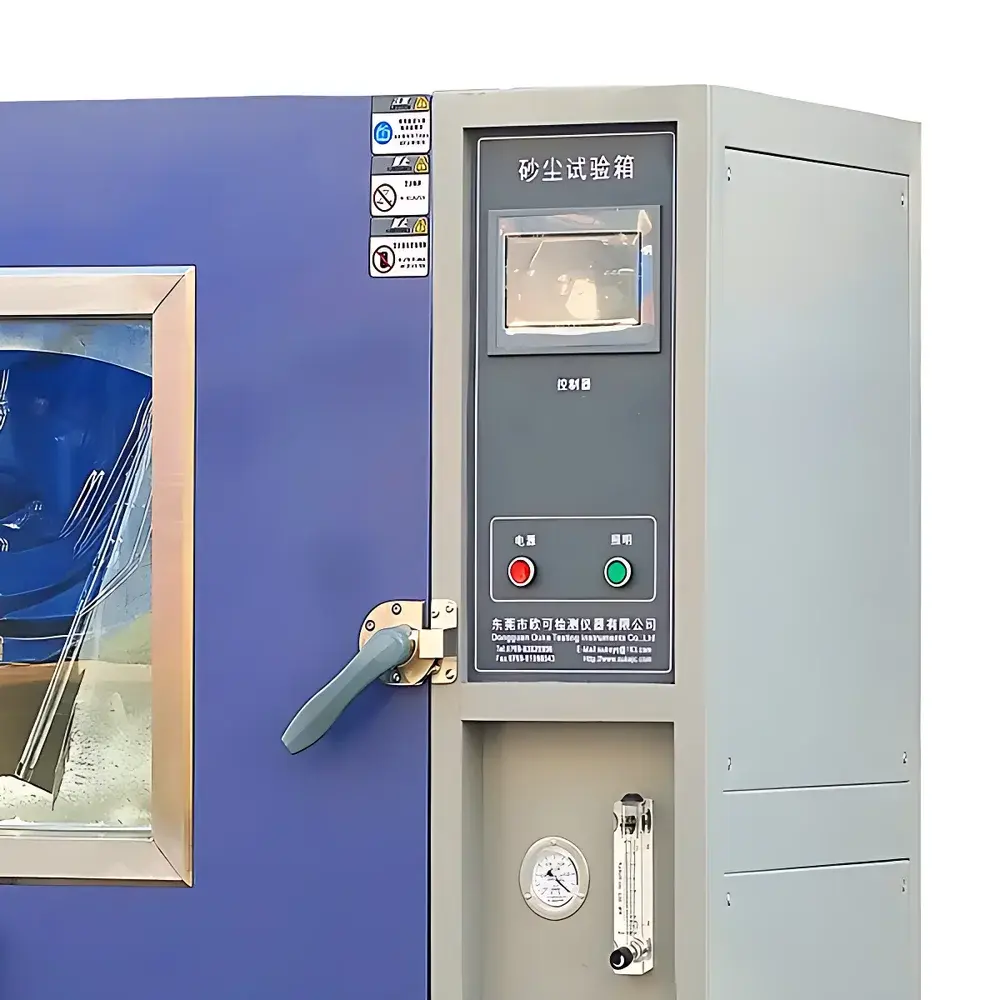
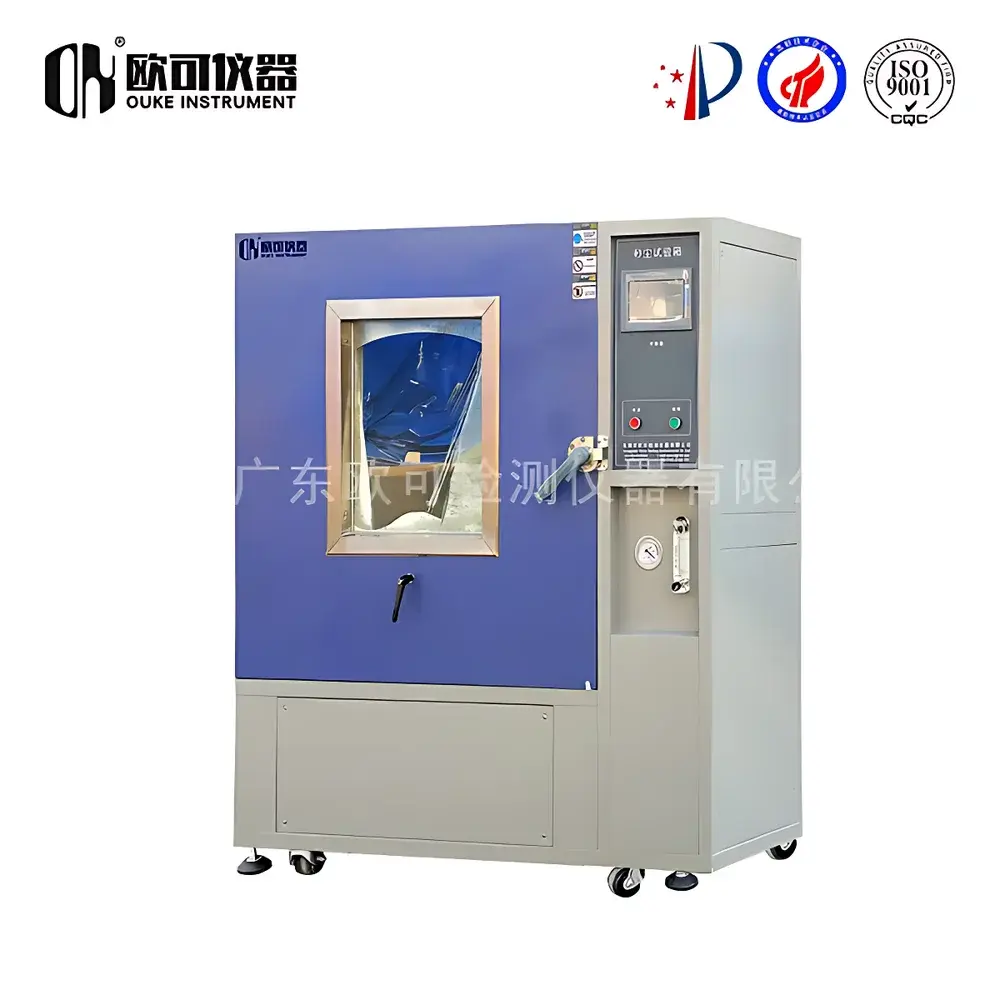
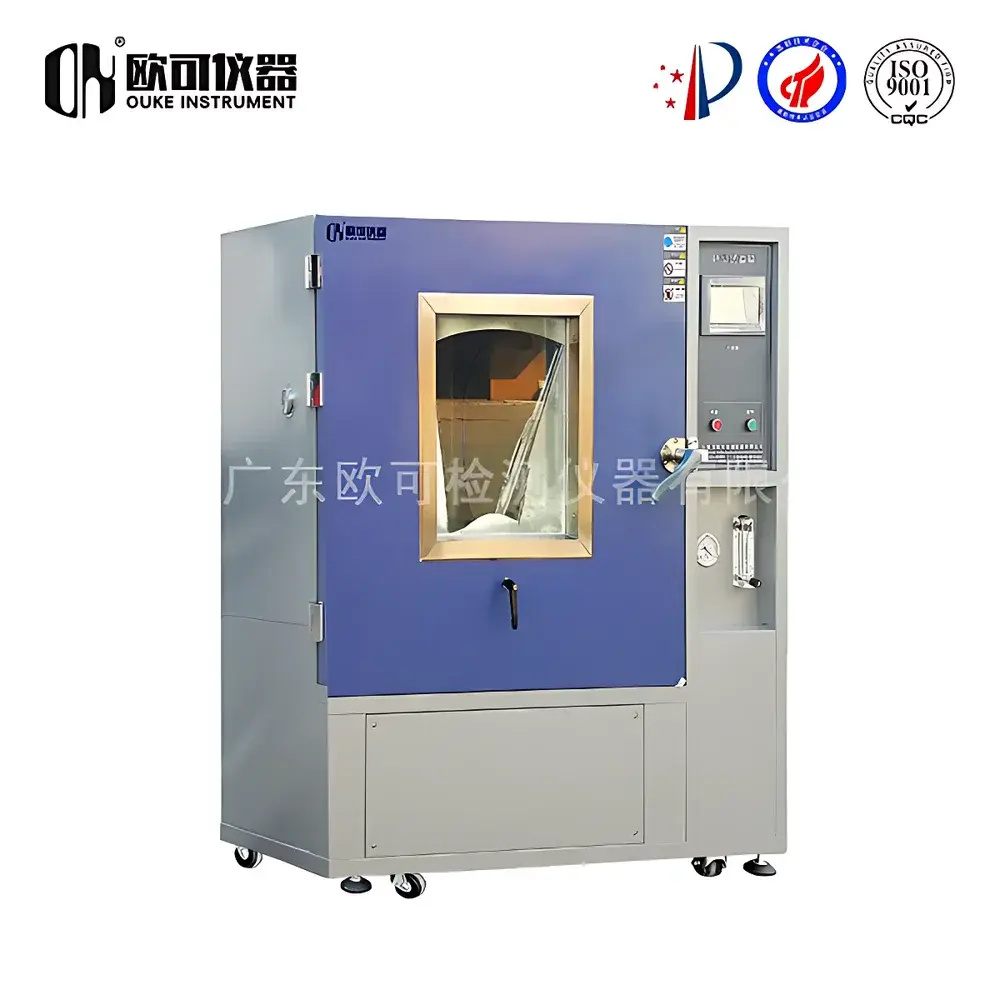
OK-HC-900.123 Sand and Dust Test Chamber
| Brand | OK Instruments |
|---|---|
| Origin | Guangdong, China |
| Manufacturer Type | Direct Manufacturer |
| Model | OK-HC-900.123 |
| Silica Content | 97–99% SiO₂ |
| Dust Concentration (Blowing) | 0.1–10.6 ±7 g/m³ |
| Dust Velocity | 8.9 ±1.2 m/s |
| Sand Concentration | 1.1 ±0.25 g/m³ to 2.2 ±0.5 g/m³ |
| Sand Velocity | 0–29 m/s |
| Compliance | IEC 60529, GB/T 4208, ISO 20653, MIL-STD-810G/H Method 510.5, GJB 150.12A |
Overview
The OK-HC-900.123 Sand and Dust Test Chamber is an engineered environmental simulation system designed to replicate controlled airborne particulate conditions—specifically sand and dust—for rigorous evaluation of ingress protection (IP), surface abrasion resistance, and functional reliability under arid, particulate-laden environments. Based on the Couette-type air recirculation principle with precision-controlled axial flow dynamics, the chamber generates repeatable, metrologically traceable dust suspension and high-velocity sand impingement profiles. It operates in strict accordance with internationally recognized test protocols for IP5X (limited dust ingress) and IP6X (complete dust-tightness), as defined in IEC 60529 and its national equivalents (GB/T 4208). Unlike generic climate chambers, this system integrates particle generation, aerodynamic transport, and real-time concentration stabilization into a single closed-loop architecture—enabling deterministic testing of enclosures, optical housings, connectors, sensors, and outdoor-rated electronics across automotive, defense, renewable energy, and industrial automation sectors.
Key Features
- Stainless steel inner chamber constructed from SUS 304 grade material—resistant to abrasive wear and corrosion from repeated silica exposure.
- Dual-layer silicone-sealed observation door with scratch-resistant tempered glass viewport, ensuring zero particulate leakage during operation and maintaining Class 8 cleanroom integrity when idle.
- Programmable rotating sample turntable (0–10 rpm, load capacity up to 50 kg), essential for uniform exposure in IP6X validation per ISO 20653 Annex C.
- High-efficiency recirculation system featuring a variable-frequency centrifugal blower (0–29 m/s adjustable output) coupled with a Venturi nozzle array and conical sedimentation sump to maintain spatial uniformity of particle distribution (±15% concentration deviation across test volume).
- Automated dosing mechanism using vibratory sieve feeders and mass-flow calibrated dust dispensers, enabling stable delivery of standardized silica dust (97–99% SiO₂) at concentrations ranging from 0.1 g/m³ to 10.6 ±7 g/m³ for dust-mode tests.
- Integrated HEPA + activated carbon filtration unit with automatic back-pulse regeneration, preventing ambient contamination during chamber access and meeting OSHA PEL (Permissible Exposure Limit) requirements for respirable crystalline silica (≤50 µg/m³, 8-hour TWA).
Sample Compatibility & Compliance
The OK-HC-900.123 accommodates samples up to 900 mm × 900 mm × 900 mm (W×D×H) and supports both powered and unpowered testing configurations. Its airflow geometry and particle dispersion profile have been validated against reference standards including IEC 60529 Annex B, ISO 20653:2021 Clause 6.3 (road vehicle dust resistance), and MIL-STD-810H Method 510.5 (sand and dust exposure). For regulatory submissions requiring auditability, the system’s PLC-based controller logs timestamped operational parameters—including wind speed, dust concentration (via gravimetric calibration traceable to NIST SRM 1633c), cycle duration, and temperature—with data export compliant with FDA 21 CFR Part 11 electronic record requirements when paired with optional audit trail firmware.
Software & Data Management
Equipped with an industrial-grade HMI touchscreen interface running embedded Linux OS, the chamber supports multi-step programmable test sequences with up to 99 user-defined profiles. All setpoints, real-time sensor readings (anemometer, thermal mass flow meter, differential pressure transducers), and alarm events are stored locally on a redundant SD card and optionally transmitted via Modbus TCP or Ethernet/IP to centralized MES/QMS platforms. Calibration certificates for integrated sensors are provided with NIST-traceable documentation, and firmware updates adhere to IEC 62443-2-4 secure update protocols. Optional PC-based software enables automated report generation aligned with ISO/IEC 17025 laboratory accreditation templates.
Applications
This chamber is routinely deployed for type approval testing of automotive lighting modules (headlamps, radar housings), EV battery enclosures, UAV avionics, military handheld radios, solar inverter cabinets, and smart city infrastructure nodes. In R&D labs, it facilitates accelerated life-cycle assessment of conformal coatings, gasket compression resilience, and lens anti-scratch film durability under cyclic sand abrasion. For quality assurance teams, it serves as a pass/fail gate prior to field deployment—particularly where equipment must operate reliably in desert deployments (e.g., Middle East oilfield instrumentation) or dusty industrial zones (e.g., cement plant control systems).
FAQ
What particle size distribution does the chamber use for standard dust testing?
The system utilizes standardized Arizona Road Dust Test Dust (ISO A2 Fine) or equivalent silica powder with median particle diameter D₅₀ ≈ 10–20 µm, fully compliant with IEC 60529 Annex B specifications.
Can the chamber be integrated with external temperature/humidity control systems?
Yes—the OK-HC-900.123 features dry-contact I/O and Modbus RTU ports for synchronized operation with standalone climatic chambers; full composite environmental testing (e.g., 70°C + 2.2 g/m³ sand) requires custom engineering and is available as the OK-HC-900.123-TH variant.
How is dust concentration verified and maintained during long-duration tests?
Concentration stability is ensured through continuous gravimetric sampling at three spatially distributed points per IEC 60529 verification protocol, with automated feedback adjustment of feeder vibration amplitude and blower RPM to maintain target tolerance bands.
Is third-party calibration and validation support available?
OK Instruments provides optional UKAS-accredited on-site validation services, including airflow uniformity mapping, concentration homogeneity assessment, and full compliance reporting against customer-specified test plans.
What maintenance intervals are recommended for optimal performance?
HEPA filter replacement every 200 operational hours; blower motor lubrication every 1,000 hours; annual recalibration of all critical sensors (anemometer, mass flow meter, temperature probes) per ISO/IEC 17025 guidelines.



